APOLOPLEX

Episode 07 / Proof & Prizes

The Assumption Tower

At Proof & Prizes, a tower of claims meets a question: what does each addition actually explain?

When do added claims about God improve an explanation? A comic examines explanatory power, simplicity and unsupported assumptions, with objections and skeptical replies.

An argument takes a day out

William, Greg, Phil, Morgan and Ruth
When does an added claim about God earn its place in an explanation?

An imagined conversation. All dialogue, actions and park incidents are fictional.

Use ← and → to move between scenes.

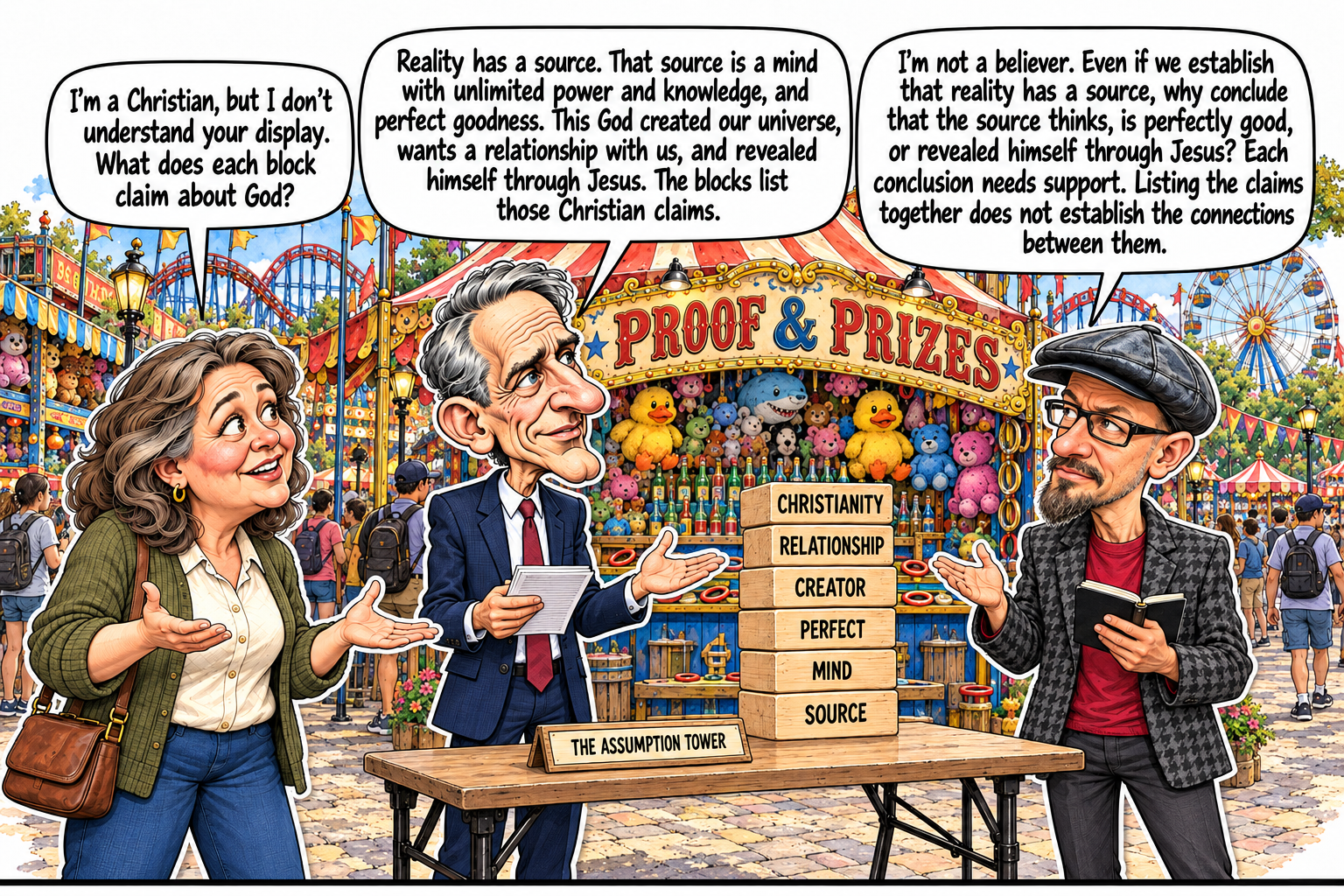
Scene 1: What the blocks claim. Ruth at left asks about the display with open palms. William holds notes and gestures toward six labeled wooden blocks; Phil at right holds an open notebook and raises an open hand. The blocks stand on a wooden folding table beside a THE ASSUMPTION TOWER placard, with the crowded Proof & Prizes booth and rides behind them.
SCENE 01 / 13View / zoom image ↗
Read dialogue

Ruth at left asks about the display with open palms. William holds notes and gestures toward six labeled wooden blocks; Phil at right holds an open notebook and raises an open hand. The blocks stand on a wooden folding table beside a THE ASSUMPTION TOWER placard, with the crowded Proof & Prizes booth and rides behind them.

Ruth: I’m a Christian, but I don’t understand your display. What does each block claim about God?

William: Reality has a source. That source is a mind with unlimited power and knowledge, and perfect goodness. This God created our universe, wants a relationship with us, and revealed himself through Jesus. The blocks list those Christian claims.

Phil: I’m not a believer. Even if we establish that reality has a source, why conclude that the source thinks, is perfectly good, or revealed himself through Jesus? Each conclusion needs support. Listing the claims together does not establish the connections between them.

Notes from the queue · 01

What the blocks claim

A single word can summarize several claims without proving any of them. The question is whether the connections have reasons behind them.

The blocks represent propositions for discussion, not separate physical parts of God or measured units of improbability.

A deeper dive

One name, several commitments

The Christian claim being discussed includes more than an unidentified cause of the universe. It attributes thought, power, goodness, creative action and a particular relationship with humanity. Those claims may be connected by arguments. Their connection must nevertheless be shown; a familiar name cannot make every step an agreed premise.

The useful question is what a proposed addition explains and how we would have reason to accept it. That question leaves room for philosophical reasoning, historical evidence and personal experience as well as repeatable experiments. Different kinds of support must still bear on the particular conclusion being drawn.

A tower is not a probability calculation

The six blocks are labels for discussion, not physical parts of God or units in a probability calculation. Several claims might follow from one strong principle. Their number therefore measures neither the probability of Christianity nor the number of independent assumptions in any particular theology. The later exchange about divine simplicity addresses that distinction directly.

The skeptical challenge is conditional: if a serious alternative explains the same observations without an extra claim, and the claim adds no supported explanatory advantage, withholding it is reasonable. Establishing that condition requires comparison. It cannot be read off the shape of a toy.

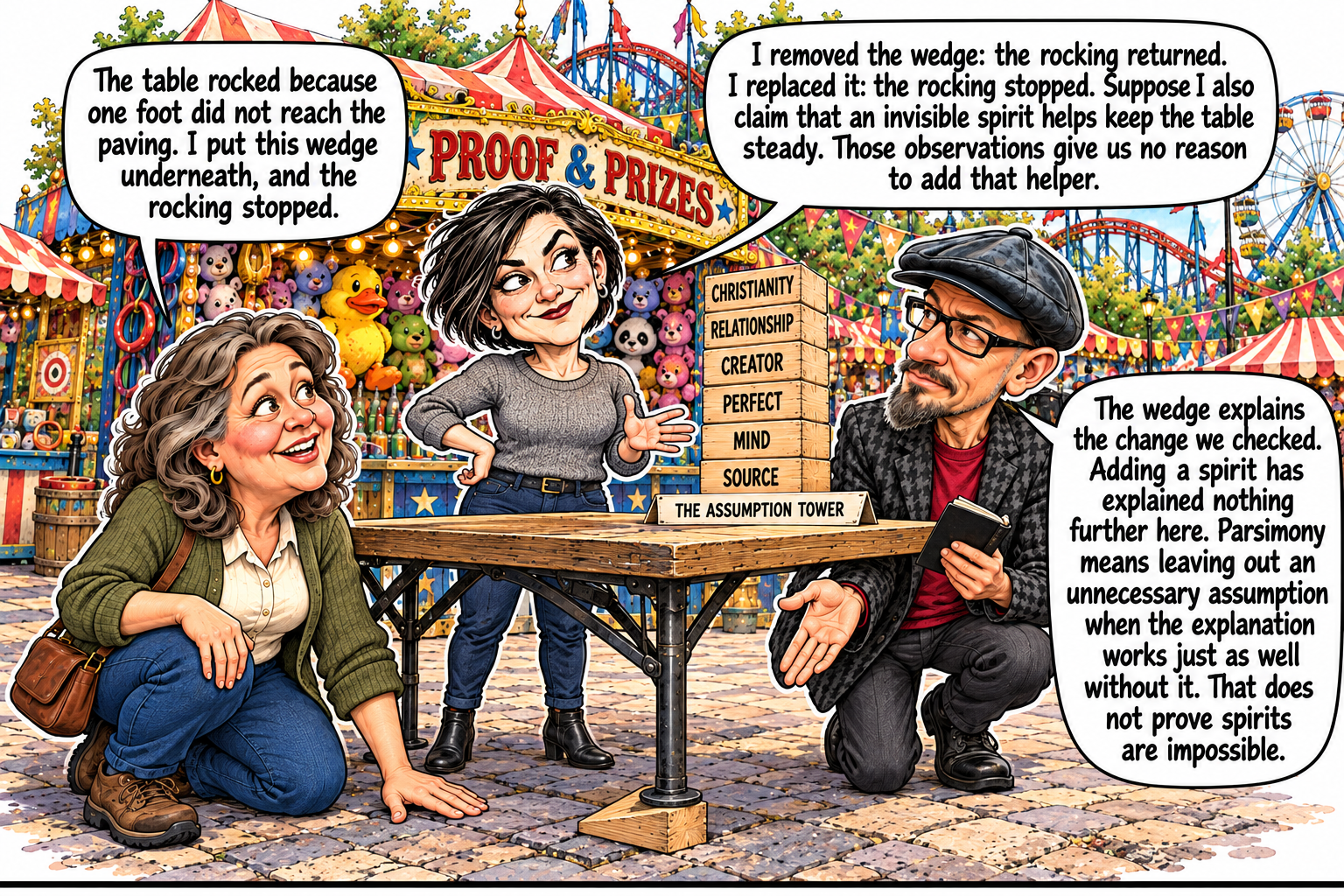
Scene 2: What the wedge explains. Ruth kneels beside a wooden folding table with one hand on the paving. A wooden wedge supports its near-right metal foot. Morgan stands behind the table with her hands withdrawn; Phil kneels opposite, holding a closed black notebook and opening his other palm toward the repair. Six upright blocks read, from bottom to top, SOURCE, MIND, PERFECT, CREATOR, RELATIONSHIP and CHRISTIANITY. A small placard reads THE ASSUMPTION TOWER. The colorful Proof & Prizes booth and rides fill the background.
SCENE 02 / 13View / zoom image ↗
Read dialogue

Ruth kneels beside a wooden folding table with one hand on the paving. A wooden wedge supports its near-right metal foot. Morgan stands behind the table with her hands withdrawn; Phil kneels opposite, holding a closed black notebook and opening his other palm toward the repair. Six upright blocks read, from bottom to top, SOURCE, MIND, PERFECT, CREATOR, RELATIONSHIP and CHRISTIANITY. A small placard reads THE ASSUMPTION TOWER. The colorful Proof & Prizes booth and rides fill the background.

Ruth: The table rocked because one foot did not reach the paving. I put this wedge underneath, and the rocking stopped.

Morgan: I removed the wedge: the rocking returned. I replaced it: the rocking stopped. Suppose I also claim that an invisible spirit helps keep the table steady. Those observations give us no reason to add that helper.

Phil: The wedge explains the change we checked. Adding a spirit has explained nothing further here. Parsimony means leaving out an unnecessary assumption when the explanation works just as well without it. That does not prove spirits are impossible.

Notes from the queue · 02

What the wedge explains

Ruth reports a repair and Morgan reports removing and replacing the wedge. These observations support the wedge’s contribution to the table’s stability. The spirit is introduced explicitly as a hypothetical additional claim, with no evidence supplied for it.

The comparison concerns the two explanations offered for this table. It neither proves that spirits cannot exist nor shows that a divine explanation of an unanswered cosmic question is unnecessary.

A deeper dive

What was checked

The observation to explain is the change in the table’s stability. A gap under one foot made the table rock. Filling the gap stopped the rocking; removing and replacing the wedge reproduced the change. Within this fictional demonstration, the condition and intervention give the group a concrete reason to accept the wedge’s contribution.

The competing proposal adds that an invisible spirit also helps. As stated, it supplies no independent evidence, no different result to check and no previously unexplained observation. Merely attaching the spirit to the successful wedge explanation does not transfer evidential support to the added helper.

The comparison has a limited scope

The conclusion is to withhold the extra claim on the reasons supplied. It is not a demonstration that spirits are logically impossible. A new observation or an independently supported account of a second cause could change the assessment, as the next exchange makes clear.

The argument also does not settle whether God could explain the origin or nature of the universe. Those are different questions, and the group has not supplied a complete rival explanation of them. Applying parsimony requires naming the problem and checking what the actual competing explanations achieve.

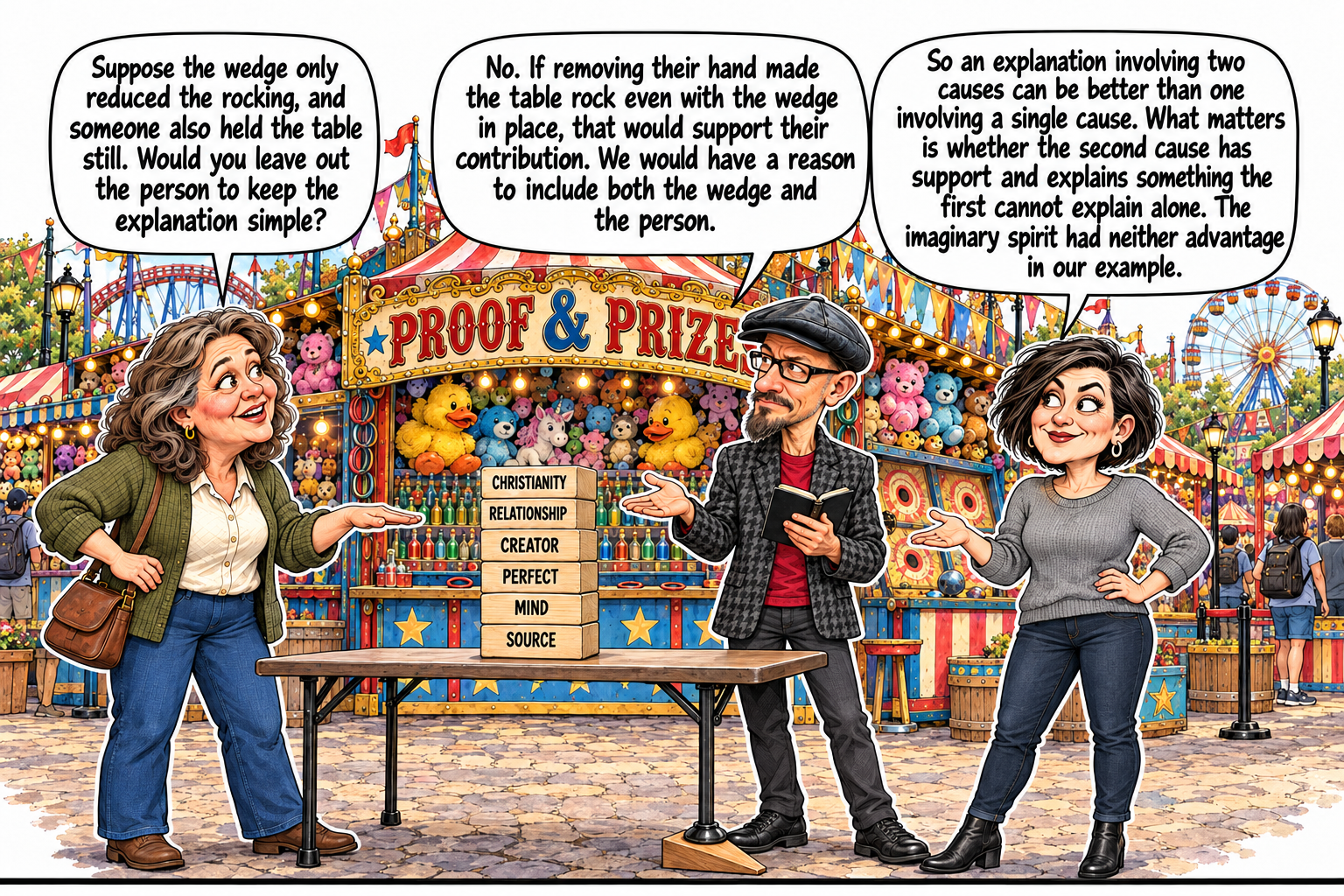
Scene 3: When two causes are needed. Ruth stands at left with one hand at her hip and the other palm hovering well above a plain folding table without touching it. Phil stands in the center holding a black notebook and opening his other palm; Morgan stands at right with one hand at her hip and her other palm open. Six wooden blocks form a vertical tower labeled SOURCE, MIND, PERFECT, CREATOR, RELATIONSHIP and CHRISTIANITY from bottom to top. A single triangular wooden wedge supports the table’s near-right metal foot on the paving. The Proof & Prizes booth, toys, bottles, rings, rides and park visitors fill the background. Three balloons read Ruth, Phil, then Morgan.
SCENE 03 / 13View / zoom image ↗
Read dialogue

Ruth stands at left with one hand at her hip and the other palm hovering well above a plain folding table without touching it. Phil stands in the center holding a black notebook and opening his other palm; Morgan stands at right with one hand at her hip and her other palm open. Six wooden blocks form a vertical tower labeled SOURCE, MIND, PERFECT, CREATOR, RELATIONSHIP and CHRISTIANITY from bottom to top. A single triangular wooden wedge supports the table’s near-right metal foot on the paving. The Proof & Prizes booth, toys, bottles, rings, rides and park visitors fill the background. Three balloons read Ruth, Phil, then Morgan.

Ruth: Suppose the wedge only reduced the rocking, and someone also held the table still. Would you leave out the person to keep the explanation simple?

Phil: No. If removing their hand made the table rock even with the wedge in place, that would support their contribution. We would have a reason to include both the wedge and the person.

Morgan: So an explanation involving two causes can be better than one involving a single cause. What matters is whether the second cause has support and explains something the first cannot explain alone. The imaginary spirit had neither advantage in our example.

Notes from the queue · 03

When two causes are needed

Ruth’s objection now has a stated target: an indiscriminate rule against additional causes would omit a person whose hand genuinely helps steady a table. Phil accepts the objection and identifies an observation that would support including the person.

This is the precise sense in which a more detailed explanation can be better. It includes an evidenced contribution that the single-cause explanation misses. The rule excludes unsupported additions, not justified detail.

A deeper dive

Why include a second cause?

Ruth changes the conditions explicitly. In her hypothetical case the wedge reduces the rocking but a person’s hand is also needed to keep the table still. An account that mentions only the wedge would leave part of the result unexplained. Removing the hand while leaving the wedge in place could reveal that additional contribution.

Phil therefore accepts a two-cause explanation when the proposed contribution has support. The number of causes is not a truth test. The relevant comparison asks whether omitting the second cause loses explanatory success or conflicts with the evidence. Here, by hypothesis, it would.

Evidence need not be direct sight

The hand is easy to see, but visibility is not the general rule. Causes can be supported indirectly through their effects, sound reasoning or other evidence. A hidden cause is not automatically an unnecessary cause, and a visible object is not automatically responsible for an observed result.

The earlier spirit claim was unsupported as presented, rather than disqualified simply for being invisible. A theological explanation deserves assessment of its own arguments and evidence. The table example establishes a standard of justification; it does not perform that assessment for every possible claim about God.

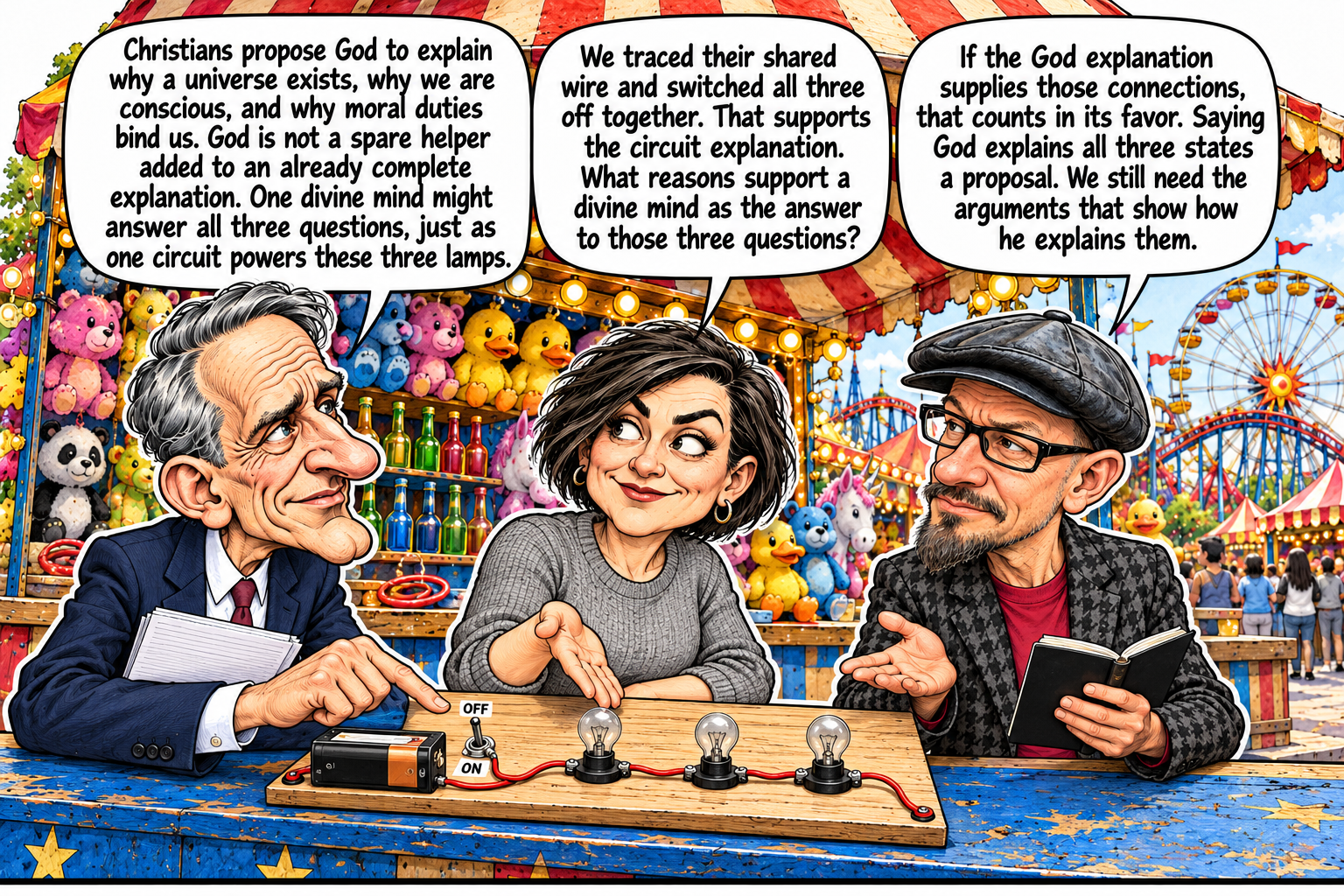
Scene 4: Does one cause explain several things?. William at left points beside an OFF switch on a board with three unlit lamps and a battery. Morgan opens a palm above the shared wire. Phil holds an open black notebook and responds with an open hand. Plush prizes, bottle rows and distant rides fill the park behind them.
SCENE 04 / 13View / zoom image ↗
Read dialogue

William at left points beside an OFF switch on a board with three unlit lamps and a battery. Morgan opens a palm above the shared wire. Phil holds an open black notebook and responds with an open hand. Plush prizes, bottle rows and distant rides fill the park behind them.

William: Christians propose God to explain why a universe exists, why we are conscious, and why moral duties bind us. God is not a spare helper added to an already complete explanation. One divine mind might answer all three questions, just as one circuit powers these three lamps.

Morgan: We traced their shared wire and switched all three off together. That supports the circuit explanation. What reasons support a divine mind as the answer to those three questions?

Phil: If the God explanation supplies those connections, that counts in its favor. Saying God explains all three states a proposal. We still need the arguments that show how he explains them.

Notes from the queue · 04

Does one cause explain several things?

William correctly distinguishes explaining unanswered questions from adding an idle helper to an already sufficient explanation. The table example alone cannot decide whether God explains the universe, consciousness or morality.

The circuit demonstrates how evidence can connect several effects to one cause. The theological proposal must provide its own connections; it cannot borrow the support for the electrical circuit.

A deeper dive

When one explanation does more

Unification means explaining several things through a shared cause or principle. It can reduce the number of unrelated assumptions a view needs. William therefore raises a serious objection to any rule that simply penalizes every added entity: one well-supported addition could replace several poorly connected explanations.

The lamp circuit works because the shared connection is more than a description. It can be traced, and the joint response to the switch fits the common-circuit account. A different case might establish a connection through historical traces or a philosophical derivation. The relevant feature is the support for the connection, not the presence of a literal wire.

Scope is an invitation to demonstrate the links

Theism may propose a common explanation of the universe, consciousness and moral obligation. Its breadth becomes an advantage insofar as a specified account of the divine nature makes those features understandable together and does so better than alternatives. Merely assigning each feature to an unrestricted divine choice leaves open why those choices, rather than many others, should be expected.

This scene does not show that no such case can succeed. Nor does it assume that naturalistic accounts have already explained all three features. It identifies the work required before a broad proposal can claim the evidential credit of an established unifying explanation.

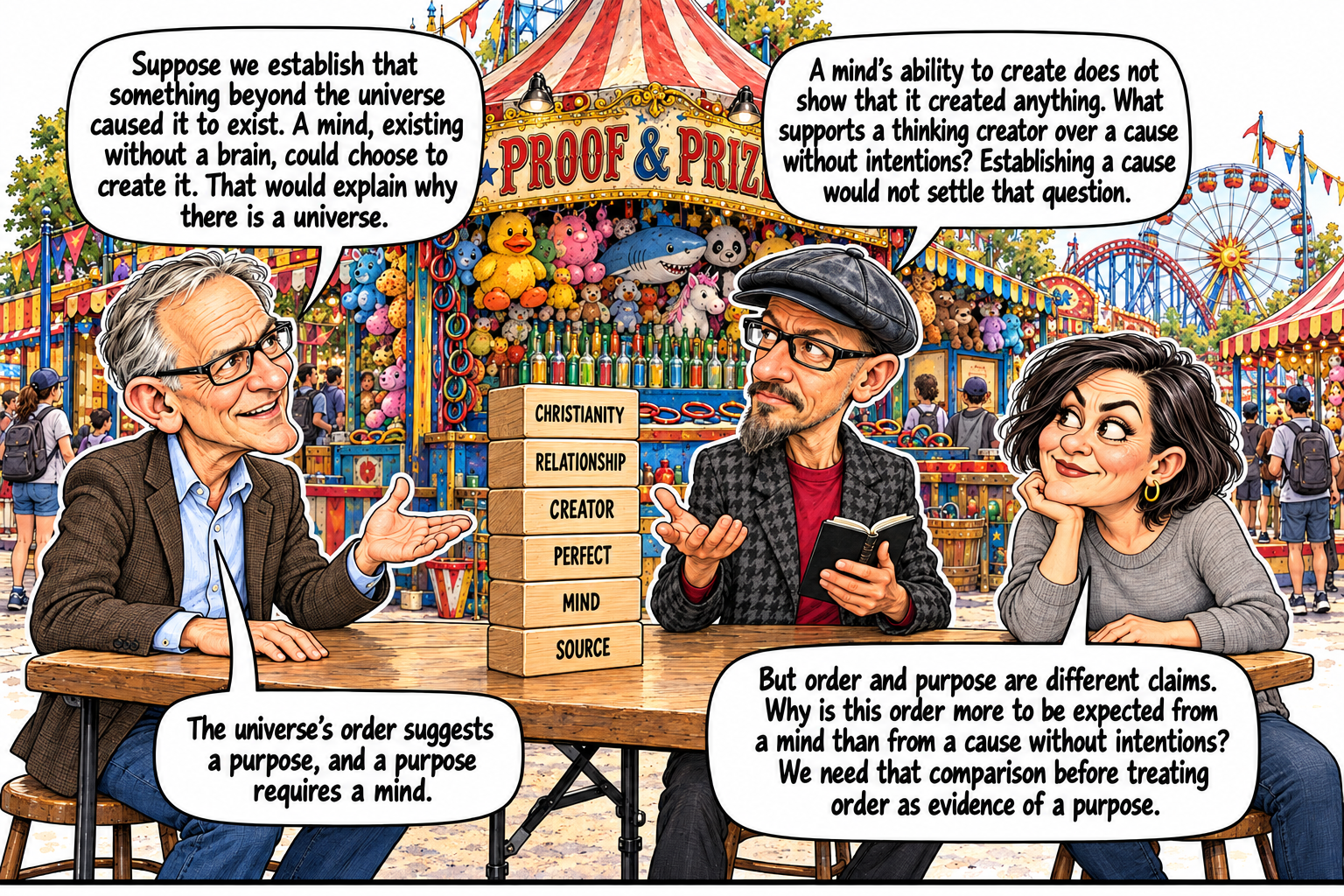
Scene 5: Why say the source thinks?. Greg sits at left with one palm open and the other hand on a plain folding table. Phil sits in the center holding a black notebook and raising an open palm. Morgan sits at right with her chin resting on one hand and her other hand on the tabletop. Six wooden blocks form a vertical tower labeled SOURCE, MIND, PERFECT, CREATOR, RELATIONSHIP and CHRISTIANITY from bottom to top. The four balloons read across the top row Greg, Phil, then across the lower row Greg, Morgan. Proof & Prizes, stuffed prizes, bottles, rides and passing visitors fill the background.
SCENE 05 / 13View / zoom image ↗
Read dialogue

Greg sits at left with one palm open and the other hand on a plain folding table. Phil sits in the center holding a black notebook and raising an open palm. Morgan sits at right with her chin resting on one hand and her other hand on the tabletop. Six wooden blocks form a vertical tower labeled SOURCE, MIND, PERFECT, CREATOR, RELATIONSHIP and CHRISTIANITY from bottom to top. The four balloons read across the top row Greg, Phil, then across the lower row Greg, Morgan. Proof & Prizes, stuffed prizes, bottles, rides and passing visitors fill the background.

Greg: Suppose we establish that something beyond the universe caused it to exist. A mind, existing without a brain, could choose to create it. That would explain why there is a universe.

Phil: A mind’s ability to create does not show that it created anything. What supports a thinking creator over a cause without intentions? Establishing a cause would not settle that question.

Greg: The universe’s order suggests a purpose, and a purpose requires a mind.

Morgan: But order and purpose are different claims. Why is this order more to be expected from a mind than from a cause without intentions? We need that comparison before treating order as evidence of a purpose.

Notes from the queue · 05

Why say the source thinks?

Greg offers the universe’s order as a reason to attribute intention to its source. The reply asks why that order should favor an intending source over a source without intentions; it does not dismiss order as irrelevant by definition.

The source is granted only for discussion. Neither its existence nor the impossibility of a nonphysical mind is established by this exchange.

A deeper dive

A possible mind and a supported mind

The group provisionally grants a cause beyond the universe to isolate a further question: what makes that cause a mind? Proposing that it could choose creation describes one candidate explanation. It does not, without more reasoning, exclude a source that does not think.

Greg supplies a proposed reason: the universe’s order suggests purpose. Morgan identifies the comparison needed to evaluate that suggestion. Why would the relevant kind of order be better explained or more expected if its source had intentions? The existence of order alone does not state the answer.

What this exchange leaves open

A defender might develop an argument about the particular order observed, what nonmental alternatives can account for, or why intentional selection better explains it. Those premises and comparisons deserve examination. The comic does not claim to have refuted every design or cosmological argument by asking for them.

Nor does this exchange prove that a mind must have a brain. It asks for support for this proposed nonphysical mind rather than ruling such a cause out in advance. Evidence that supports a general cause may be relevant without automatically establishing all the cause’s alleged properties.

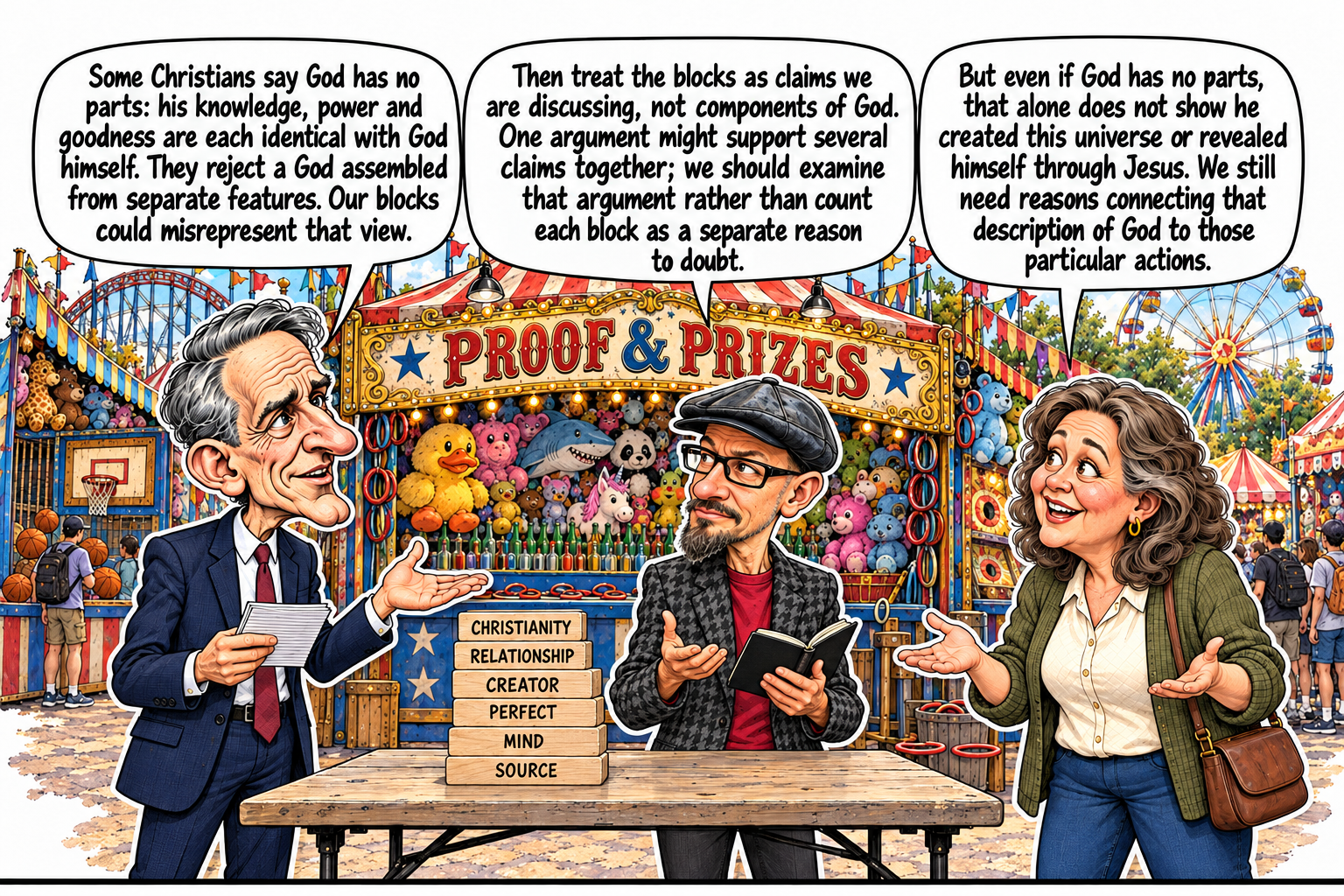
Scene 6: Are the blocks parts of God?. William at left holds notes and opens a palm toward Phil. Phil holds an open notebook and responds with an open hand; Ruth at right raises both palms. The six labeled wooden blocks remain together on the table, with plush prizes, bottles and rides behind the group.
SCENE 06 / 13View / zoom image ↗
Read dialogue

William at left holds notes and opens a palm toward Phil. Phil holds an open notebook and responds with an open hand; Ruth at right raises both palms. The six labeled wooden blocks remain together on the table, with plush prizes, bottles and rides behind the group.

William: Some Christians say God has no parts: his knowledge, power and goodness are each identical with God himself. They reject a God assembled from separate features. Our blocks could misrepresent that view.

Phil: Then treat the blocks as claims we are discussing, not components of God. One argument might support several claims together; we should examine that argument rather than count each block as a separate reason to doubt.

Ruth: But even if God has no parts, that alone does not show he created this universe or revealed himself through Jesus. We still need reasons connecting that description of God to those particular actions.

Notes from the queue · 06

Are the blocks parts of God?

Divine simplicity is the claim that God lacks physical and metaphysical parts. It is more demanding than simply saying there is one God.

Even if that account succeeds, claims about this particular creation and religious history still need a connection to it.

A deeper dive

What the simplicity objection changes

Classical divine simplicity denies that God is assembled from distinguishable metaphysical components. On such an account, knowledge, power and goodness are not detachable pieces. A criticism that counts them as independent objects would miss the position it is supposed to examine.

A related argument says that unrestricted power or knowledge can be simpler to describe than a finely chosen finite ceiling. That can be a genuine economy within a family of proposed agents. It does not establish, without further comparison, that positing such an agent is simpler or better supported than every impersonal account.

The claims about action remain

Granting a simple divine nature for discussion does not yet tell us why this world exists, why divine activity has this distribution, or why a specific religious history is authoritative. The defender may offer further arguments or say these actions reflect free choice. Either approach needs an account of the link between nature, choice and the events being explained.

The reply therefore gives the simplicity defense credit where it succeeds. It does not settle the coherence of the doctrine, insist that its attributes are independent, or assign numerical penalties. It asks whether the complete explanation has fewer unsupported commitments after all its necessary links are included.

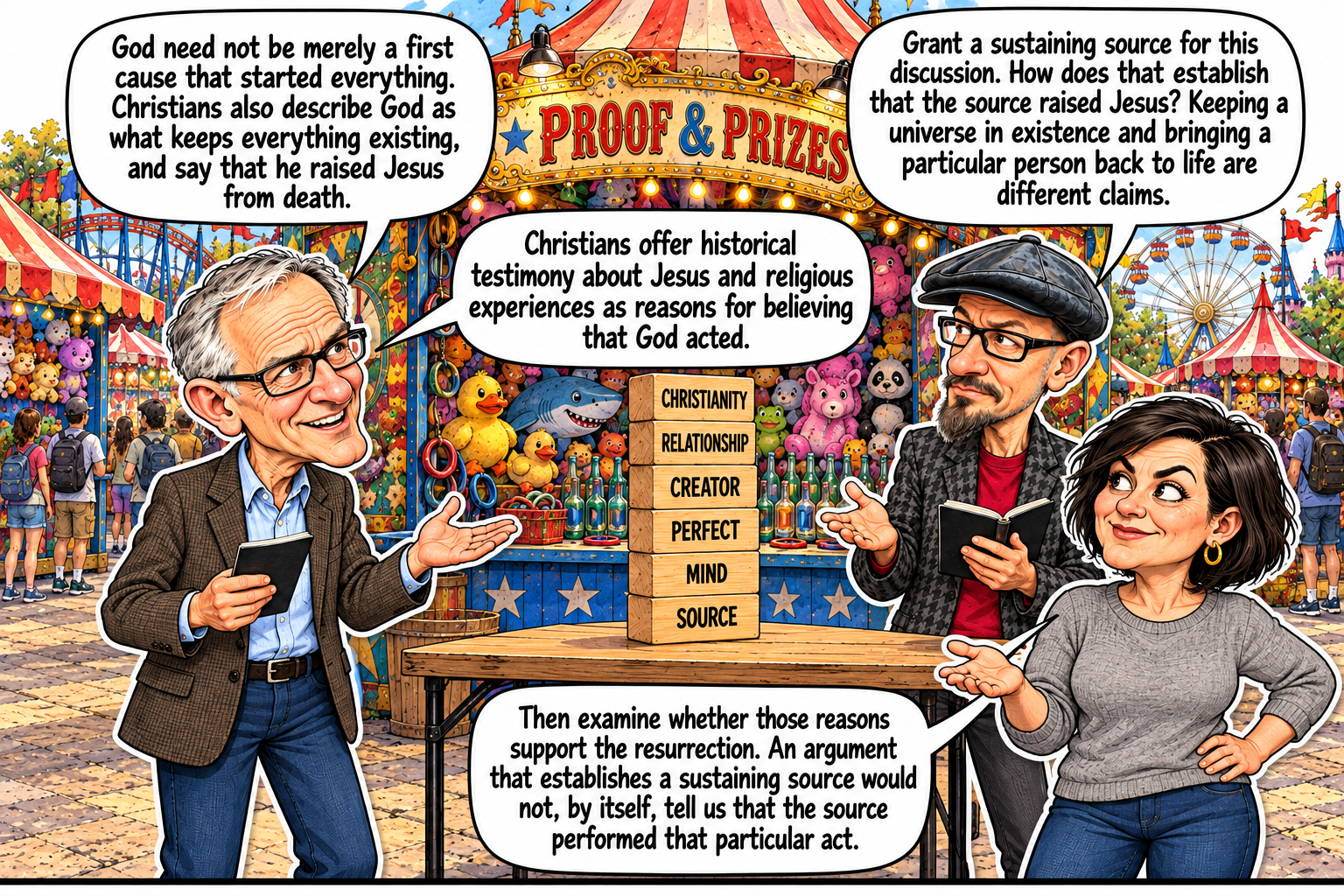
Scene 7: Does a source establish a resurrection?. Greg stands at left holding a closed dark pamphlet and opening his other palm. Phil stands behind the right side of a plain folding table, holding a black notebook and opening his other palm. Morgan stands at lower right with one hand at her hip and her other palm open. Six wooden blocks form a vertical tower labeled SOURCE, MIND, PERFECT, CREATOR, RELATIONSHIP and CHRISTIANITY from bottom to top. The balloons read Greg at upper left, Phil at upper right, Greg in the center, then Morgan below. Proof & Prizes, stuffed prizes, bottles, rides and park visitors fill the background.
SCENE 07 / 13View / zoom image ↗
Read dialogue

Greg stands at left holding a closed dark pamphlet and opening his other palm. Phil stands behind the right side of a plain folding table, holding a black notebook and opening his other palm. Morgan stands at lower right with one hand at her hip and her other palm open. Six wooden blocks form a vertical tower labeled SOURCE, MIND, PERFECT, CREATOR, RELATIONSHIP and CHRISTIANITY from bottom to top. The balloons read Greg at upper left, Phil at upper right, Greg in the center, then Morgan below. Proof & Prizes, stuffed prizes, bottles, rides and park visitors fill the background.

Greg: God need not be merely a first cause that started everything. Christians also describe God as what keeps everything existing, and say that he raised Jesus from death.

Phil: Grant a sustaining source for this discussion. How does that establish that the source raised Jesus? Keeping a universe in existence and bringing a particular person back to life are different claims.

Greg: Christians offer historical testimony about Jesus and religious experiences as reasons for believing that God acted.

Morgan: Then examine whether those reasons support the resurrection. An argument that establishes a sustaining source would not, by itself, tell us that the source performed that particular act.

Notes from the queue · 07

Does a source establish a resurrection?

A foundation of existence and a claim about Jesus have different content. Reasons for the first may matter to the second, but they do not automatically establish it.

Historical testimony and religious experience are possible sources of support to assess. This exchange does not pretend to have completed that assessment.

A deeper dive

A different kind of explanation still makes claims

To call God the ground of existence is to propose a relation of dependence, not merely another item in the inventory of the universe. That distinction deserves to be taken seriously. A comparison that simply added one ordinary object to a list would fail to capture the proposal.

But changing the kind of explanation does not establish all its personal specifications. Whether the proposed foundation thinks, intends, loves or acts in history remains consequential content. Those properties must follow from defensible premises or receive support; they cannot enter unnoticed through the title given to the foundation.

Why the particular event needs particular reasons

A Christian account of Jesus is more specific than a claim that reality has a sustaining source. Its specificity can be a strength because it makes claims about an identifiable history. It also creates work: testimony, experience and other evidence must be assessed for how well they favor that history over serious alternatives.

Evidence need not belong to only one inference. A cumulative case may use an established foundation as relevant background. The mistake would be to treat the same general argument as if it independently proved every further claim. This scene identifies that risk without declaring the historical questions resolved.

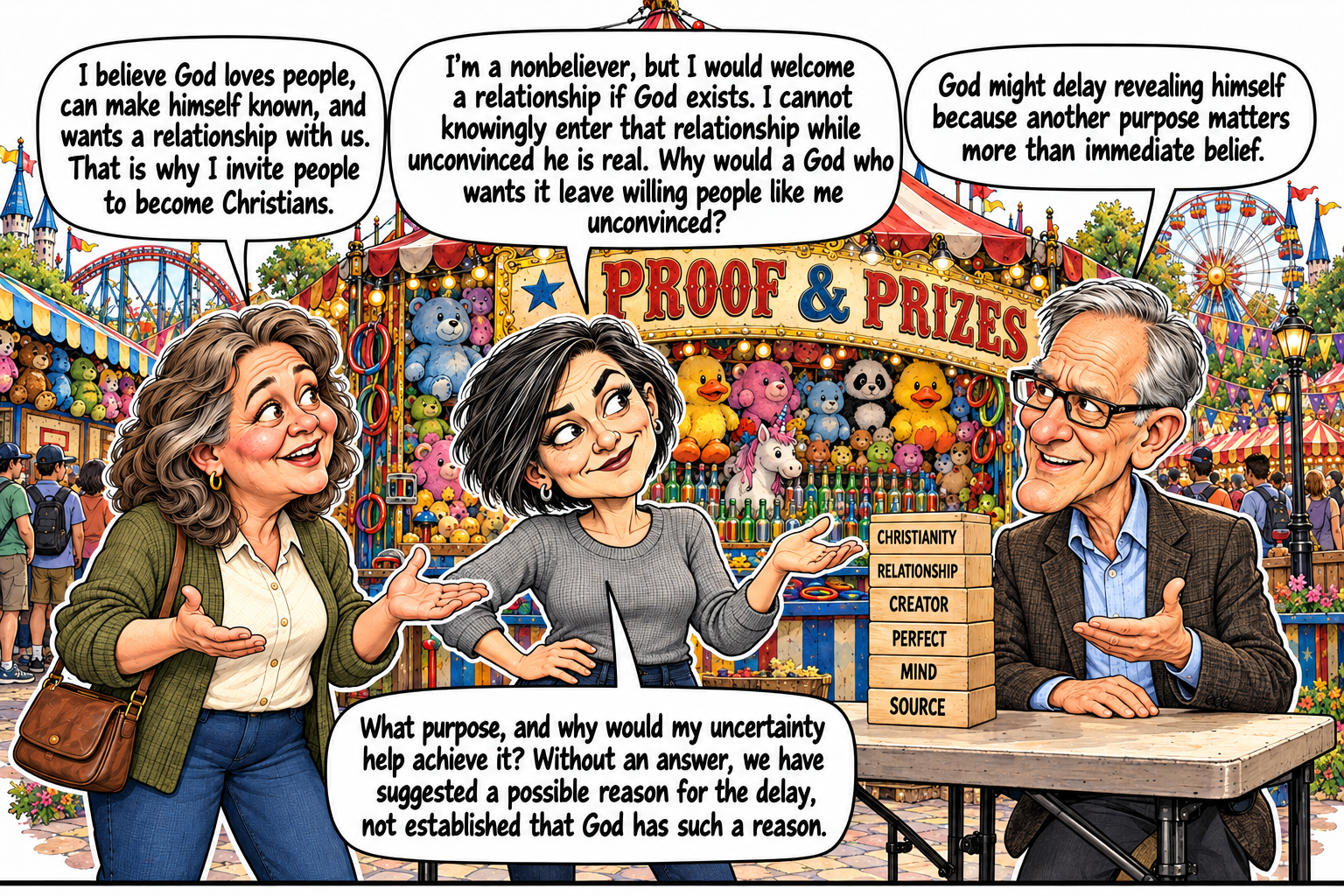
Scene 8: Why expect God to make himself known?. Ruth stands at left with both palms open. Morgan, with a short black bob and gray sweater, stands in the center with one hand at her hip and the other palm raised toward Greg. Greg stands at right behind a plain folding table, opening one palm and resting his other hand beside six wooden blocks. From bottom to top they read SOURCE, MIND, PERFECT, CREATOR, RELATIONSHIP and CHRISTIANITY. Proof & Prizes, stuffed animals, rings, bottles, rides and passing visitors fill the background. Four balloons read Ruth, Morgan, Greg, then Morgan.
SCENE 08 / 13View / zoom image ↗
Read dialogue

Ruth stands at left with both palms open. Morgan, with a short black bob and gray sweater, stands in the center with one hand at her hip and the other palm raised toward Greg. Greg stands at right behind a plain folding table, opening one palm and resting his other hand beside six wooden blocks. From bottom to top they read SOURCE, MIND, PERFECT, CREATOR, RELATIONSHIP and CHRISTIANITY. Proof & Prizes, stuffed animals, rings, bottles, rides and passing visitors fill the background. Four balloons read Ruth, Morgan, Greg, then Morgan.

Ruth: I believe God loves people, can make himself known, and wants a relationship with us. That is why I invite people to become Christians.

Morgan: I’m a nonbeliever, but I would welcome a relationship if God exists. I cannot knowingly enter that relationship while unconvinced he is real. Why would a God who wants it leave willing people like me unconvinced?

Greg: God might delay revealing himself because another purpose matters more than immediate belief.

Morgan: What purpose, and why would my uncertainty help achieve it? Without an answer, we have suggested a possible reason for the delay, not established that God has such a reason.

Notes from the queue · 08

Why expect God to make himself known?

Hiddenness challenges a particular combination: ability to make oneself known, love, and a desire for relationship with willing people.

A further divine purpose may matter. Its possibility and its evidential support are different questions.

A deeper dive

An expectation tied to a claim

Hiddenness means the difficulty of recognizing divine presence, especially for people willing to enter a relationship if they knew such a being existed. The challenge here depends on an account of God that combines sufficient ability, love and a desire for relationship. It is not a rule that every imaginable deity would announce itself.

The proposed relationship requires willing people to recognize whom they are relating to. Morgan states that barrier explicitly: she cannot knowingly enter a relationship with someone she does not believe exists. If God can remove that barrier and wants the relationship, her continued uncertainty calls for an explanation. Ruth’s stated beliefs supply the premises of the question without declaring Morgan dishonest or resistant.

Further purposes need assessment

A defender can argue that other goods change what should be expected. That may be a substantive response if the goods are independently defended and the account explains how the relevant distance serves them. Merely listing imaginable purposes leaves open whether any of them is the actual reason for the situation.

The scene establishes a question and a burden, not a deductive disproof. It does not settle which people are nonresistant, demand complete access to divine motives, or claim that every version of divine love makes exactly the same prediction. The proposed relationship must be specified before its apparent absence can be assessed fairly.

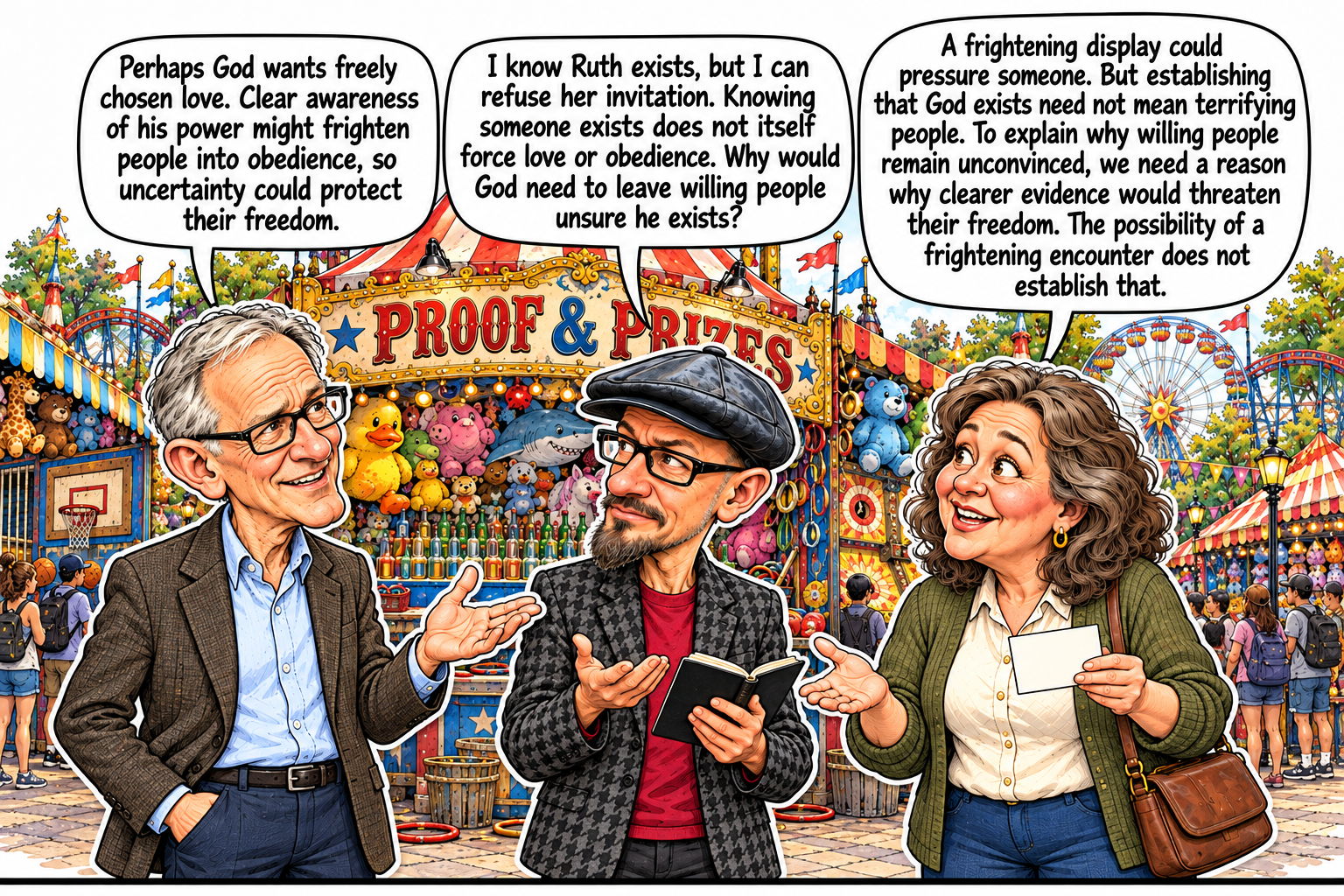
Scene 9: Does knowing someone exists remove freedom?. Greg stands at left with one hand in his pocket and the other palm open toward Phil. Phil stands in the center holding one black notebook and raising an open palm. Ruth stands at right holding a blank rectangular invitation card and opening her other palm toward them. The Proof & Prizes booth, stuffed prizes, bottle rows, rides and passing visitors fill the background. Three balloons read Greg, Phil, then Ruth.
SCENE 09 / 13View / zoom image ↗
Read dialogue

Greg stands at left with one hand in his pocket and the other palm open toward Phil. Phil stands in the center holding one black notebook and raising an open palm. Ruth stands at right holding a blank rectangular invitation card and opening her other palm toward them. The Proof & Prizes booth, stuffed prizes, bottle rows, rides and passing visitors fill the background. Three balloons read Greg, Phil, then Ruth.

Greg: Perhaps God wants freely chosen love. Clear awareness of his power might frighten people into obedience, so uncertainty could protect their freedom.

Phil: I know Ruth exists, but I can refuse her invitation. Knowing someone exists does not itself force love or obedience. Why would God need to leave willing people unsure he exists?

Ruth: A frightening display could pressure someone. But establishing that God exists need not mean terrifying people. To explain why willing people remain unconvinced, we need a reason why clearer evidence would threaten their freedom. The possibility of a frightening encounter does not establish that.

Notes from the queue · 09

Does knowing someone exists remove freedom?

Freedom to accept a relationship is distinct from knowing the other person exists. A pressure-based reply must explain why clearer evidence would undermine that freedom.

The comparison with Ruth has limits: an overwhelming divine encounter could differ from an ordinary introduction. That possibility still needs an argument connecting it to the actual uncertainty being defended.

A deeper dive

Two kinds of freedom

Believing that someone exists and choosing to trust, love or obey that person are different states. Phil’s ordinary example makes that distinction available without specialized terminology. Knowing Ruth is present does not settle whether he will accept any invitation she offers.

The example challenges a shortcut: it is insufficient simply to assert that clear knowledge would eliminate free relationship. The defender needs a further premise about the kind of knowledge, its pressure and why the proposed divine aim requires uncertainty rather than some less overwhelming form of disclosure.

The strongest version deserves an answer

Greg’s concern is stronger than the bare claim that knowledge always compels love. Awareness of an unsurpassably powerful being might exert pressure unlike an ordinary human introduction. Ruth grants that possibility. She then asks whether it establishes the need for the actual extent and distribution of uncertainty.

A developed freedom defense could specify limits, distinguish coercion from influence and explain how relationship remains available to willing people. If supported, those details would improve the account. In their absence, the imagined benefit of uncertainty remains a possible reason, not a demonstrated explanation of hiddenness.

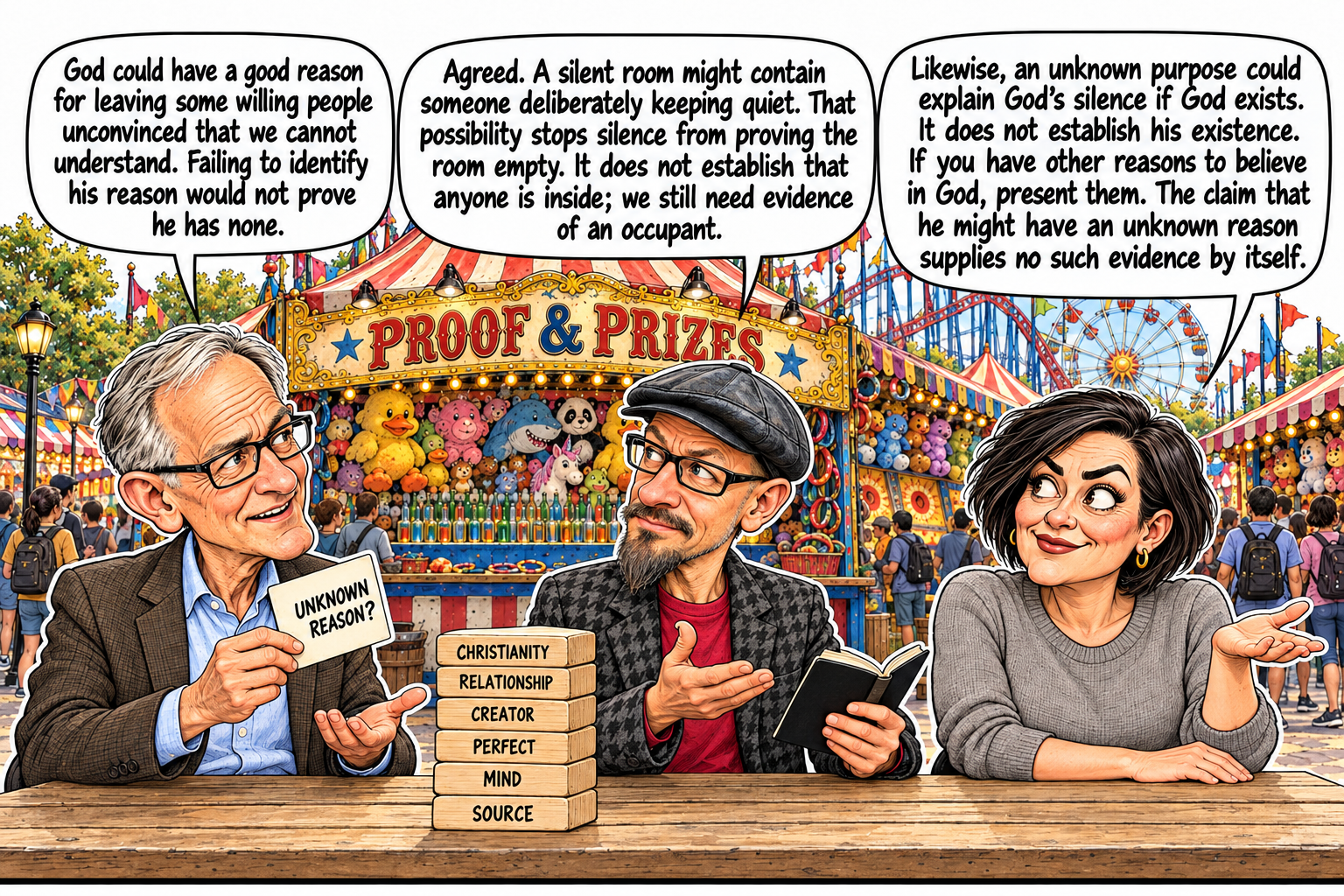
Scene 10: An unknown reason is still unknown. Greg sits at left holding a loose card marked UNKNOWN REASON? and opening his other palm. Phil sits in the center holding one black notebook and raising an open palm. Morgan sits at right with one palm raised and the other hand on the table. Six wooden blocks on the plain tabletop read SOURCE, MIND, PERFECT, CREATOR, RELATIONSHIP and CHRISTIANITY from bottom to top. Proof & Prizes, stuffed prizes, bottles, rides and park visitors fill the background. Three balloons read Greg, Phil, then Morgan.
SCENE 10 / 13View / zoom image ↗
Read dialogue

Greg sits at left holding a loose card marked UNKNOWN REASON? and opening his other palm. Phil sits in the center holding one black notebook and raising an open palm. Morgan sits at right with one palm raised and the other hand on the table. Six wooden blocks on the plain tabletop read SOURCE, MIND, PERFECT, CREATOR, RELATIONSHIP and CHRISTIANITY from bottom to top. Proof & Prizes, stuffed prizes, bottles, rides and park visitors fill the background. Three balloons read Greg, Phil, then Morgan.

Greg: God could have a good reason for leaving some willing people unconvinced that we cannot understand. Failing to identify his reason would not prove he has none.

Phil: Agreed. A silent room might contain someone deliberately keeping quiet. That possibility stops silence from proving the room empty. It does not establish that anyone is inside; we still need evidence of an occupant.

Morgan: Likewise, an unknown purpose could explain God’s silence if God exists. It does not establish his existence. If you have other reasons to believe in God, present them. The claim that he might have an unknown reason supplies no such evidence by itself.

Notes from the queue · 10

An unknown reason is still unknown

The room example shows why absence of a response need not prove absence of an occupant. It also shows why imagining a reason for silence does not establish an occupant.

The same distinction applies to God’s proposed silence. Other reasons for believing in God can be assessed, but the mere availability of an unknown-purpose story does not supply them.

A deeper dive

What an unknown reason can accomplish

A contradiction claim says that the proposed God and the observed situation cannot both be real. Showing a possible reason for the situation can weaken that claim, even when the reason is not known to be actual. Greg is therefore entitled to point out a limit in our access to divine purposes.

Positive support asks a different question: does the situation give us reason to favor this divine explanation over alternatives? A reason whose content is left unspecified may accommodate the situation without making it particularly expected. Removing an alleged contradiction does not automatically establish the explanation.

An analogy about inference, not equal odds

The silent-room example separates “someone could be keeping quiet” from “someone is inside.” Independent evidence of an occupant could change the assessment. The bare possibility of concealment does not supply that evidence on its own.

God and an ordinary room occupant are not identical explanatory proposals, and the example makes no claim about their prior probabilities. Its narrow use is to expose a common missing step. A separate case for God could provide background support; then the strength would come from that case, not from inventing an unknown reason after the apparent absence is noticed.

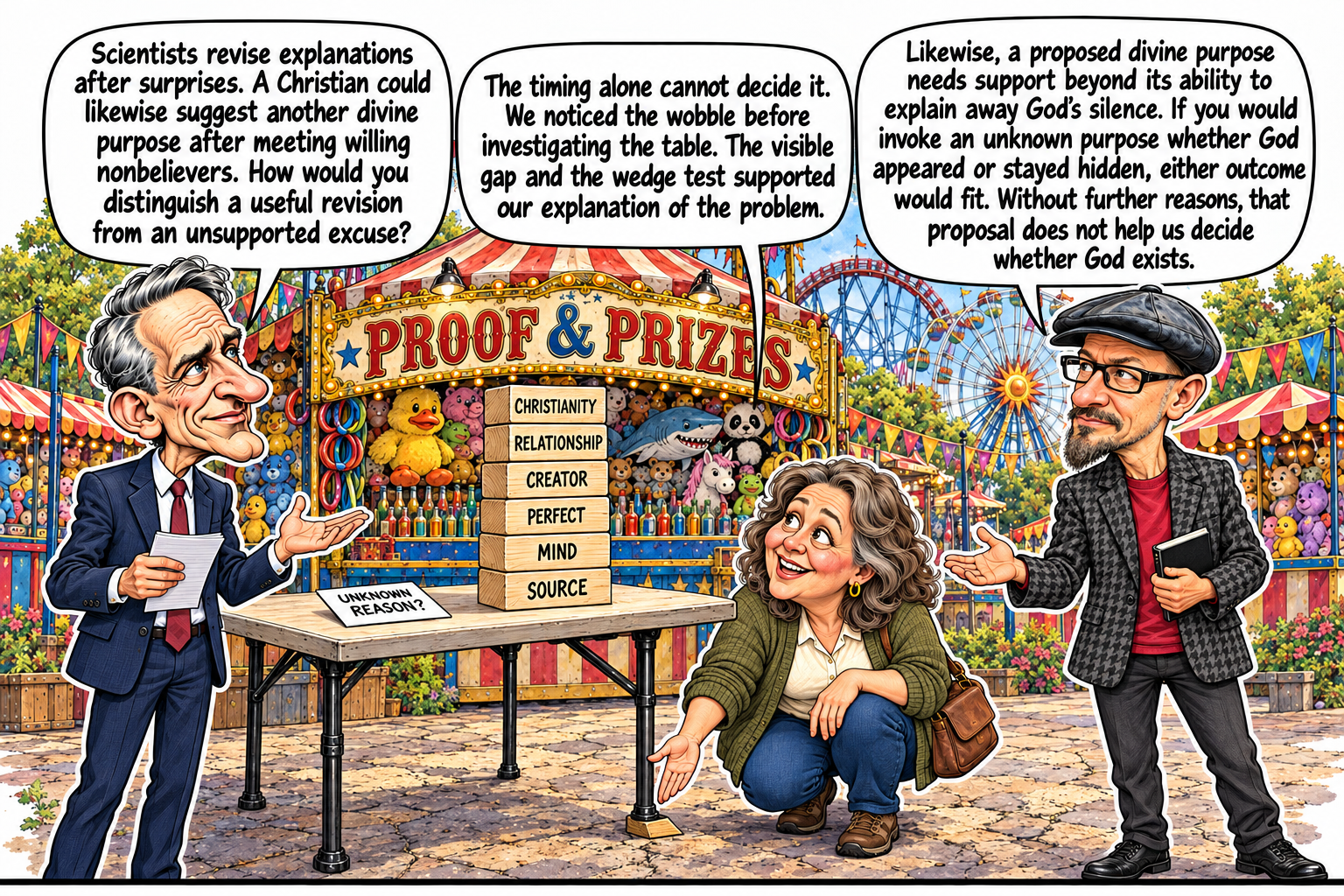
Scene 11: When a revised explanation deserves support. William at left raises an open palm while holding notes. Ruth crouches beside the table and gestures toward the single wooden wedge under its near-right metal foot. Phil at right holds a closed black notebook and responds with an open hand. The six-block tower stands on the tabletop beside a separate UNKNOWN REASON? card, against the busy Proof & Prizes booth.
SCENE 11 / 13View / zoom image ↗
Read dialogue

William at left raises an open palm while holding notes. Ruth crouches beside the table and gestures toward the single wooden wedge under its near-right metal foot. Phil at right holds a closed black notebook and responds with an open hand. The six-block tower stands on the tabletop beside a separate UNKNOWN REASON? card, against the busy Proof & Prizes booth.

William: Scientists revise explanations after surprises. A Christian could likewise suggest another divine purpose after meeting willing nonbelievers. How would you distinguish a useful revision from an unsupported excuse?

Ruth: The timing alone cannot decide it. We noticed the wobble before investigating the table. The visible gap and the wedge test supported our explanation of the problem.

Phil: Likewise, a proposed divine purpose needs support beyond its ability to explain away God’s silence. If you would invoke an unknown purpose whether God appeared or stayed hidden, either outcome would fit. Without further reasons, that proposal does not help us decide whether God exists.

Notes from the queue · 11

When a revised explanation deserves support

Finding a problem before proposing an explanation does not disqualify the explanation. Independent support and further consequences matter.

A proposal that can accommodate anything may preserve possibility while doing little to distinguish itself from competitors.

A deeper dive

Later does not mean illegitimate

Unexpected findings often motivate useful inquiry. The order in which a problem and an explanation appear is therefore not enough to decide the explanation’s merit. Rejecting every later adjustment would exclude ordinary discovery, repair and correction.

A supporting assumption can be assessed through evidence other than the difficulty it was invented to resolve, through consequences not chosen to match that difficulty, or through a defensible connection to established principles. In the table example, the gap and the effect of the wedge provide more than a verbal excuse.

What protection alone leaves unpaid

The concern is a revision whose only support is that the favored account would otherwise face trouble. If a new hidden purpose can make any pattern acceptable and supplies no further reasons to expect one pattern over another, its flexibility should not be reported as new confirmation.

This diagnosis applies to a particular explanation, not to an entire discipline. A naturalistic account can also absorb every outcome through unsupported adjustments. A theological response can be independently motivated and informative. The question is what the addition contributes and how honestly its limits are recorded.

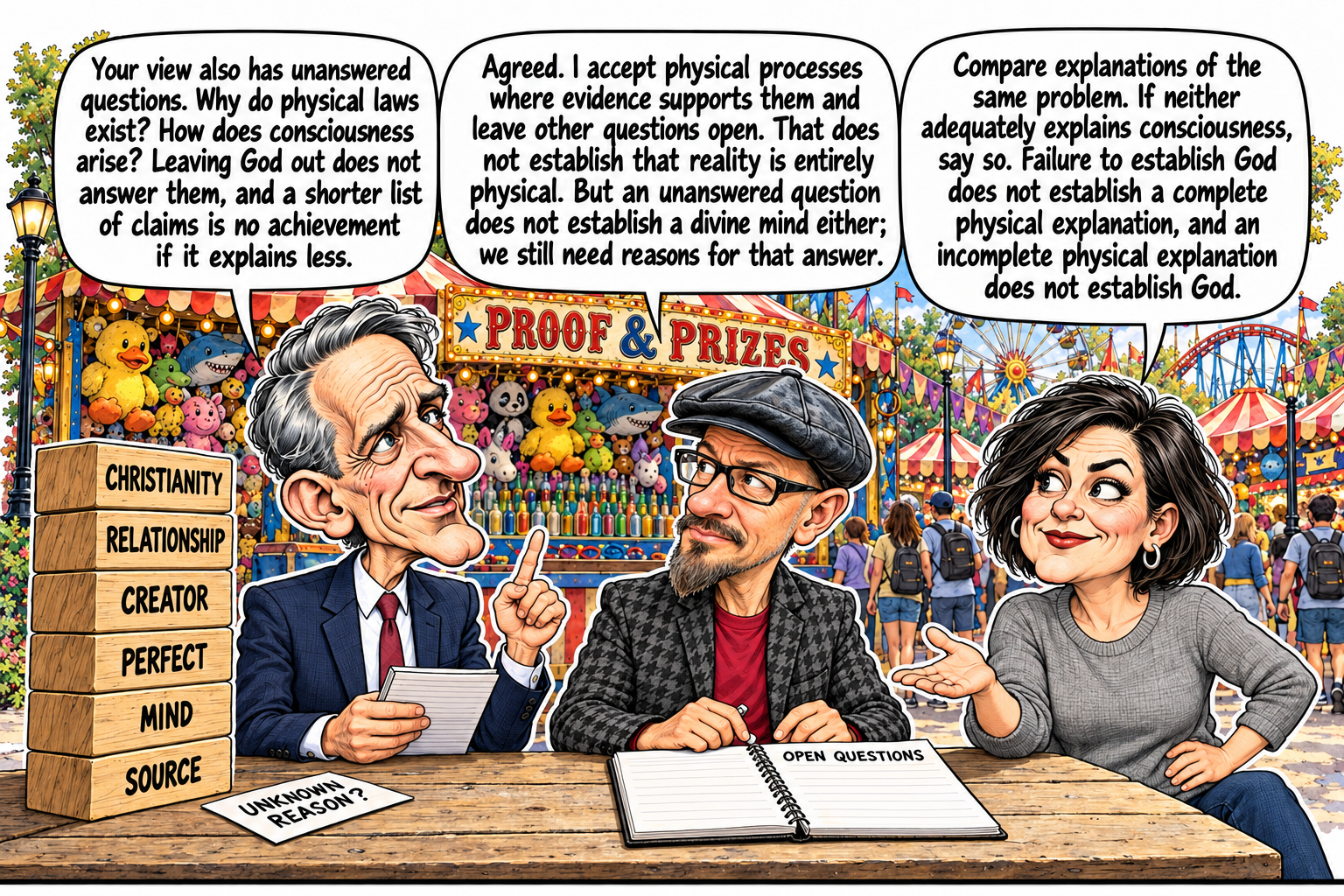
Scene 12: Unanswered questions remain unanswered. William, Phil and Morgan sit at the wooden table in front of Proof & Prizes. William raises one index finger while holding his notes. Phil rests his hands beside an open notebook headed OPEN QUESTIONS, with otherwise blank ruled pages. Morgan opens one palm toward it. The six labeled blocks remain upright at the left; a loose UNKNOWN REASON? card lies flat on the table. Colorful prizes, rides and passing visitors fill the background.
SCENE 12 / 13View / zoom image ↗
Read dialogue

William, Phil and Morgan sit at the wooden table in front of Proof & Prizes. William raises one index finger while holding his notes. Phil rests his hands beside an open notebook headed OPEN QUESTIONS, with otherwise blank ruled pages. Morgan opens one palm toward it. The six labeled blocks remain upright at the left; a loose UNKNOWN REASON? card lies flat on the table. Colorful prizes, rides and passing visitors fill the background.

William: Your view also has unanswered questions. Why do physical laws exist? How does consciousness arise? Leaving God out does not answer them, and a shorter list of claims is no achievement if it explains less.

Phil: Agreed. I accept physical processes where evidence supports them and leave other questions open. That does not establish that reality is entirely physical. But an unanswered question does not establish a divine mind either; we still need reasons for that answer.

Morgan: Compare explanations of the same problem. If neither adequately explains consciousness, say so. Failure to establish God does not establish a complete physical explanation, and an incomplete physical explanation does not establish God.

Notes from the queue · 12

Unanswered questions remain unanswered

Acknowledging ignorance is honest but does not solve the problem. A simpler view must actually match the explanatory task before it can claim a comparative advantage.

The skeptical stance here is open to evidence of a nonphysical cause. It does not impose an unconditional ban and then call the result a discovery.

A deeper dive

Restraint is not a completed worldview

A naturalistic position has commitments too. It relies on some account of the physical world, regularities, mental life and the methods used to investigate them. Saying that future science will explain everything would add a promise, not deliver the missing explanation.

Phil adopts a limited stance: accept processes for which there is support, keep unresolved issues open and remain willing to revise. That stance can justify refusing an inadequately supported addition. It does not by itself establish that every cause is physical or that every difficult question will receive a naturalistic solution.

The comparison must do the same work

William’s objection succeeds whenever one account appears lean only because it ignores what the other genuinely explains. An explanation that handles more evidence or connects previously separate facts may earn its extra commitments. Matching the task is a condition of a fair parsimony argument.

If both accounts remain inadequate, the honest result may be unresolved inquiry. There is no obligation to select a complete worldview merely because rival labels are available. Conversely, an unresolved question does not give any proposed answer a free pass: its premises and connections still require assessment.

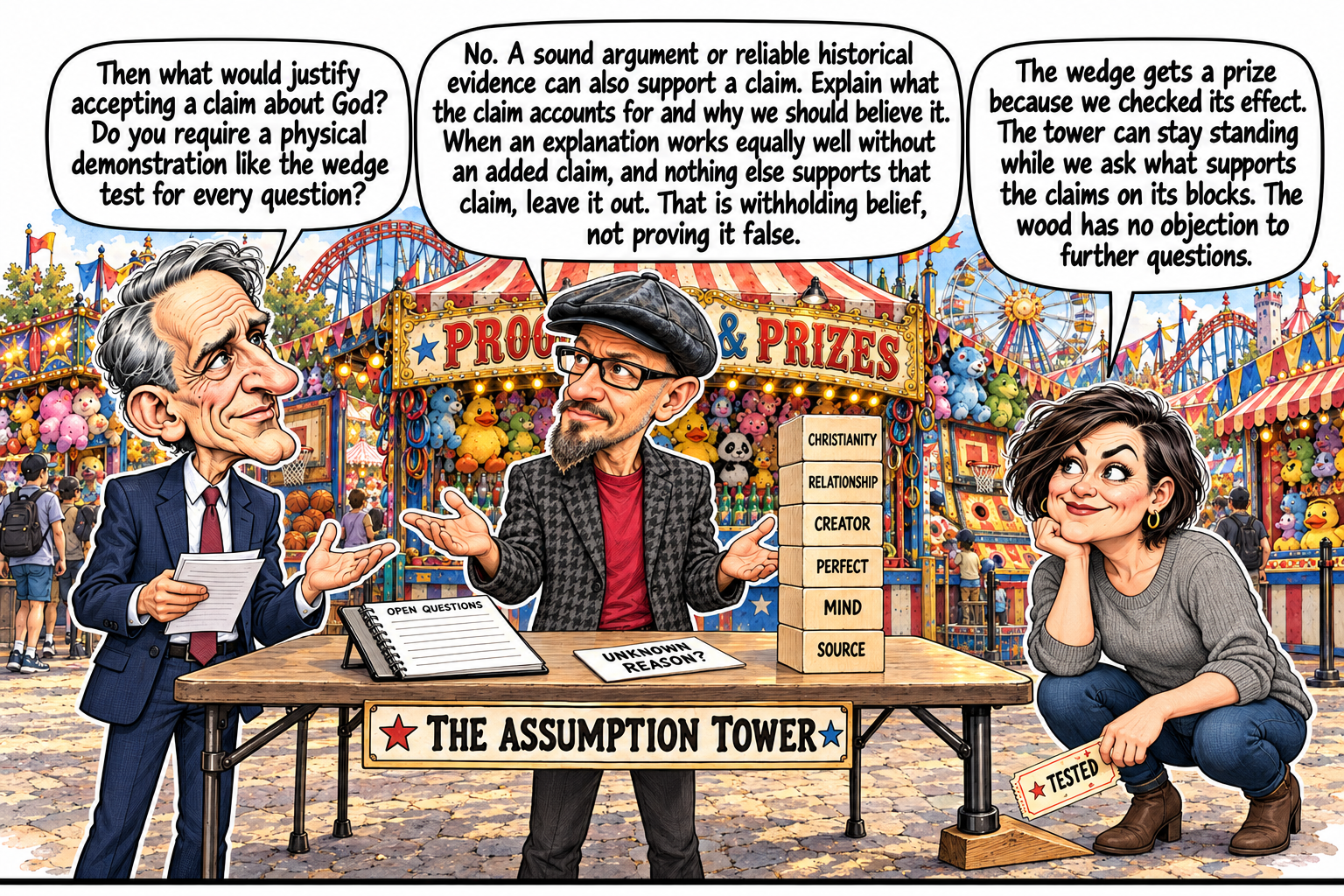
Scene 13: What would justify another claim?. At Proof & Prizes, William stands at the left with paper notes and an open palm; Phil stands in the center with both hands open and empty. Morgan crouches at the right, resting her chin on one hand and holding a TESTED prize ticket beside the wooden wedge supporting the table’s near-right metal foot. The six blocks remain standing, labeled from bottom to top SOURCE, MIND, PERFECT, CREATOR, RELATIONSHIP and CHRISTIANITY. One open black spiral notebook marked OPEN QUESTIONS is propped on the table beside the loose UNKNOWN REASON? card. A THE ASSUMPTION TOWER placard hangs from the table. Plush prizes, rings, bottles, rides and passing visitors fill the park behind them.
SCENE 13 / 13View / zoom image ↗
Read dialogue

At Proof & Prizes, William stands at the left with paper notes and an open palm; Phil stands in the center with both hands open and empty. Morgan crouches at the right, resting her chin on one hand and holding a TESTED prize ticket beside the wooden wedge supporting the table’s near-right metal foot. The six blocks remain standing, labeled from bottom to top SOURCE, MIND, PERFECT, CREATOR, RELATIONSHIP and CHRISTIANITY. One open black spiral notebook marked OPEN QUESTIONS is propped on the table beside the loose UNKNOWN REASON? card. A THE ASSUMPTION TOWER placard hangs from the table. Plush prizes, rings, bottles, rides and passing visitors fill the park behind them.

William: Then what would justify accepting a claim about God? Do you require a physical demonstration like the wedge test for every question?

Phil: No. A sound argument or reliable historical evidence can also support a claim. Explain what the claim accounts for and why we should believe it. When an explanation works equally well without an added claim, and nothing else supports that claim, leave it out. That is withholding belief, not proving it false.

Morgan: The wedge gets a prize because we checked its effect. The tower can stay standing while we ask what supports the claims on its blocks. The wood has no objection to further questions.

Notes from the queue · 13

What would justify another claim?

The conclusion is a standard for accepting extra claims, not a universal score for entire worldviews. An addition can earn its place through stronger explanation and support.

The wedge receives a tested label. The tower receives further questions. Neither wooden object proves whether God exists.

A deeper dive

The condition that matters

A fair skeptical conclusion begins with a comparison: identify the question, specify the rival accounts and ask whether they explain the relevant evidence comparably. If the richer account requires a commitment that the leaner account can omit, that commitment needs an advantage sufficient to justify accepting it.

Support can take several forms. Independent evidence can favor a cause; a sound argument can establish a connection; a new successful expectation can show that an account does more than fit what was already known; unification can reduce unsupported assumptions elsewhere. These possibilities prevent parsimony from becoming a refusal to learn.

Withholding without pretending to disprove

Where the added commitment remains unsupported and supplies no compensating advantage, there is no reason from that addition to favor the richer explanation. That is a consequential limit on justified belief. It is not the claim that the addition is impossible, that its probability is zero or that every rival is complete.

The tower stays standing because wooden stability was never the test. Morgan’s ticket goes to the checked repair, making the distinction visible one last time. The invitation to further inquiry remains open: show what the next claim contributes, supply its reasons and let the assessment change if those reasons succeed.

After the ride · The skeptical case & private feedbackWhat Would Make the God Explanation Earn Its Place?Open the article and feedback formClose the article and feedback form 7 min read

“God explains it” can be the beginning of an argument. It cannot be allowed to stand in for every missing part of that argument. A proposed explanation must tell us enough about its cause, powers and intentions to show why the observation makes sense. Otherwise the unexplained fact has acquired a magnificent name while the explanatory work remains undone.

Parsimony is the discipline of asking whether an added assumption is needed and justified. It gives the skeptical reader a pointed question: what does adding this particular claim about God enable us to understand that a serious alternative cannot explain as well? The question is demanding. It is also open to an answer. A rule that refused every addition would prevent discovery as effectively as a rule that accepted every imaginable story.

First compare explanations that do the same work

The shortest answer does not automatically win. “It just happens” is admirably brief and frequently unhelpful. If an explanation accounts for observations that a simpler rival cannot handle, predicts something successfully or connects facts that previously looked unrelated, those achievements can justify its additional claims. If a wedge and a person’s hand both contribute to a table’s stability, an explanation that omits the hand is incomplete. Evidence of that contribution justifies including it; the mere invention of an unseen helper does not.

The comparison must therefore name the problem and the rivals. Explaining why a table rocks is different from explaining why there is a universe. A naturalistic account that handles the first has not thereby answered the second. Equally, a proposal about an ultimate source has not thereby explained every detail of human history. Explanatory credit belongs to the work actually done.

A defensible use of parsimony asks whether an extra claim remains unnecessary after the evidence and explanatory gains are considered. If two serious accounts do the relevant work comparably, accepting an additional unsupported commitment requires a reason. There is no virtue in making a belief harder to justify when the added burden purchases no understanding.

One word can contain a great deal of unfinished argument

Consider the route from an ultimate source to the Christian God. A source is said to be a mind; that mind is said to have maximal power, knowledge and goodness; it is said to create this world, govern events, seek a relationship with humans and disclose itself through a particular religious history. Some steps may be connected by philosophical arguments. Others may appeal to testimony or experience. None becomes established merely because all are collected under one name.

The point is not that every sentence adds an independent probability penalty. The claims can depend on one another, follow from a common principle or receive support from overlapping evidence. Multiplying invented percentages would produce numerical theater. Even counting entities can mislead: many lamps may share one supported cause, while one proposed being can carry an extensive set of unexplained powers and intentions.

The relevant question concerns each connection. Does an argument for a foundation establish thought? Does a claim of perfect goodness establish this particular act of creation? Does a proposed willingness to communicate identify Christianity as the communication? A conclusion cannot borrow the full credit of a more general premise unless the further inference is justified.

Give simplicity and unification their strongest hearing

A serious Christian reply says that God unifies matters that naturalism leaves disconnected: cosmic order, conscious life, moral obligation and religious experience. If a specified account genuinely supplies those connections and reduces unsupported assumptions elsewhere, that is an explanatory gain. The skeptic should credit it. The question is whether the proposal yields the connections, rather than announcing a common author and leaving each decision unexplained.

Classical divine simplicity also deserves more than a block-counting joke. It says that God lacks physical and metaphysical parts, so the divine attributes are not a collection of components. A related defense holds that unlimited knowledge can be simpler to specify than an arbitrary finite ceiling. Both points challenge crude counting. Neither should be dismissed simply because a skeptic finds the resulting theology unfamiliar.

Even granting those arguments, the account still needs to connect the proposed divine nature to this world and its particular history. A simple source does not automatically specify its effects. An unrestricted choice may be compatible with many worlds; the explanation needs reasons for expecting or understanding this one. Simplicity within the proposed deity and support for the deity’s supposed actions are connected questions, but they are not interchangeable.

A foundation does not identify a revelation

Describing God as the ground of existence changes the kind of explanation being offered. The claim is about what sustains reality, not a large invisible object alongside other objects. A fair criticism must engage that proposal rather than quietly replace it with a caricature. It should also resist the opposite shortcut: calling something a ground does not establish its thoughts, love, commands or historical actions.

Christian claims about Jesus involve identifiable people, events and interpretations. That specificity can expose the view to evidence rather than insulate it. The evidence then needs to support the particular claim over serious alternatives. A general argument for a sustaining source cannot be counted repeatedly as if it independently established a revelation, an incarnation and a resurrection.

Nothing here makes historical testimony or religious experience inadmissible. Their reliability, interpretation and relevance have to be assessed. The present objection is to an unearned transfer of support, not a completed verdict on every historical argument. Calling the whole package an explanation is the invitation to examine it, not a certificate that every connection has passed.

Hidden reasons can preserve possibility without supplying evidence

A God who can make himself known and wants a loving relationship with willing people creates an expectation of some access to that relationship. The existence of people who sincerely seek and remain unconvinced raises a question about that account. The question is conditional on the proposed abilities and intentions. It is not a demand that every conceivable god appear on a billboard.

A freedom defense may answer that overwhelming awareness could distort a person’s choice. That is a concern worth examining. Knowing another person exists does not itself compel trust or affection, however, and the possibility of an overwhelming display does not establish that all clearer disclosure would be coercive. The explanation needs a reason why the relevant uncertainty is required and why its extent fits the proposed purpose.

An appeal to unknown divine reasons has a different strength. It can remind us that failure to identify a reason does not prove no reason exists. That may undermine a claim of strict contradiction. But an unspecified reason that fits almost any situation gives little help in choosing this explanation over rivals. If a separate argument already supplies strong support for God, say so and assess it. Do not count the imaginable reason itself as a discovery.

Apply the same scrutiny to the skeptic’s account

Naturalism does not become assumption-free by declining theological vocabulary. Its accounts of laws, minds, causation and the reach of inquiry have commitments and unresolved questions. A promise that future science will answer everything has not answered anything yet. The skeptical reader should be as suspicious of that blank check as of an unknown divine purpose presented as a settled explanation.

Nor is every revision an excuse. Finding a surprising result can motivate a good new hypothesis. The issue is what supports the added claim beyond the need to preserve the old view: independent evidence, a defensible derivation, a further successful consequence or a genuine reduction of unexplained commitments elsewhere. These are opportunities for theological and naturalistic proposals alike.

If neither account adequately explains the target, acknowledging that remains a legitimate result. Withholding an inadequately supported divine addition does not establish that every cause is physical. It does prevent an open question from being filled with a confident answer whose supporting argument has not been supplied.

Let the next claim earn the next step

The skeptical conclusion is limited enough to be defensible and strong enough to matter. Where a leaner, specified rival does the relevant explanatory work equally well, and an additional Christian claim has neither adequate support nor a compensating explanatory gain, parsimony favors withholding that addition. Calling it profound, ultimate or part of a single simple being does not discharge the unfinished reasoning.

That conclusion is not a proof of nonexistence. New evidence or a better argument can change the assessment. An added claim that actually explains more and earns support should receive credit, however unwelcome it might be to a preferred worldview. Confidence should move with the reasons, not with allegiance to a shorter or taller story.

The wooden tower can stay standing. What needs support is the belief. Before asking someone to climb from a source of reality to a personal God and then to a particular religion, show what makes each step warranted. The height of the claim is no substitute for the strength of the reasons beneath it.

A private note

What did you think?

Have a question, correction or suggestion? Send it privately to Phil. Your message will not appear on this site.

Each added claim needs a reason.

Keep the questions coming.

Open original size ↗

Choose Zoom in for full-size lettering.

Read dialogue

A deeper dive