APOLOPLEX

Episode 06 / Proof & Prizes

The Floating Fortress

An elaborate fortress model has a beautifully consistent plan. The visitors ask what holds the argument up.

Does a coherent theology establish that its claims are true? A comic examines consistency, evidence and explanations protected from criticism, with skeptical analysis.

An argument takes a day out

Greg, William, Michael, Phil, Alex and Ruth
When does an explanation connect with reality, and when does it merely protect itself?

An imagined conversation. All dialogue, actions and park incidents are fictional.

Use ← and → to move between scenes.

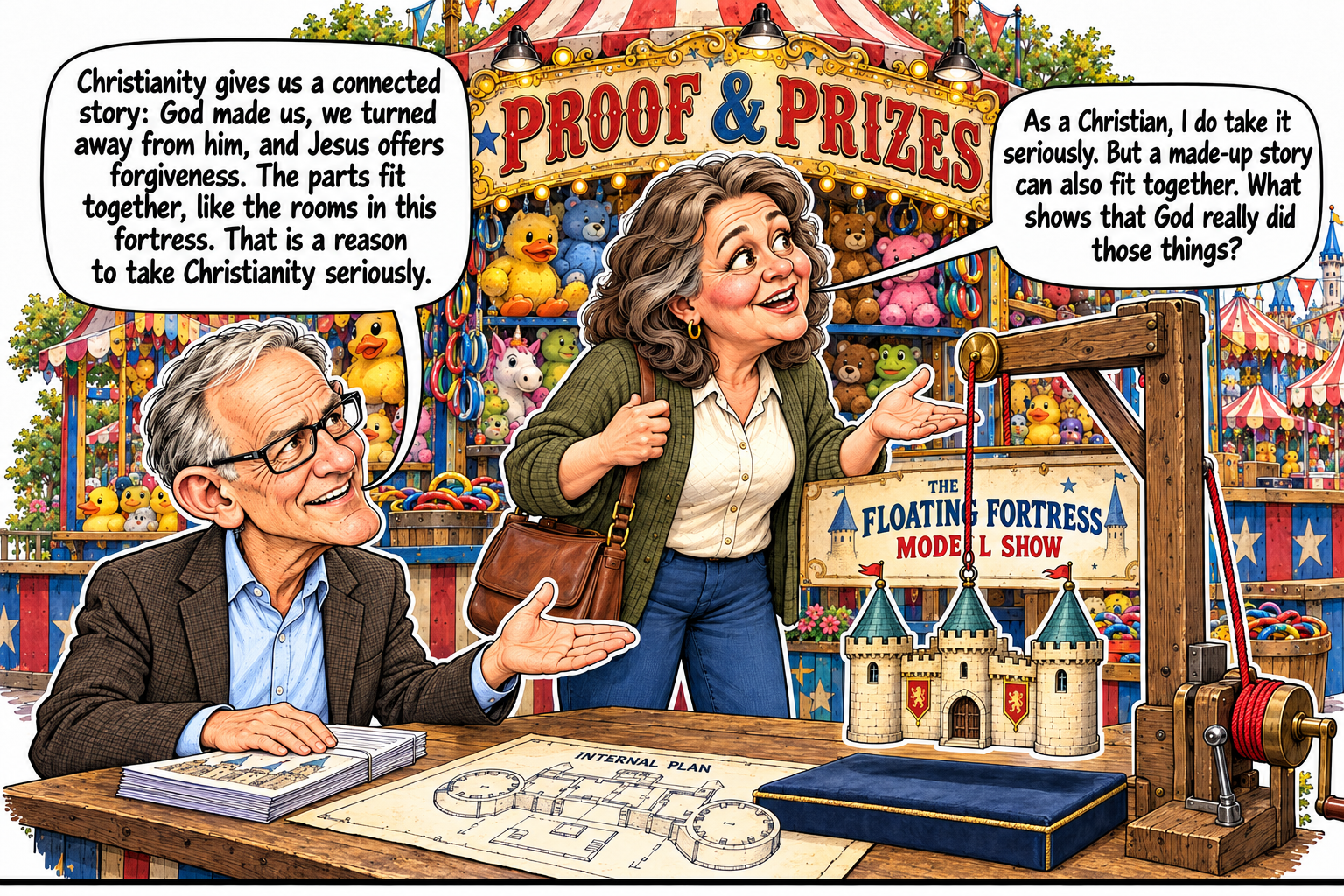
Scene 1: Every room fits. Greg sits at the left of the booth, one palm open above an open floor plan and his other hand on leaflets. Ruth stands behind him holding her bag strap and opening her other hand toward a three-tower model. A red cord suspends the model above a blue pad, passing over a pulley toward the crank on the right. Bright prizes fill the booth behind them.
SCENE 01 / 16View / zoom image ↗
Read dialogue

Greg sits at the left of the booth, one palm open above an open floor plan and his other hand on leaflets. Ruth stands behind him holding her bag strap and opening her other hand toward a three-tower model. A red cord suspends the model above a blue pad, passing over a pulley toward the crank on the right. Bright prizes fill the booth behind them.

Greg: Christianity gives us a connected story: God made us, we turned away from him, and Jesus offers forgiveness. The parts fit together, like the rooms in this fortress. That is a reason to take Christianity seriously.

Ruth: As a Christian, I do take it seriously. But a made-up story can also fit together. What shows that God really did those things?

Notes from the queue · 01

Every room fits

A coherent account avoids internal contradictions. That is worth having, but it does not establish that its starting claims describe the world.

The model is openly a model. The comparison concerns the support for an explanation, not whether God needs a physical foundation.

A deeper dive

Consistency is valuable, but incomplete

An internally coherent account has parts that can be held together without contradiction. That achievement matters. If a proposed explanation requires an event both to occur and not to occur in the same respect, it needs repair. Ruth is therefore right to value careful reasoning within her tradition.

The next question is different: are the premises true, and does the explanation fit the world better than its competitors? Two incompatible accounts can each be coherent. A consistent account of a city on an invented island does not place that city on a map. Further reasoning or evidence is needed to connect the account to reality.

Where the analogy stops

The fortress does not prove that Christianity is invented. It isolates an inference: the arrangement of claims cannot, by itself, establish their external reference. A Christian can answer with historical testimony, experience or philosophical arguments. Those reasons deserve assessment on their own merits rather than dismissal because they are religious.

Conversely, the beauty and complexity of the system cannot substitute for assessing those reasons. The skeptical question remains open and specific: what connects the premises to the world? Rejecting an inadequate answer to that question is not yet a proof that every possible answer must fail.

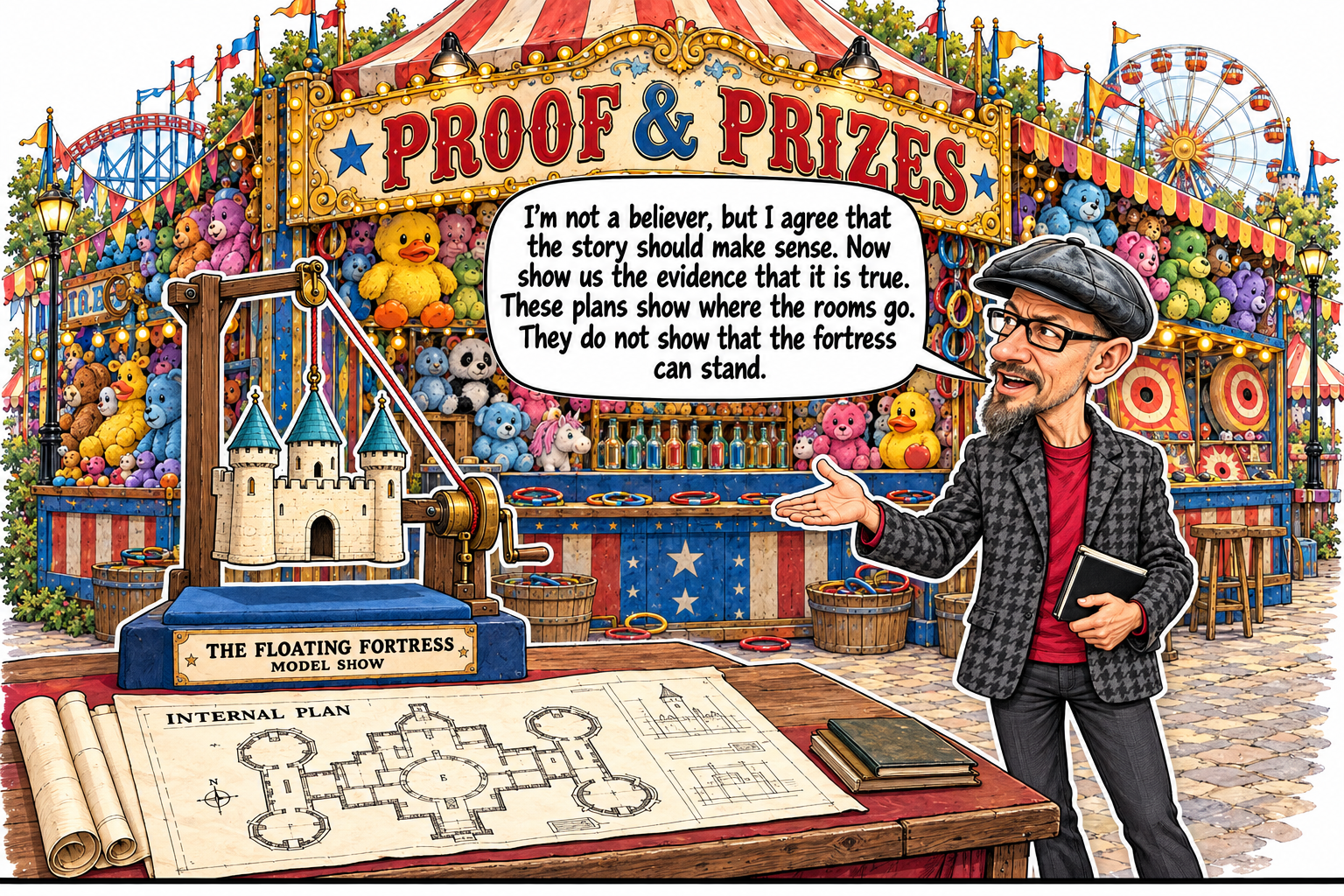
Scene 2: What holds the story up?. Phil stands on the right, holding his closed notebook low and opening his other hand toward a large floor plan spread on the table. At left, a red cord over a brass pulley holds a cream three-tower model above a blue pad; the stationary drum and crank are visible. Colorful prizes fill the booth behind him.
SCENE 02 / 16View / zoom image ↗
Read dialogue

Phil stands on the right, holding his closed notebook low and opening his other hand toward a large floor plan spread on the table. At left, a red cord over a brass pulley holds a cream three-tower model above a blue pad; the stationary drum and crank are visible. Colorful prizes fill the booth behind him.

Phil: I’m not a believer, but I agree that the story should make sense. Now show us the evidence that it is true. These plans show where the rooms go. They do not show that the fortress can stand.

Notes from the queue · 02

What holds the story up?

A coherent account avoids internal contradictions. That is worth having, but it does not establish that its starting claims describe the world.

The model is openly a model. The comparison concerns the support for an explanation, not whether God needs a physical foundation.

A deeper dive

Consistency is valuable, but incomplete

An internally coherent account has parts that can be held together without contradiction. That achievement matters. If a proposed explanation requires an event both to occur and not to occur in the same respect, it needs repair. Ruth is therefore right to value careful reasoning within her tradition.

The next question is different: are the premises true, and does the explanation fit the world better than its competitors? Two incompatible accounts can each be coherent. A consistent account of a city on an invented island does not place that city on a map. Further reasoning or evidence is needed to connect the account to reality.

Where the analogy stops

The fortress does not prove that Christianity is invented. It isolates an inference: the arrangement of claims cannot, by itself, establish their external reference. A Christian can answer with historical testimony, experience or philosophical arguments. Those reasons deserve assessment on their own merits rather than dismissal because they are religious.

Conversely, the beauty and complexity of the system cannot substitute for assessing those reasons. The skeptical question remains open and specific: what connects the premises to the world? Rejecting an inadequate answer to that question is not yet a proof that every possible answer must fail.

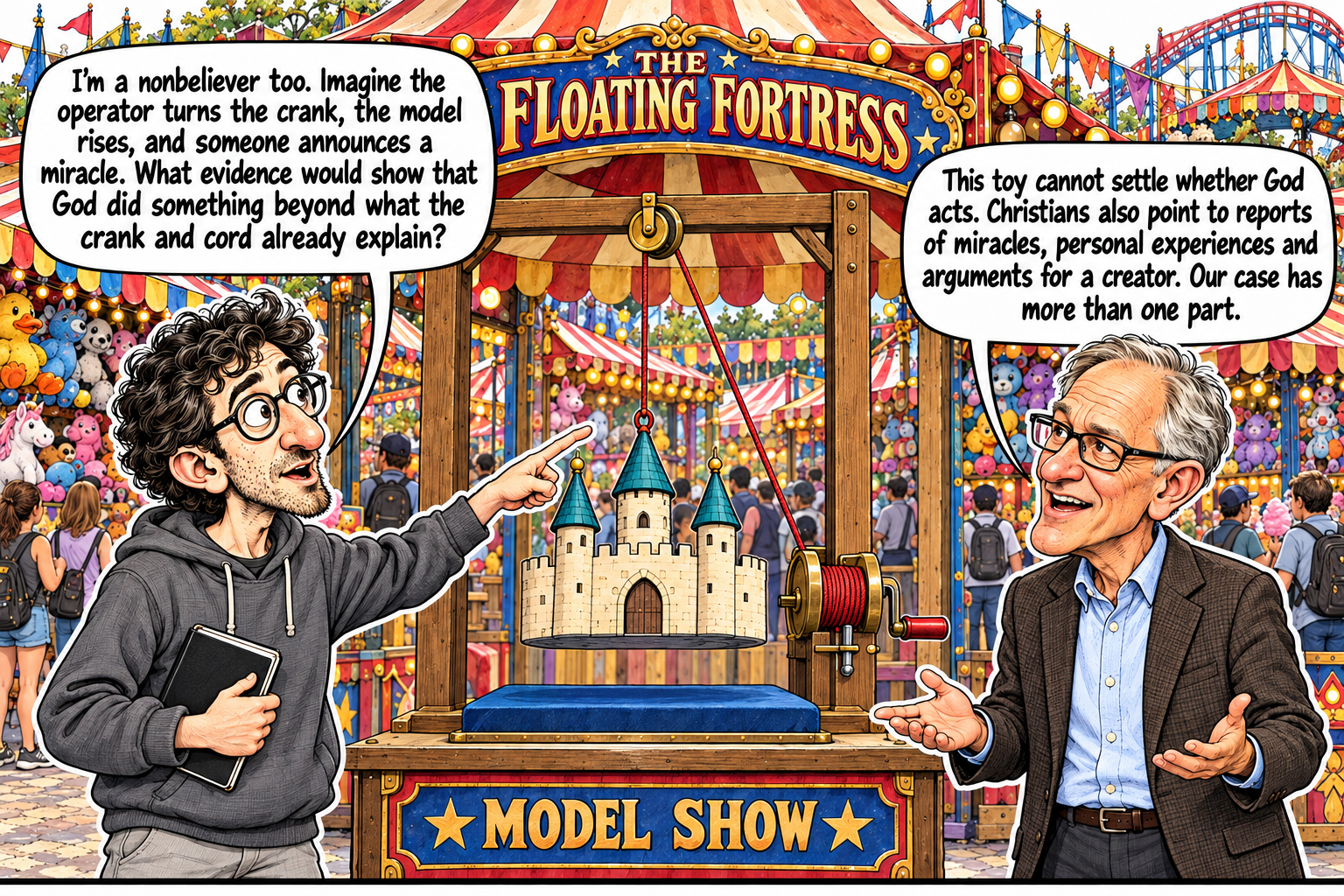
Scene 3: What would be different?. Alex holds a notebook and points toward the red cord’s attachment above the model. Greg faces him with both palms open. Between them, a three-tower cream castle hangs above a blue pad; its red cord runs over a brass pulley to a drum and stationary crank. Prizes and passing visitors fill the booth behind them.
SCENE 03 / 16View / zoom image ↗
Read dialogue

Alex holds a notebook and points toward the red cord’s attachment above the model. Greg faces him with both palms open. Between them, a three-tower cream castle hangs above a blue pad; its red cord runs over a brass pulley to a drum and stationary crank. Prizes and passing visitors fill the booth behind them.

Alex: I’m a nonbeliever too. Imagine the operator turns the crank, the model rises, and someone announces a miracle. What evidence would show that God did something beyond what the crank and cord already explain?

Greg: This toy cannot settle whether God acts. Christians also point to reports of miracles, personal experiences and arguments for a creator. Our case has more than one part.

Notes from the queue · 03

What would be different?

Seeing the model rise would not identify the cause by itself. An operator turning the crank is one explanation to compare with the suggested act of God.

A historical argument and a mechanical demonstration use different evidence. Both still need a connection between the evidence and the conclusion.

A deeper dive

Support requires a comparison

Suppose two explanations can both accommodate something we observed. That fact alone does not tell us which deserves greater confidence. We need reasons to judge how expected the observation would be under each account, together with whatever independent reasons support the accounts themselves. An explanation that merely permits an event has not yet explained why that event favors it.

This comparison need not begin with precise numbers. Source quality, independent corroboration, a reliable causal connection or a pattern that one account explains better may supply a qualitative difference. When that difference has not been established, the honest result is an unfinished comparison, not a claim that the competing probabilities must be equal.

A cumulative case still has connecting steps

Greg is right that arguments can reinforce one another. A historical claim might become more credible in light of a separately defended account of divine purposes; a philosophical argument might change the starting plausibility of an intervention. The whole case need not fit inside one booth experiment.

But the supporting steps must be stated and examined. A case does not become cumulative merely because several unsupported assertions are displayed together. The cord supplies a modest analogy for a connection that can be investigated. It does not set the only permissible method of inquiry or establish the failure of any particular historical argument.

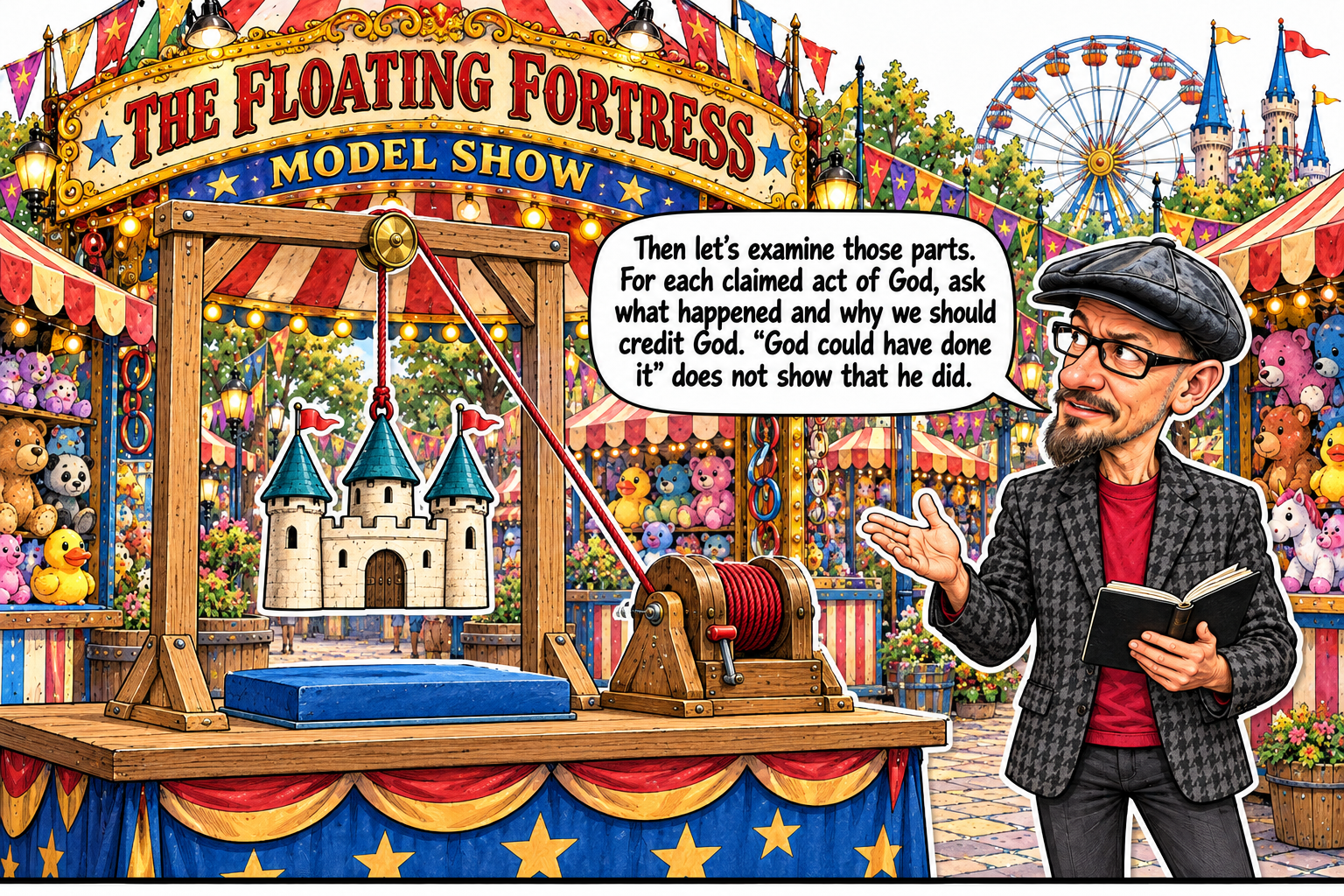
Scene 4: Why credit God?. Phil stands at right with an open notebook in his left hand and his right palm extended toward the demonstration. A three-tower cream model hangs above a blue pad at left; one red cord runs over a brass pulley to the stationary crank. The booth reads THE FLOATING FORTRESS and MODEL SHOW.
SCENE 04 / 16View / zoom image ↗
Read dialogue

Phil stands at right with an open notebook in his left hand and his right palm extended toward the demonstration. A three-tower cream model hangs above a blue pad at left; one red cord runs over a brass pulley to the stationary crank. The booth reads THE FLOATING FORTRESS and MODEL SHOW.

Phil: Then let’s examine those parts. For each claimed act of God, ask what happened and why we should credit God. “God could have done it” does not show that he did.

Notes from the queue · 04

Why credit God?

Seeing the model rise would not identify the cause by itself. An operator turning the crank is one explanation to compare with the suggested act of God.

A historical argument and a mechanical demonstration use different evidence. Both still need a connection between the evidence and the conclusion.

A deeper dive

Support requires a comparison

Suppose two explanations can both accommodate something we observed. That fact alone does not tell us which deserves greater confidence. We need reasons to judge how expected the observation would be under each account, together with whatever independent reasons support the accounts themselves. An explanation that merely permits an event has not yet explained why that event favors it.

This comparison need not begin with precise numbers. Source quality, independent corroboration, a reliable causal connection or a pattern that one account explains better may supply a qualitative difference. When that difference has not been established, the honest result is an unfinished comparison, not a claim that the competing probabilities must be equal.

A cumulative case still has connecting steps

Greg is right that arguments can reinforce one another. A historical claim might become more credible in light of a separately defended account of divine purposes; a philosophical argument might change the starting plausibility of an intervention. The whole case need not fit inside one booth experiment.

But the supporting steps must be stated and examined. A case does not become cumulative merely because several unsupported assertions are displayed together. The cord supplies a modest analogy for a connection that can be investigated. It does not set the only permissible method of inquiry or establish the failure of any particular historical argument.

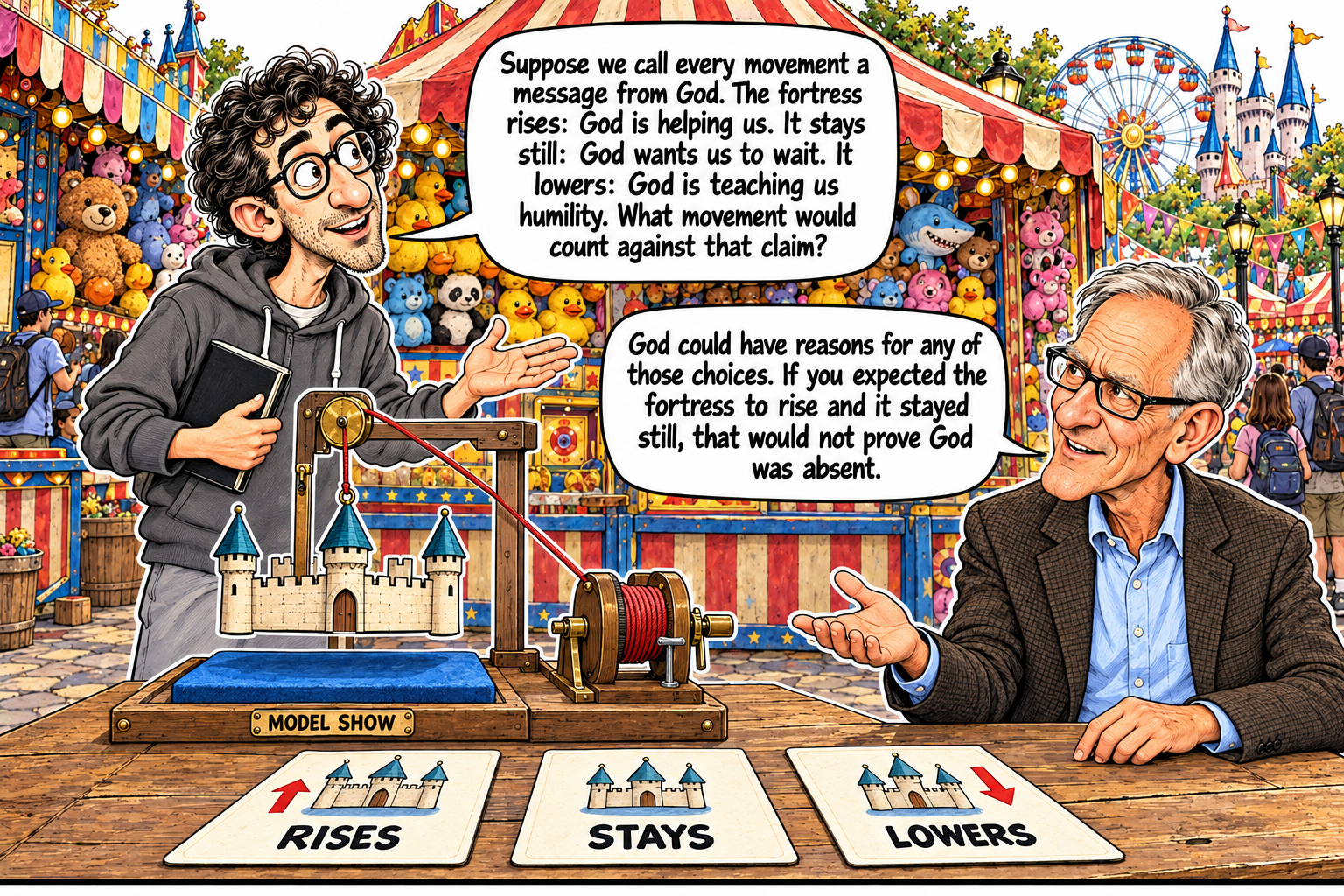
Scene 5: Three outcomes, three victories. Alex stands above-left of the demonstration while Greg sits or leans at the near counter on the right. Both hold open palms toward the discussion. Three foreground cards read RISES, STAYS and LOWERS with matching directions. The three-tower model hangs above its blue pad; the cord, pulley, locked drum and crank remain visible.
SCENE 05 / 16View / zoom image ↗
Read dialogue

Alex stands above-left of the demonstration while Greg sits or leans at the near counter on the right. Both hold open palms toward the discussion. Three foreground cards read RISES, STAYS and LOWERS with matching directions. The three-tower model hangs above its blue pad; the cord, pulley, locked drum and crank remain visible.

Alex: Suppose we call every movement a message from God. The fortress rises: God is helping us. It stays still: God wants us to wait. It lowers: God is teaching us humility. What movement would count against that claim?

Greg: God could have reasons for any of those choices. If you expected the fortress to rise and it stayed still, that would not prove God was absent.

Notes from the queue · 05

Three outcomes, three victories

Calling a stationary model a message to wait does not establish that anyone sent a message. The crank may simply have stopped.

A theory may permit several results and still favor some over others. The problem here is that no supported difference in expectation has been supplied.

A deeper dive

What the three cards expose

The hidden-power account can be kept consistent with every listed result by adding a suitable intention. If the only reason for choosing that intention is that it accommodates what happened, the explanation has not gained independent support. It has redescribed the outcome in language that preserves the favored conclusion.

This is more precise than saying that a claim allowing every possible result can never receive evidence. A probabilistic theory can allow many results while assigning them different expectations. Those differences can matter. The problem with the three approving stories is the absence of a defended comparison, not the bare fact that more than one result is possible.

What the defense establishes

Greg makes a sound point: an unexpected result does not logically prove that a purposeful agent is absent. Unknown intentions can explain why a real agent does something surprising. But there is a difference between identifying that possibility and establishing that a particular hidden intention actually explains this case.

Ruth asks for reasons that constrain the interpretation. Those reasons might come from independently credible commitments, repeated patterns or other evidence. Without them, the approving labels do not improve the argument. The conclusion is about the explanatory rule’s lack of added support, not a claim that the hidden-power hypothesis has been deductively disproved.

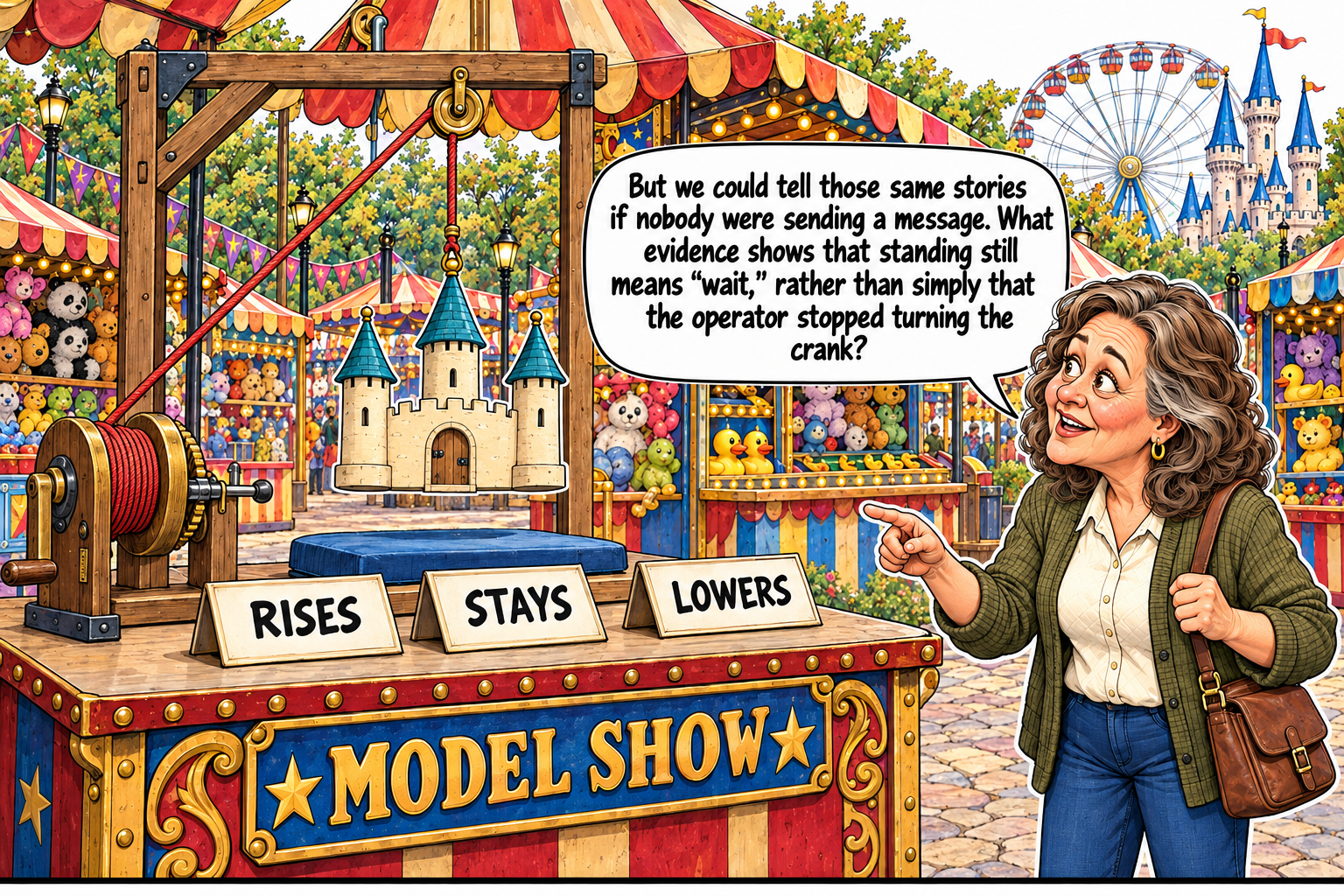
Scene 6: Why does stillness mean wait?. Ruth stands at right, holding her bag strap and pointing left above three cards labeled RISES, STAYS and LOWERS. The cream three-tower model remains suspended above its blue pad, with the red cord, brass pulley, stationary drum and crank visible. Her balloon asks why stillness should be interpreted as a message.
SCENE 06 / 16View / zoom image ↗
Read dialogue

Ruth stands at right, holding her bag strap and pointing left above three cards labeled RISES, STAYS and LOWERS. The cream three-tower model remains suspended above its blue pad, with the red cord, brass pulley, stationary drum and crank visible. Her balloon asks why stillness should be interpreted as a message.

Ruth: But we could tell those same stories if nobody were sending a message. What evidence shows that standing still means “wait,” rather than simply that the operator stopped turning the crank?

Notes from the queue · 06

Why does stillness mean wait?

Calling a stationary model a message to wait does not establish that anyone sent a message. The crank may simply have stopped.

A theory may permit several results and still favor some over others. The problem here is that no supported difference in expectation has been supplied.

A deeper dive

What the three cards expose

The hidden-power account can be kept consistent with every listed result by adding a suitable intention. If the only reason for choosing that intention is that it accommodates what happened, the explanation has not gained independent support. It has redescribed the outcome in language that preserves the favored conclusion.

This is more precise than saying that a claim allowing every possible result can never receive evidence. A probabilistic theory can allow many results while assigning them different expectations. Those differences can matter. The problem with the three approving stories is the absence of a defended comparison, not the bare fact that more than one result is possible.

What the defense establishes

Greg makes a sound point: an unexpected result does not logically prove that a purposeful agent is absent. Unknown intentions can explain why a real agent does something surprising. But there is a difference between identifying that possibility and establishing that a particular hidden intention actually explains this case.

Ruth asks for reasons that constrain the interpretation. Those reasons might come from independently credible commitments, repeated patterns or other evidence. Without them, the approving labels do not improve the argument. The conclusion is about the explanatory rule’s lack of added support, not a claim that the hidden-power hypothesis has been deductively disproved.

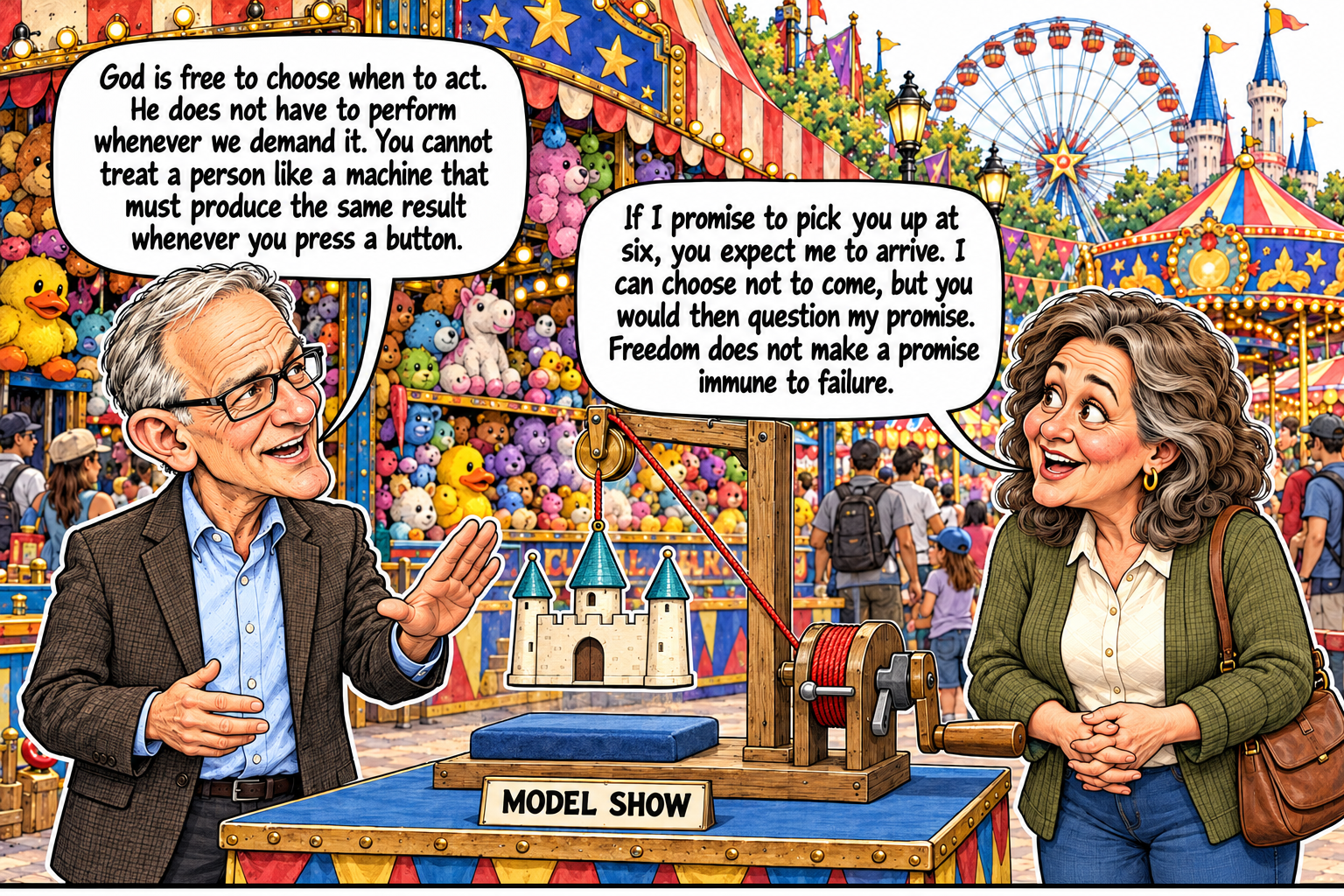
Scene 7: The operator is free. Greg raises an open palm beside the stationary model while Ruth stands opposite with her hands clasped. The three-tower castle hangs over the blue pad. Its red cord passes over one brass pulley to a crank with an engaged pin. Their balloons compare freedom to choose with the reliability of a promise.
SCENE 07 / 16View / zoom image ↗
Read dialogue

Greg raises an open palm beside the stationary model while Ruth stands opposite with her hands clasped. The three-tower castle hangs over the blue pad. Its red cord passes over one brass pulley to a crank with an engaged pin. Their balloons compare freedom to choose with the reliability of a promise.

Greg: God is free to choose when to act. He does not have to perform whenever we demand it. You cannot treat a person like a machine that must produce the same result whenever you press a button.

Ruth: If I promise to pick you up at six, you expect me to arrive. I can choose not to come, but you would then question my promise. Freedom does not make a promise immune to failure.

Notes from the queue · 07

The operator is free

A promise to pick someone up gives them a reason to expect a ride. The driver remains free to stay home, but that freedom does not make a missed pickup fulfillment of the promise.

If no relevant expectations can be justified, the public evidence claim must be correspondingly modest.

A deeper dive

A choice is not a random blank

If Ruth promises to pick someone up at six, she gives that person a reason to expect her arrival. A breakdown or emergency might explain her absence; further information might show that the promise had a condition the listener overlooked. But simply saying that Ruth was free to stay home would not show that she kept the promise. Being free and being answerable for what one promised are compatible.

The same logical distinction applies when a defender attributes character and purposes to God. A claim about a loving, communicative or promise-keeping agent purports to say something more specific than “anything whatsoever may happen.” The defender must explain which expectations follow and how strongly, rather than invoking freedom as a general exemption from comparison.

Mystery can limit both sides

A skeptic should not assume complete knowledge of divine reasons and declare every surprising outcome impossible under theism. Greg’s objection blocks that shortcut. Yet the defender cannot simultaneously insist that divine purposes are too obscure to constrain expectations and that a particular favorable result clearly demonstrates those purposes.

If the relevant intentions remain unspecified, uncertainty affects the positive claim as well as the objection. It may leave room for belief based on other reasons. What it cannot do by itself is turn an otherwise inconclusive public observation into strong support for a particular intervention or promise.

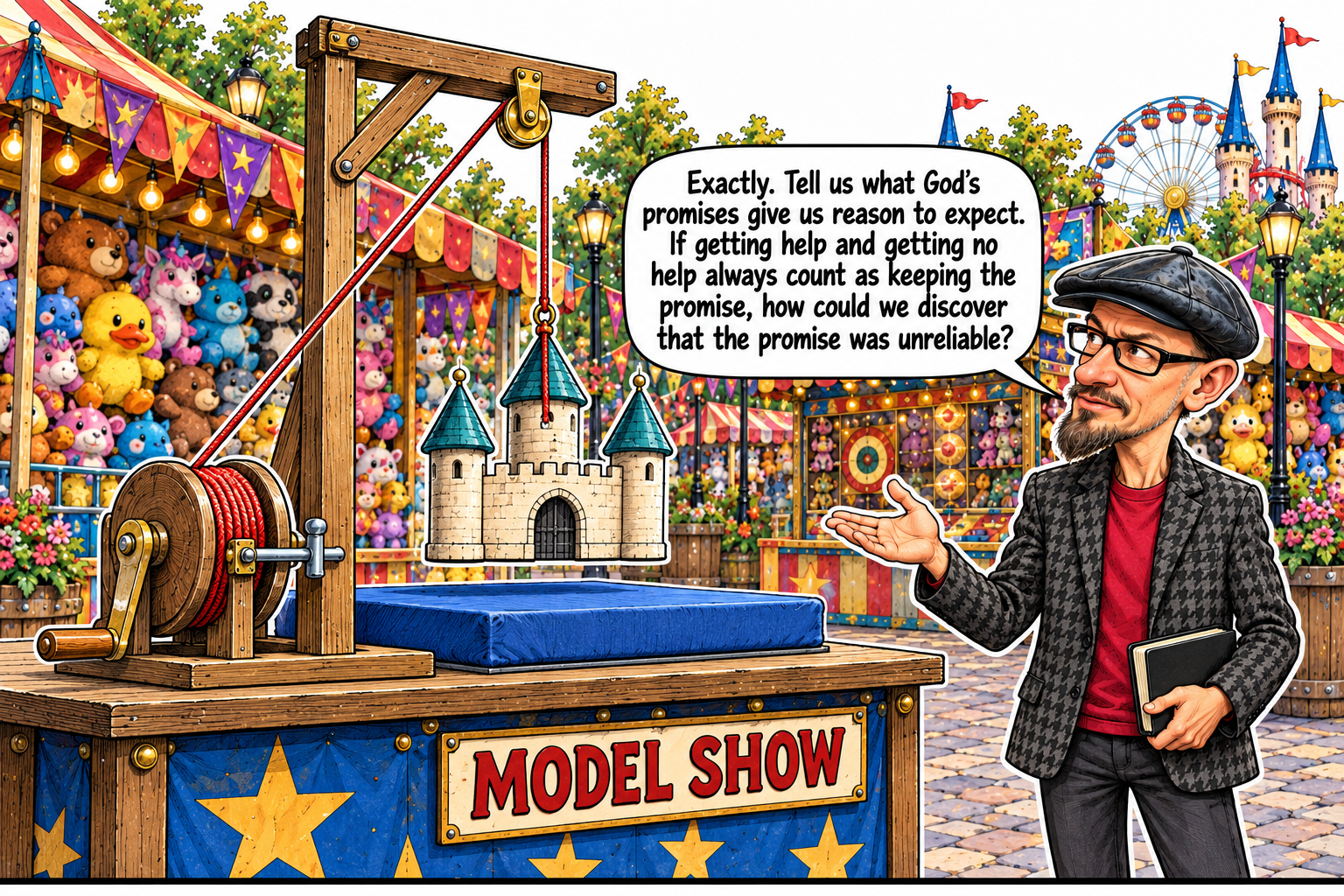
Scene 8: What would break the promise?. Phil stands at right holding his closed notebook and extending an open palm toward the model. The stationary three-tower castle hangs above a blue padded stand. One red cord is tied at its central roof eye and passes over the brass pulley to the locked drum at left. His balloon asks what would show that a promise was unreliable.
SCENE 08 / 16View / zoom image ↗
Read dialogue

Phil stands at right holding his closed notebook and extending an open palm toward the model. The stationary three-tower castle hangs above a blue padded stand. One red cord is tied at its central roof eye and passes over the brass pulley to the locked drum at left. His balloon asks what would show that a promise was unreliable.

Phil: Exactly. Tell us what God’s promises give us reason to expect. If getting help and getting no help always count as keeping the promise, how could we discover that the promise was unreliable?

Notes from the queue · 08

What would break the promise?

A promise to pick someone up gives them a reason to expect a ride. The driver remains free to stay home, but that freedom does not make a missed pickup fulfillment of the promise.

If no relevant expectations can be justified, the public evidence claim must be correspondingly modest.

A deeper dive

A choice is not a random blank

If Ruth promises to pick someone up at six, she gives that person a reason to expect her arrival. A breakdown or emergency might explain her absence; further information might show that the promise had a condition the listener overlooked. But simply saying that Ruth was free to stay home would not show that she kept the promise. Being free and being answerable for what one promised are compatible.

The same logical distinction applies when a defender attributes character and purposes to God. A claim about a loving, communicative or promise-keeping agent purports to say something more specific than “anything whatsoever may happen.” The defender must explain which expectations follow and how strongly, rather than invoking freedom as a general exemption from comparison.

Mystery can limit both sides

A skeptic should not assume complete knowledge of divine reasons and declare every surprising outcome impossible under theism. Greg’s objection blocks that shortcut. Yet the defender cannot simultaneously insist that divine purposes are too obscure to constrain expectations and that a particular favorable result clearly demonstrates those purposes.

If the relevant intentions remain unspecified, uncertainty affects the positive claim as well as the objection. It may leave room for belief based on other reasons. What it cannot do by itself is turn an otherwise inconclusive public observation into strong support for a particular intervention or promise.

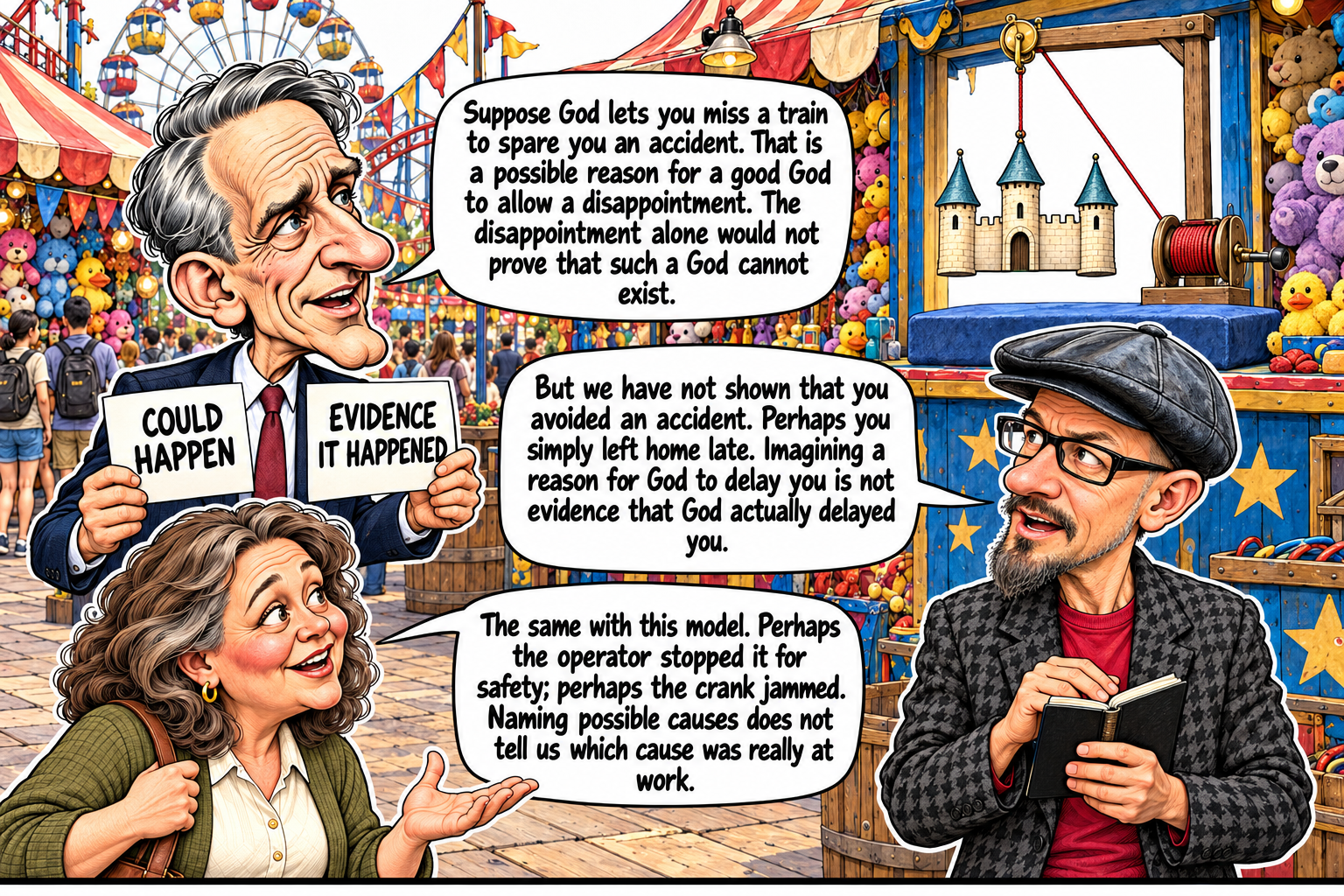
Scene 9: “Could” is not “did”. William holds separate cards labeled COULD HAPPEN and EVIDENCE IT HAPPENED. Phil holds his notebook slightly open while answering. Ruth grips her bag strap and presents an open palm. The three-tower model hangs motionless by one red cord above its blue pad.
SCENE 09 / 16View / zoom image ↗
Read dialogue

William holds separate cards labeled COULD HAPPEN and EVIDENCE IT HAPPENED. Phil holds his notebook slightly open while answering. Ruth grips her bag strap and presents an open palm. The three-tower model hangs motionless by one red cord above its blue pad.

William: Suppose God lets you miss a train to spare you an accident. That is a possible reason for a good God to allow a disappointment. The disappointment alone would not prove that such a God cannot exist.

Phil: But we have not shown that you avoided an accident. Perhaps you simply left home late. Imagining a reason for God to delay you is not evidence that God actually delayed you.

Ruth: The same with this model. Perhaps the operator stopped it for safety; perhaps the crank jammed. Naming possible causes does not tell us which cause was really at work.

Notes from the queue · 09

“Could” is not “did”

Perhaps the operator stopped the model to protect it; perhaps the crank jammed. Suggesting a possible reason does not establish which reason, if either, explains the stopped model.

Possibility, comparative likelihood and actual truth are different questions. A useful distinction should constrain both sides.

A deeper dive

What a possibility defense can accomplish

A claim of logical incompatibility is very strong: it says that the propositions cannot both be true. If a defender supplies a genuinely coherent possible situation in which both are true, that situation can defeat the incompatibility claim. It need not be demonstrated to be the actual situation.

The qualification “genuinely possible” matters. Merely pronouncing an unknown reason possible does not settle a dispute about whether it is coherent. But when the possibility is granted, the skeptic should recognize what follows: the specific contradiction argument has not succeeded.

What it cannot accomplish by itself

Perhaps a delay kept someone off a train that would have crashed; perhaps the person simply left home late. Suggesting the first possibility does not establish that a crash was avoided or that God caused the delay. Likewise, the operator might have stopped the model for safety, or the crank might have jammed. Naming possible causes does not identify the actual cause.

This distinction prevents a common change of question. Phil asks what supports an explanation; William describes how to defeat an impossibility objection. The answer may be sound while addressing a different burden. Ruth makes the fair result explicit: neither side should claim a victory larger than the argument has earned. Keeping an account possible is not the same achievement as grounding confidence in it.

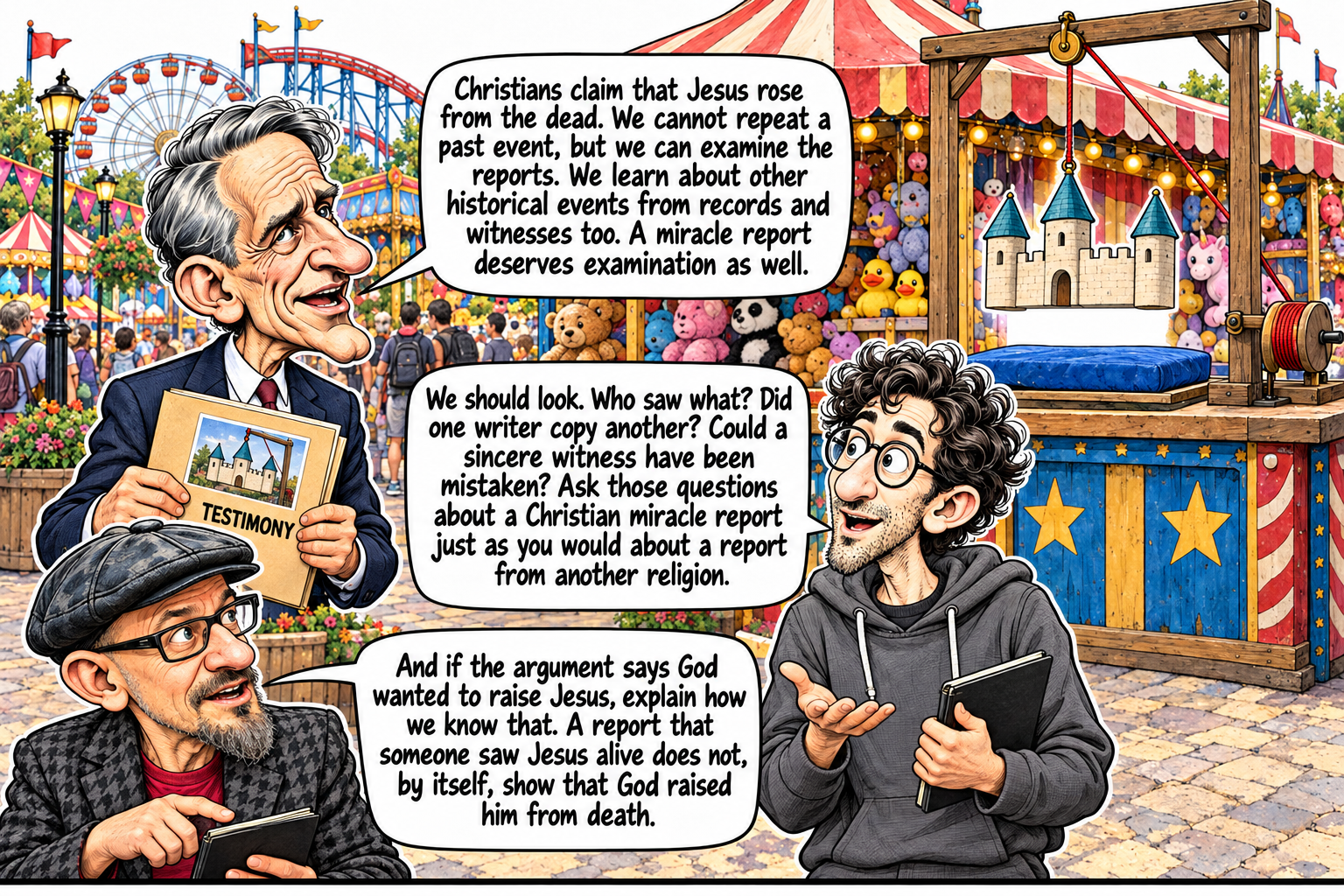
Scene 10: History can reach the ground. William holds a folder labeled TESTIMONY with a small photograph of the demonstration. Alex raises an open palm while holding a closed notebook; Phil rests an index finger on his own notebook. Behind them the three-tower castle hangs above its blue pad with the cord, pulley and drum visible.
SCENE 10 / 16View / zoom image ↗
Read dialogue

William holds a folder labeled TESTIMONY with a small photograph of the demonstration. Alex raises an open palm while holding a closed notebook; Phil rests an index finger on his own notebook. Behind them the three-tower castle hangs above its blue pad with the cord, pulley and drum visible.

William: Christians claim that Jesus rose from the dead. We cannot repeat a past event, but we can examine the reports. We learn about other historical events from records and witnesses too. A miracle report deserves examination as well.

Alex: We should look. Who saw what? Did one writer copy another? Could a sincere witness have been mistaken? Ask those questions about a Christian miracle report just as you would about a report from another religion.

Phil: And if the argument says God wanted to raise Jesus, explain how we know that. A report that someone saw Jesus alive does not, by itself, show that God raised him from death.

Notes from the queue · 10

History can reach the ground

The past can leave evidence even when an event cannot be repeated. The appropriate questions concern the record, its independence and the competing explanations.

A miracle argument may also depend on a background case about God and divine intentions. Those premises belong in the argument, where they can be assessed.

A deeper dive

Unrepeatable does not mean inaccessible

Historical inquiry concerns events that have already happened. We can assess documents, material traces, witness reports, dependence between accounts and the background conditions in which an event is alleged to have occurred. Repeating the original event is not a universal requirement for justified belief about it.

It would therefore be a mistake to exclude a miracle claim merely because it concerns a unique event. It would also be a mistake to treat the age or religious commitments of a source as automatically rendering its testimony worthless. Those features can affect evaluation, but they do not eliminate the need to assess the particular evidence.

The extra inference remains visible

Establishing that a report exists, that its author was sincere, that an unusual event happened and that a specific deity caused the event are different claims. Evidence for an earlier step may support a later step, but the connection needs an argument. Source dependence, ordinary alternatives and the relevant background assumptions all matter.

A defender can present a combined case in which prior reasons for theism affect how the historical record is interpreted. The skeptical demand is that those reasons be disclosed and assessed, with comparable scrutiny for favorable, adverse and rival evidence. This scene does not decide whether a complete resurrection argument succeeds. It rejects an exemption from comparison disguised as respect for history.

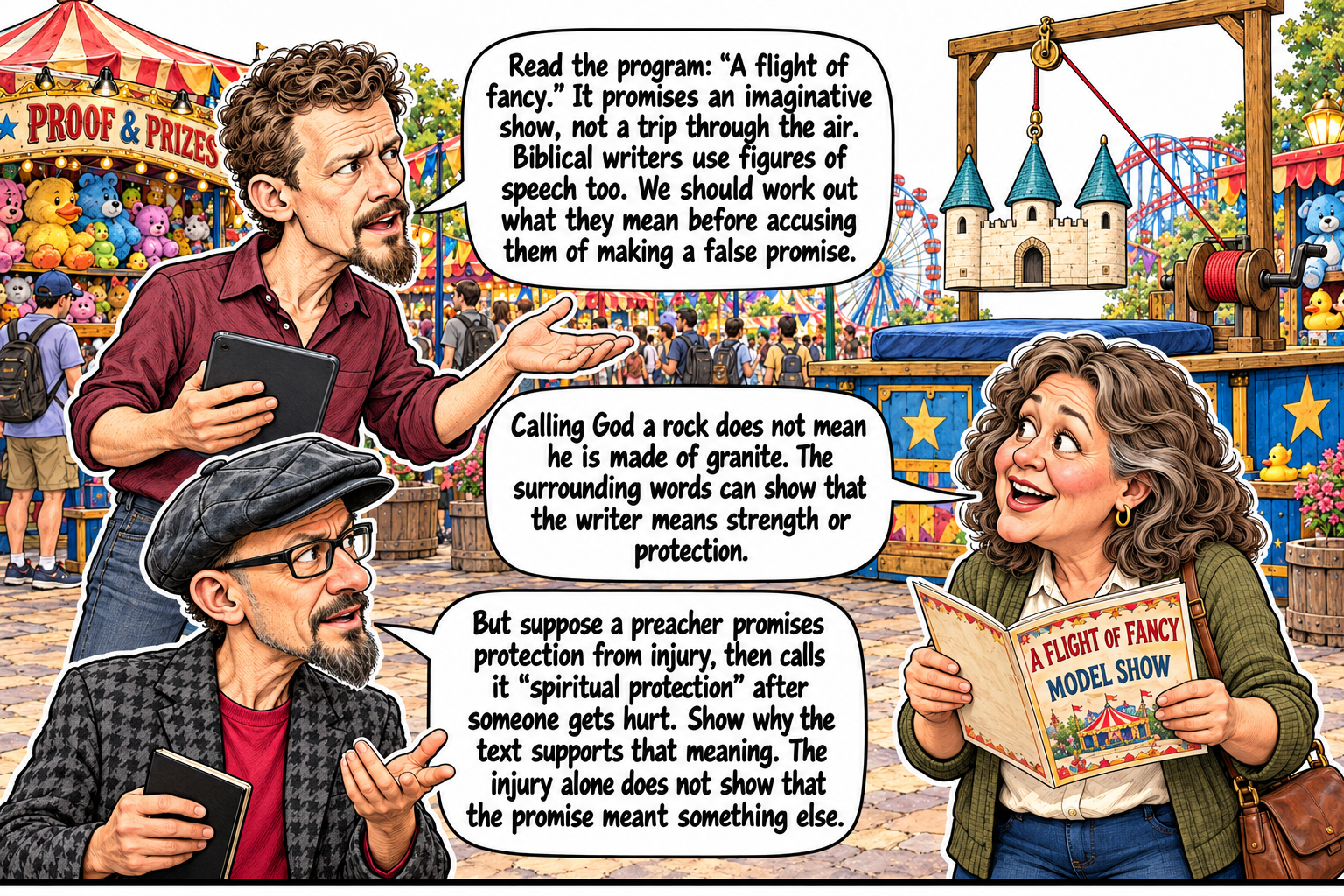
Scene 11: Context is allowed. Michael gestures with an open palm while holding his tablet. Ruth holds an open program marked A FLIGHT OF FANCY and MODEL SHOW. Phil holds a closed notebook and raises his free palm. Behind them, the three-tower castle hangs above its blue pad on a cord connected to the crank drum.
SCENE 11 / 16View / zoom image ↗
Read dialogue

Michael gestures with an open palm while holding his tablet. Ruth holds an open program marked A FLIGHT OF FANCY and MODEL SHOW. Phil holds a closed notebook and raises his free palm. Behind them, the three-tower castle hangs above its blue pad on a cord connected to the crank drum.

Michael: Read the program: “A flight of fancy.” It promises an imaginative show, not a trip through the air. Biblical writers use figures of speech too. We should work out what they mean before accusing them of making a false promise.

Ruth: Calling God a rock does not mean he is made of granite. The surrounding words can show that the writer means strength or protection.

Phil: But suppose a preacher promises protection from injury, then calls it “spiritual protection” after someone gets hurt. Show why the text supports that meaning. The injury alone does not show that the promise meant something else.

Notes from the queue · 11

Context is allowed

A figure of speech can be recognized from the surrounding words. The show program’s flight of fancy is not a promise of actual flight.

If protection from injury is later described as spiritual protection, the interpreter needs reasons for that reading. The fact that someone got hurt does not, by itself, establish a new meaning.

A deeper dive

Meaning comes before testing

Calling God a rock need not assert that God is made of stone. Surrounding words can show that the comparison concerns strength, shelter or reliability. Similarly, a theatrical program promising a flight of fancy need not advertise transportation. A criticism that ignores the intended meaning could manufacture a failed prediction that the speaker never made.

Michael therefore earns a real concession. Linguistic usage, genre, surrounding text, historical context and other independently supported considerations can justify a figurative reading. Neither nonbelief nor a preference for measurable evidence licenses ignoring those considerations.

A different interpretation needs reasons

Suppose a preacher uses a passage to promise freedom from physical injury. After someone is hurt, the preacher says that the passage promised only spiritual protection. The later reading might be correct, but the injury alone does not establish that reading. The preacher needs reasons from the language or context, and should acknowledge that the earlier physical assurance was mistaken.

An interpreter should explain why the reading fits the text and what the earlier presentation got wrong. The revised interpretation should apply consistently rather than switching back to the literal claim whenever a favorable example appears. This distinction concerns the function and support of the interpretation. It does not require accusing the interpreter of dishonesty or treating every metaphor as an escape route.

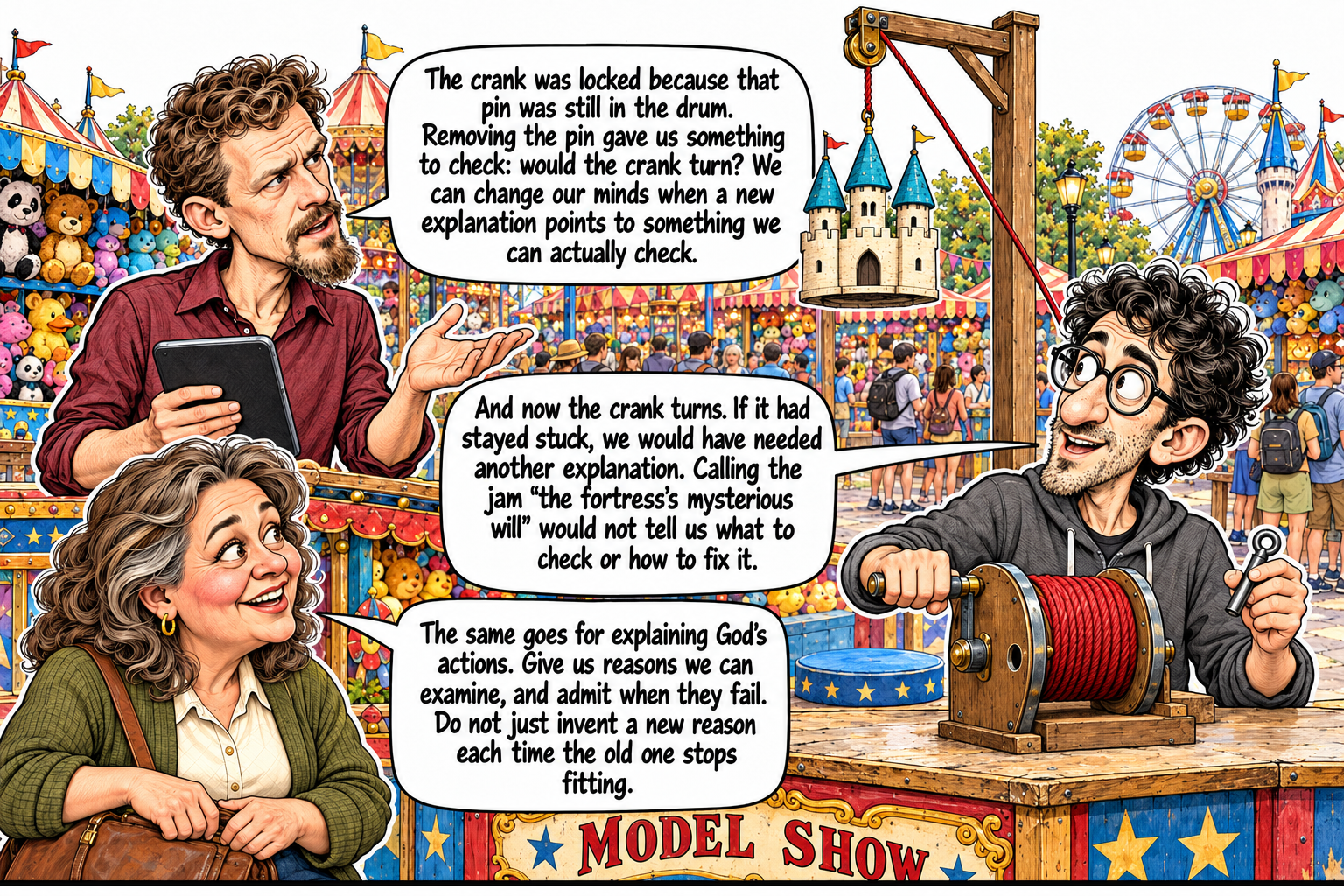
Scene 12: A repair that risks being wrong. Michael holds his tablet and opens one palm while Alex grips the foreground crank with his right hand and displays the removed locking pin in his left. Ruth rests her hands on her bag. The three-tower model hangs high above a blue landing cushion, with one cord over the pulley returning behind Alex to the drum.
SCENE 12 / 16View / zoom image ↗
Read dialogue

Michael holds his tablet and opens one palm while Alex grips the foreground crank with his right hand and displays the removed locking pin in his left. Ruth rests her hands on her bag. The three-tower model hangs high above a blue landing cushion, with one cord over the pulley returning behind Alex to the drum.

Michael: The crank was locked because that pin was still in the drum. Removing the pin gave us something to check: would the crank turn? We can change our minds when a new explanation points to something we can actually check.

Alex: And now the crank turns. If it had stayed stuck, we would have needed another explanation. Calling the jam “the fortress’s mysterious will” would not tell us what to check or how to fix it.

Ruth: The same goes for explaining God’s actions. Give us reasons we can examine, and admit when they fail. Do not just invent a new reason each time the old one stops fitting.

Notes from the queue · 12

A repair that risks being wrong

Removing the pin lets the crank turn. If it had remained stuck, the pin alone would not have explained the problem. This is a correction with a consequence someone can check.

The toy’s successful repair illustrates an independently checkable account. It does not reduce all theological inquiry to mechanical troubleshooting.

A deeper dive

Learning usually starts with a problem

A failed expectation can reveal a mistaken assumption. Revising that assumption is not inherently dishonest or irrational. An explanation developed after an observation can receive support when it connects to other evidence, improves understanding or leads to consequences that can be checked independently of the initial difficulty.

The locking pin illustrates this structure. It is a visible part of the mechanism. Removing it should permit movement if the diagnosis is sufficient. If movement remains impossible, another problem must be considered. The explanation makes itself answerable to something beyond its own ability to describe the original failure.

The calendar is not the test

A qualification stated before a result can still be empty if it permits every result to count as success. Conversely, a qualification discovered afterward can be legitimate. The relevant questions concern independent support, the expectations it constrains, its treatment of contrary evidence and whether it changes the original claim.

The same discipline should apply to skeptics. An ordinary explanation cannot be rescued indefinitely with unsupported adjustments while religious explanations are criticized for doing the same. The target is a method of protecting a favored conclusion from evidential loss, whoever uses it. The scene offers a concrete example of accountable learning, not a rule that theology must become a branch of engineering.

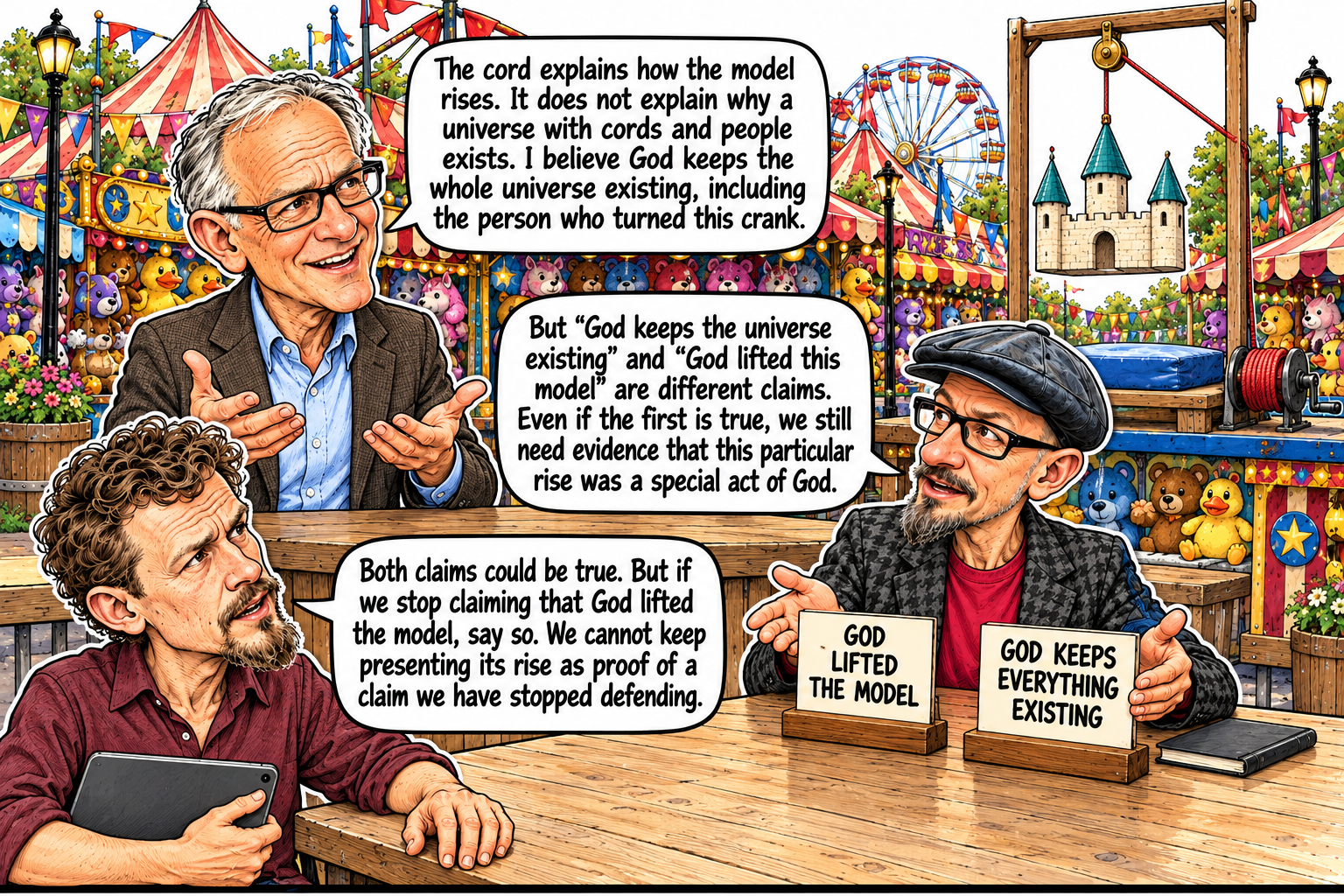
Scene 13: Keep the claim on the table. Greg, Phil and Michael discuss two cards on the counter: GOD LIFTED THE MODEL and GOD KEEPS EVERYTHING EXISTING. Greg opens both palms; Phil presents the cards while his closed notebook lies nearby. Michael holds a tablet and rests his other hand on the counter. The three-tower castle hangs above its blue pad behind them.
SCENE 13 / 16View / zoom image ↗
Read dialogue

Greg, Phil and Michael discuss two cards on the counter: GOD LIFTED THE MODEL and GOD KEEPS EVERYTHING EXISTING. Greg opens both palms; Phil presents the cards while his closed notebook lies nearby. Michael holds a tablet and rests his other hand on the counter. The three-tower castle hangs above its blue pad behind them.

Greg: The cord explains how the model rises. It does not explain why a universe with cords and people exists. I believe God keeps the whole universe existing, including the person who turned this crank.

Phil: But “God keeps the universe existing” and “God lifted this model” are different claims. Even if the first is true, we still need evidence that this particular rise was a special act of God.

Michael: Both claims could be true. But if we stop claiming that God lifted the model, say so. We cannot keep presenting its rise as proof of a claim we have stopped defending.

Notes from the queue · 13

Keep the claim on the table

The claim that God keeps the universe existing does not, by itself, show that God specially raised this model. The model’s rise requires its own explanation.

The two claims could both be true. A defense still has to say which claim it supports and what evidence supports it.

A deeper dive

Different levels of explanation can coexist

Greg correctly observes that describing a mechanism does not logically settle every question about why a world with such mechanisms exists. A person could accept the cord’s role in lifting the model and also defend a metaphysical claim about the ultimate dependence of reality. Those assertions are not automatically contradictory.

But coexistence is not confirmation. A specific intervention claim says something about why this particular event occurred rather than an alternative. A general claim that God sustains existence has a different subject and may be intended to hold whichever particular event occurs. Evidence relevant to one does not automatically establish the other.

Account for what changed

The problem arises when a concrete event is advertised as evidence for divine agency, the inference is challenged, and a less specific conception of God is offered as though it had preserved the original evidential case. The revised view may be coherent and may have independent arguments in its favor. Merely changing the subject of the claim supplies none of those arguments.

An honest revision states what was withdrawn, what is still asserted and what supports the remaining view. If the specific intervention retains independent support, present it. If it does not, the broader metaphysical possibility cannot restore that missing support by definition. The criticism concerns an unearned transfer of authority, not the existence of abstract theology or the discovery of ordinary mechanisms.

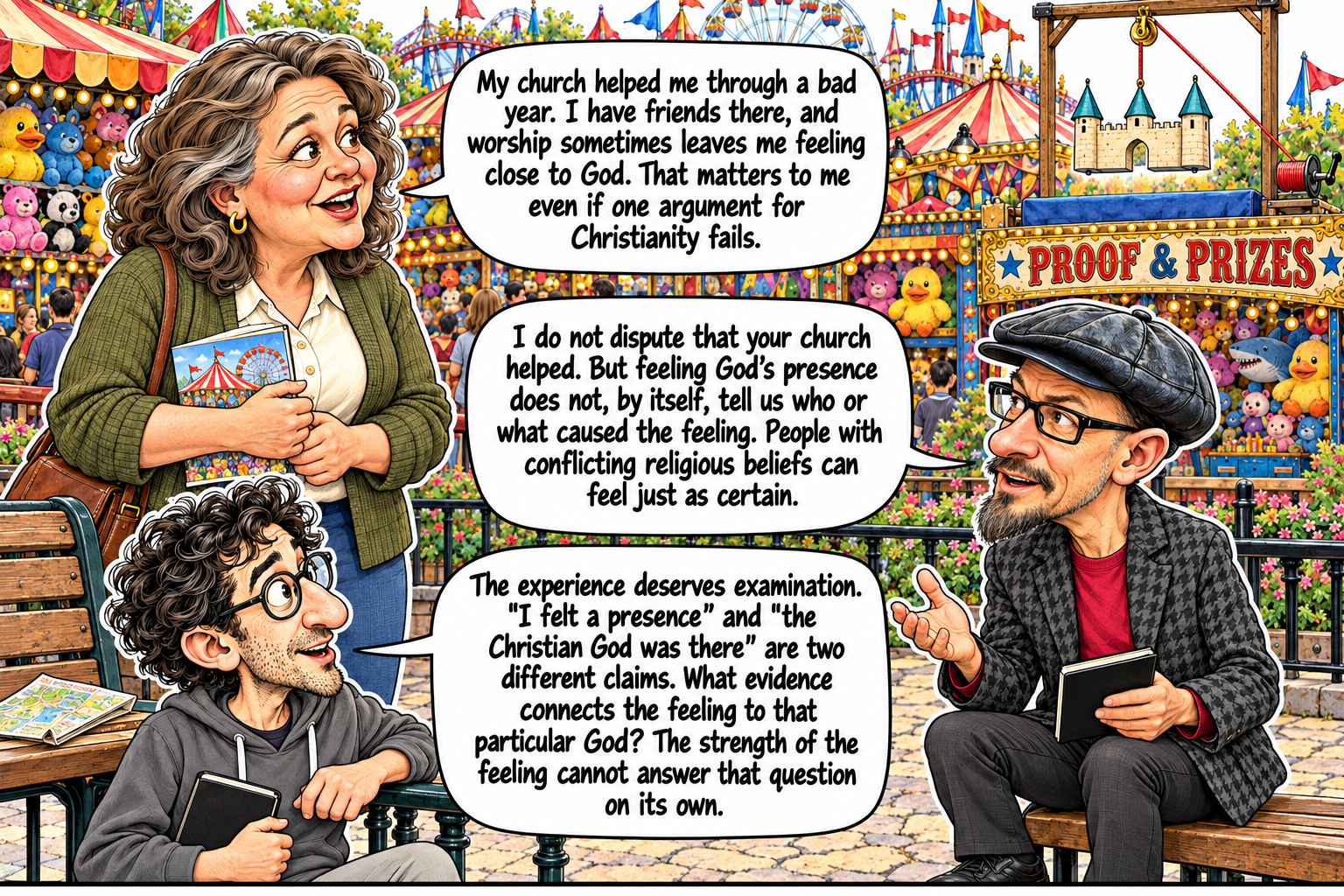
Scene 14: The feeling and its cause. Ruth holds her closed park program while describing her church. Phil sits to the right with a closed notebook and an open palm. Alex rests beside the rail, holding his closed notebook. A folded map lies on the left bench. Across the path, the three-tower model remains suspended over its blue pad above the Proof & Prizes booth.
SCENE 14 / 16View / zoom image ↗
Read dialogue

Ruth holds her closed park program while describing her church. Phil sits to the right with a closed notebook and an open palm. Alex rests beside the rail, holding his closed notebook. A folded map lies on the left bench. Across the path, the three-tower model remains suspended over its blue pad above the Proof & Prizes booth.

Ruth: My church helped me through a bad year. I have friends there, and worship sometimes leaves me feeling close to God. That matters to me even if one argument for Christianity fails.

Phil: I do not dispute that your church helped. But feeling God’s presence does not, by itself, tell us who or what caused the feeling. People with conflicting religious beliefs can feel just as certain.

Alex: The experience deserves examination. “I felt a presence” and “the Christian God was there” are two different claims. What evidence connects the feeling to that particular God? The strength of the feeling cannot answer that question on its own.

Notes from the queue · 14

The feeling and its cause

Ruth’s church helped her through a difficult year. That benefit need not settle what caused her feeling of closeness to God.

A strong experience deserves attention. Identifying it as the presence of a particular God is a further claim that needs reasons.

A deeper dive

Value and truth ask different questions

Ruth describes help from her church, friendships and a feeling of closeness to God during worship. Those are distinct things to assess. The help and friendships can be real without settling what caused the feeling. Accepting the benefits does not require accepting a supernatural explanation, and disputing that explanation does not erase the benefits.

Ruth also distinguishes the failure of one argument from the collapse of all her reasons. That is fair. A person may have experiences or background commitments that have not been addressed by a particular public debate. The conclusion should remain limited to the reasons actually examined.

An experience is not its interpretation

An experience can provide evidence. Its force depends partly on what happened, how reliably it is remembered and which explanations fit it. An experience interpreted as divine communication does not come with its supernatural cause already established. Comparable experiences interpreted within rival traditions make the need for comparison especially clear.

This does not entail that all experiences are equivalent or that none could justify a religious conclusion. It does mean that strong public claims require more than an invitation to adopt another person’s certainty. A believer can acknowledge that an experience remains personally persuasive while its proposed explanation has not been publicly established. The skeptical criticism concerns overstating that public reach, not erasing the person’s experience.

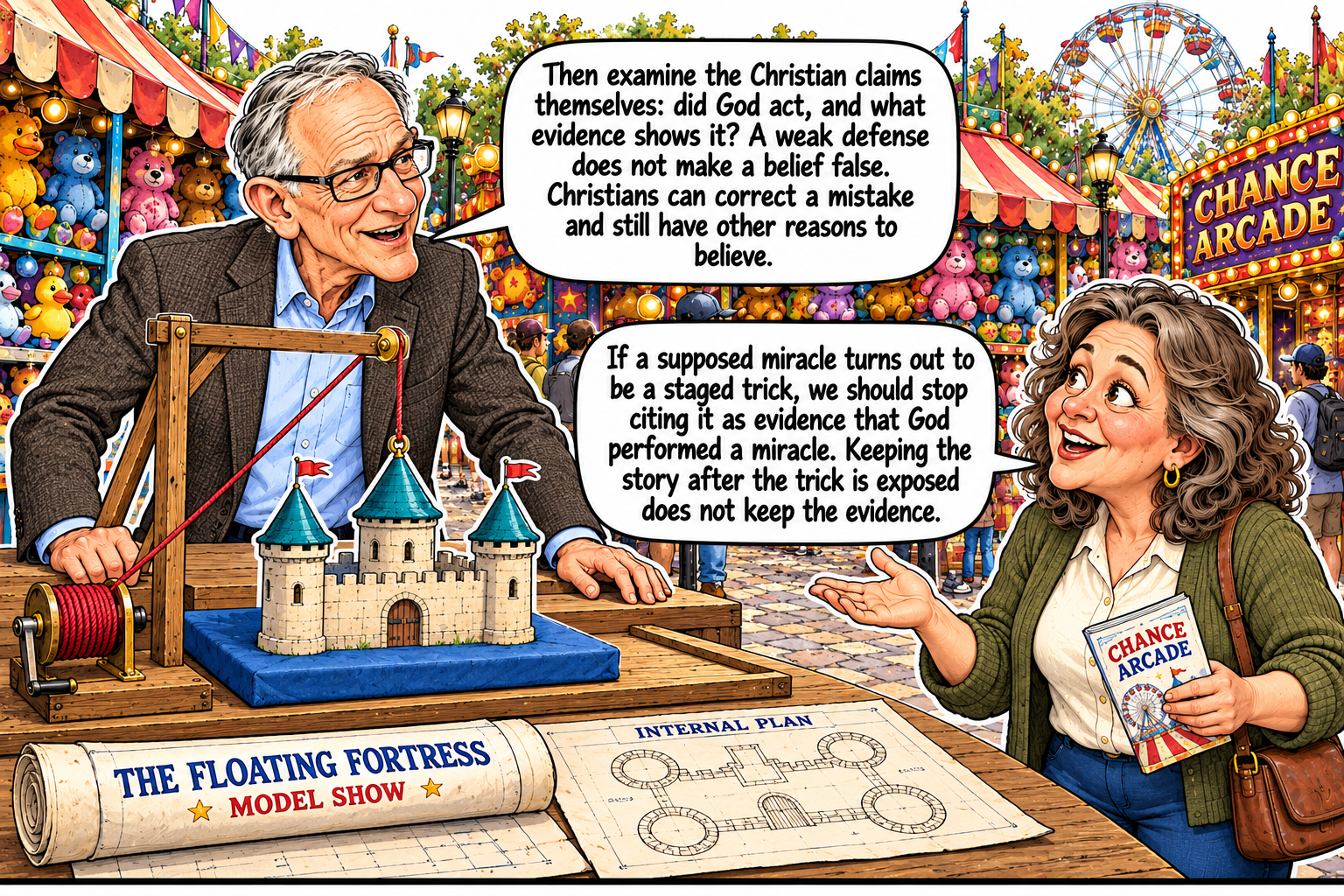
Scene 15: Permission to land. Greg rests both hands on the counter while Ruth holds her program and opens her other palm. The intact three-tower model rests on a blue pad, with its attached cord passing over the pulley to the stationary drum. A partly rolled plan in the foreground carries INTERNAL PLAN and THE FLOATING FORTRESS / MODEL SHOW labels.
SCENE 15 / 16View / zoom image ↗
Read dialogue

Greg rests both hands on the counter while Ruth holds her program and opens her other palm. The intact three-tower model rests on a blue pad, with its attached cord passing over the pulley to the stationary drum. A partly rolled plan in the foreground carries INTERNAL PLAN and THE FLOATING FORTRESS / MODEL SHOW labels.

Greg: Then examine the Christian claims themselves: did God act, and what evidence shows it? A weak defense does not make a belief false. Christians can correct a mistake and still have other reasons to believe.

Ruth: If a supposed miracle turns out to be a staged trick, we should stop citing it as evidence that God performed a miracle. Keeping the story after the trick is exposed does not keep the evidence.

Notes from the queue · 15

Permission to land

A story can fit together without being true. A suggested excuse can be possible without being the actual explanation. Changing a claim does not show that the earlier claim was correct.

Responsible inquiry permits confidence to rise or fall, acknowledges changed claims and applies the same standards to favored explanations and their rivals.

A deeper dive

A limited conclusion can still be demanding

The skeptical argument does not need to show that every Christian claim is false. It identifies a failure in a particular way of defending claims: when the offered evidence lacks the required connection and a rescue adds none, the advertised conclusion remains unsupported by that package. Changing the wording or showing that the conclusion is still possible does not repair the missing inference.

Greg’s final challenge is therefore appropriate. A bad defense does not entail a false belief, and a revised explanation may earn support through independent reasons. The critic must evaluate those reasons rather than declare the case closed because a caricature has landed a joke.

What keeps an explanation grounded

An accountable explanation states what it claims, identifies relevant alternatives and admits what would weaken it. If an interpretation changes, it says what was surrendered and what still has support. These practices leave room for uncertainty, long-term commitment and disagreement without treating every result as victory.

The standard is reciprocal. A skeptical or nonreligious explanation also fails when it survives only by inventing a new unsupported exception for each difficulty. The final question is about contact with the world: what allows evidence to change the argument? A system can remain beautiful, meaningful and coherent while the answer is missing. Its impressive architecture does not fill that gap.

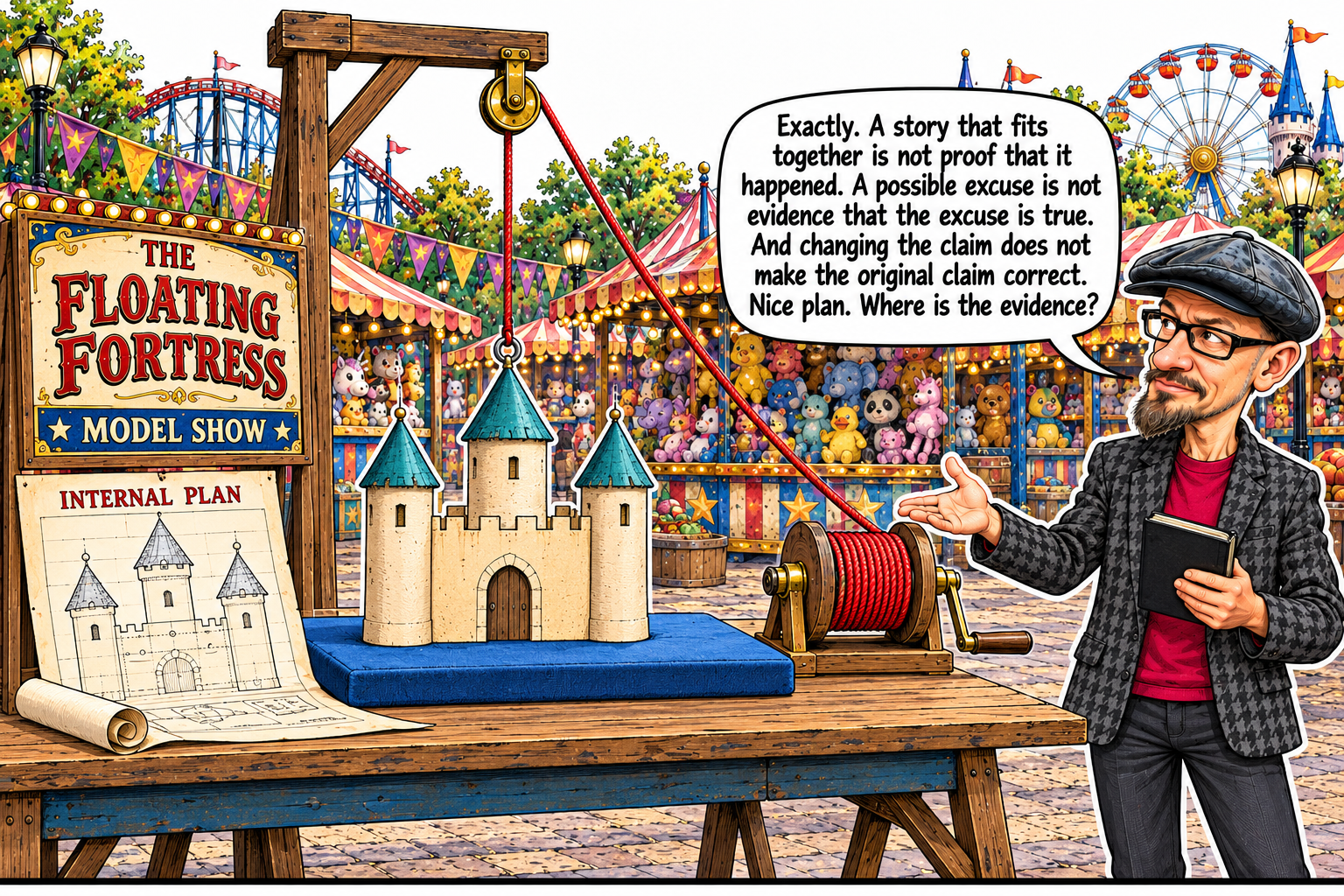
Scene 16: Where is the evidence?. Phil stands at the right, holding a closed black notebook and opening his other palm toward the display. The plain three-tower model rests directly on a blue pad. A single cord runs from its center roof over the pulley to the drum on the right. The partly rolled INTERNAL PLAN leans against the display at the left, below THE FLOATING FORTRESS / MODEL SHOW sign.
SCENE 16 / 16View / zoom image ↗
Read dialogue

Phil stands at the right, holding a closed black notebook and opening his other palm toward the display. The plain three-tower model rests directly on a blue pad. A single cord runs from its center roof over the pulley to the drum on the right. The partly rolled INTERNAL PLAN leans against the display at the left, below THE FLOATING FORTRESS / MODEL SHOW sign.

Phil: Exactly. A story that fits together is not proof that it happened. A possible excuse is not evidence that the excuse is true. And changing the claim does not make the original claim correct. Nice plan. Where is the evidence?

Notes from the queue · 16

Where is the evidence?

A story can fit together without being true. A suggested excuse can be possible without being the actual explanation. Changing a claim does not show that the earlier claim was correct.

Responsible inquiry permits confidence to rise or fall, acknowledges changed claims and applies the same standards to favored explanations and their rivals.

A deeper dive

A limited conclusion can still be demanding

The skeptical argument does not need to show that every Christian claim is false. It identifies a failure in a particular way of defending claims: when the offered evidence lacks the required connection and a rescue adds none, the advertised conclusion remains unsupported by that package. Changing the wording or showing that the conclusion is still possible does not repair the missing inference.

Greg’s final challenge is therefore appropriate. A bad defense does not entail a false belief, and a revised explanation may earn support through independent reasons. The critic must evaluate those reasons rather than declare the case closed because a caricature has landed a joke.

What keeps an explanation grounded

An accountable explanation states what it claims, identifies relevant alternatives and admits what would weaken it. If an interpretation changes, it says what was surrendered and what still has support. These practices leave room for uncertainty, long-term commitment and disagreement without treating every result as victory.

The standard is reciprocal. A skeptical or nonreligious explanation also fails when it survives only by inventing a new unsupported exception for each difficulty. The final question is about contact with the world: what allows evidence to change the argument? A system can remain beautiful, meaningful and coherent while the answer is missing. Its impressive architecture does not fill that gap.

After the ride · The skeptical case & private feedbackWhat Would Make the Fortress Touch the Ground?Open the article and feedback formClose the article and feedback form 7 min read

An elaborate belief system can be an intellectual achievement. Its distinctions may be careful, its interpretations subtle, its implications worked out across generations. None of that is trivial. None of it, by itself, establishes that the system describes something beyond its own assumptions. A magnificent plan is still a plan. The question is what connects it to the world.

The skeptical objection is strongest when it stays with that question. It need not caricature every Christian as afraid of evidence or pretend that every meaningful statement belongs in a laboratory. It asks something narrower and harder to evade: when a theological claim is offered as evidence about what happened, what makes the offered reasons favor that claim over relevant alternatives?

A consistent story has not yet earned an address

Internal consistency concerns how a set of claims fits together. Correspondence concerns whether those claims describe reality. The first can contribute to the second, because a contradictory account has a serious problem. But avoiding contradiction does not uniquely identify a true account. Incompatible descriptions can each be internally orderly. The missing work lies in evaluating their premises and their connection to what we can learn.

This is why the number of footnotes or the intricacy of an interpretive system cannot settle its external claims. Those details may contain valuable arguments; they must be examined. Their sheer existence is not a substitute for that examination. Complexity does not become evidence simply because it makes criticism time-consuming.

The same point applies to skepticism. A consistent nonreligious worldview still needs support for its positive claims. The objection does not award truth to whichever camp has the shorter manual. It denies either camp an exemption from defending the connecting steps.

An explanation must do more than survive the result

Suppose a defender says that an observation supports divine action. The essential question is why that observation is more expected if the proposed action occurred than under a relevant alternative. A claim that God could produce the observation establishes compatibility. It does not yet establish the comparative support being advertised.

That comparison can be qualitative. We need not invent precise probabilities where none are justified. Historical reliability, independent corroboration, background knowledge and a constrained account of an agent’s purposes can all matter. But where the comparison has not been established, it remains unestablished. Ignorance does not assign equal odds, and rhetorical confidence does not supply the missing numbers.

Now consider a rule that calls a favorable outcome confirmation, an unfavorable one a concealed benefit, and no visible change a lesson in patience. Each story might be possible. If nothing independently supports the selection, however, the rule has added no reason to prefer the favored explanation. It has given every exit a sign pointing back to the entrance.

The problem is not that the account allows multiple outcomes. A probabilistic explanation can allow every outcome while expecting some much more strongly than others. The problem is a defense that supplies no supported differences while claiming credit for whatever occurs. Survival under that rule is cheap; explanatory support is what remains unpaid.

Mystery can preserve a possibility without proving a cause

A Christian can reasonably object that a free God would not operate like a vending machine. An agent may have reasons we do not understand. A surprising result therefore need not be logically incompatible with divine action. Where a genuine possible reason defeats a claimed contradiction, the critic should concede that point.

But defeating an impossibility objection and supplying evidence for an explanation are different achievements. Showing that an account could be true does not identify it as the actual cause or establish that the evidence favors it. A possible hidden intention cannot do all three jobs merely because it is convenient.

Nor can divine freedom make character and promises evidentially useful only when the outcome is favorable. We form limited, revisable expectations about free agents precisely because their stated intentions and observed conduct can tell us something. If divine reasons are too unspecified to justify any relevant expectation, that uncertainty limits the positive public claim as well as the skeptical objection. Mystery is not a one-way valve for confidence.

History and interpretation deserve real scrutiny

A unique historical event does not have to be recreated before evidence can support it. Testimony, documents and surviving traces can justify beliefs about the past. A miracle should not be rejected merely by definition, and an ancient religious source should not be treated as worthless merely because it is ancient or religious.

The particular inference still matters. A sincere report, an unusual occurrence and a specific divine cause are different conclusions. The argument must explain how the evidence supports each step, how dependent accounts are handled and how alternatives compare. If a strong background theology is needed to make the historical conclusion persuasive, that theology belongs in the public argument rather than behind its curtain.

Interpretation also deserves a fair hearing. Poetry, metaphor and historical context can overturn a naive literal reading. A text should be assessed according to what there is reason to think it means. The defect begins when a meaning is selected solely because it absorbs the latest failure, then the older, stronger meaning returns when a favorable story is available. Context can constrain a reading; an unrestricted rescue simply keeps it out of reach.

Revision should disclose what it has given up

Changing an account after a problem is often how inquiry improves. A late explanation can be well supported; an early escape clause can be empty. The useful tests concern independent reasons, further consequences, consistent standards and whether the new account still says what the original account said.

Suppose a concrete intervention claim becomes a claim that God sustains existence as a whole. The broader view may be serious metaphysics. An ordinary causal mechanism does not by itself disprove it, and the two claims could coexist. Yet that broader possibility does not restore missing evidence for the specific intervention. The argument has changed, and the support must be assessed accordingly.

Likewise, a physical promise may become a statement about inner transformation, or a present verification claim may be deferred beyond present experience. The revised belief may retain meaning and might be true. What it cannot do is silently inherit the evidential authority of a claim it no longer makes. A future possibility of verification is not current confirmation. Intellectual honesty here requires an account of the content that changed, not a louder declaration that nothing important was lost.

Meaning does not settle the external explanation

Religious practice can provide community and comfort. Experiences interpreted religiously can matter deeply and may be relevant evidence. Those concessions do not establish a supernatural interpretation, just as disputing that interpretation does not erase the experience or its value. Rival interpretations should be compared rather than settled by the intensity of conviction.

A person can remain privately persuaded while recognizing that a public argument has failed to establish its conclusion. That is a limit on the reach of the reasons offered, not a verdict that the person is insincere or that every possible God-concept is false. The skeptical demand is to state the limit plainly.

Let evidence change the altitude

The constructive requirement is simple to state and demanding to practice: specify the claim, explain the comparison, identify reasons for qualifications and allow adverse evidence to reduce confidence. When the claim changes, say so. Apply the same scrutiny to ordinary explanations and religious ones, to one’s own tradition and to its rivals.

These practices do not guarantee agreement or demand abandonment at the first anomaly. They distinguish a belief that can learn from a defense that treats every result as protection for the same conclusion. If the offered record supplies no adequate support and the rescue supplies none, the combined argument remains inadequate. Its possible truth does not make that argument successful.

The fortress may be beautiful. Its occupants may be thoughtful, its rooms coherent, its view consoling. Those qualities cannot carry the public claim across the gap. An argument that asks for confidence about reality must accept correction from reality. Until it does, altitude should not be mistaken for support.

A private note

What did you think?

Have a question, correction or suggestion? Send it privately to Phil. Your message will not appear on this site.

After the ride · The skeptical case

Keep the questions coming.

Open original size ↗

Choose Zoom in for full-size lettering.

Read dialogue

A deeper dive