







A promise earns its force by letting someone expect something. When the requested help arrives, that expectation may be met. When it does not, there is something to explain. A promise that takes credit for both outcomes while permitting neither to count against it has acquired a remarkable privilege: it receives the authority of a guarantee without accepting the possibility of failure.
That is the target of this criticism. It is not every prayer, every Christian interpretation, or every possible divine act. It is the public assurance of dependable intervention followed by explanations that protect the assurance from any unfavorable result. The distinction matters because a modest claim can be coherent while the much stronger claim used to recruit confidence remains unsupported.
Begin with what was actually requested
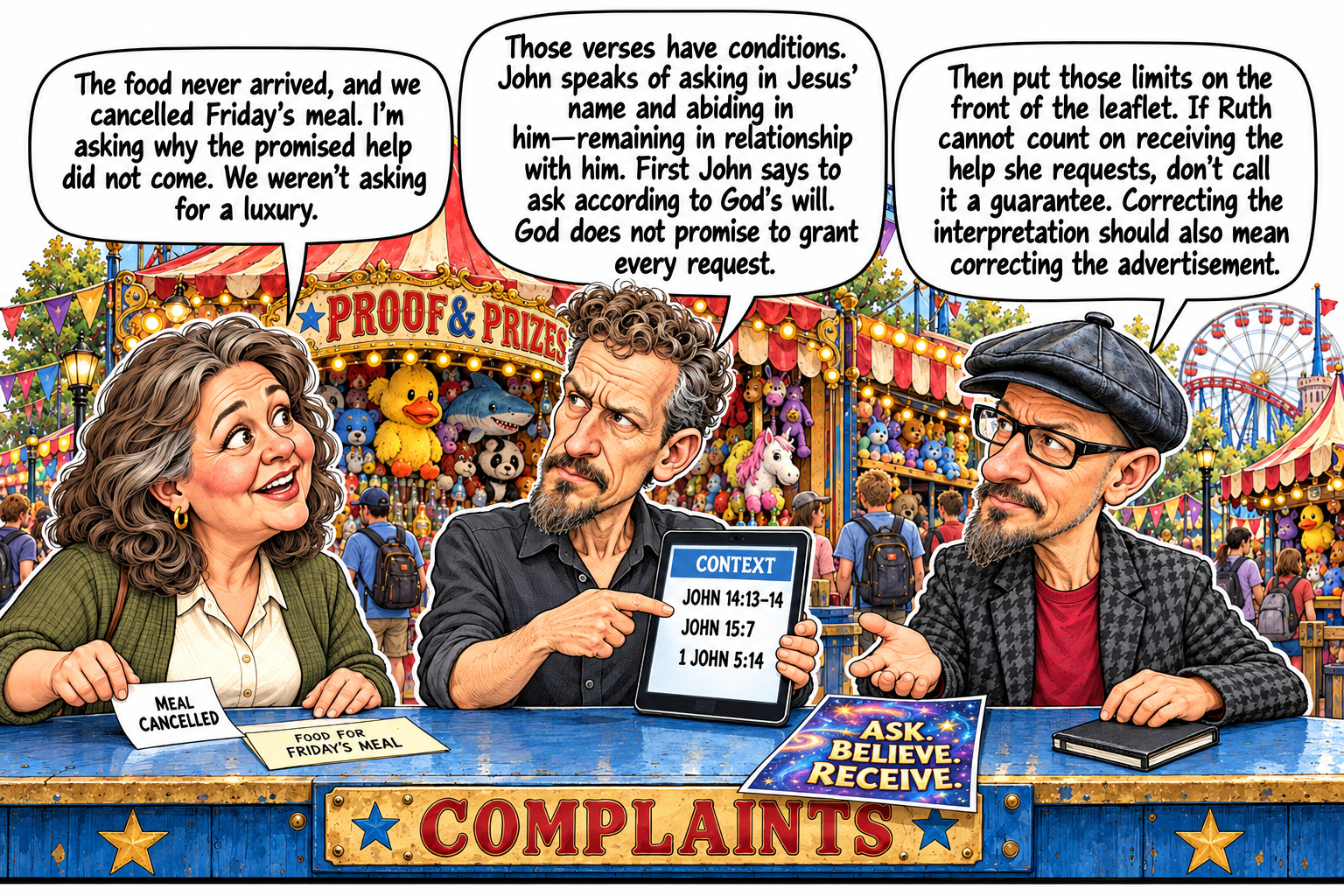
Ruth asked for food for a particular meal. That description does not establish that God owed her the food. It establishes what would count as receiving the thing she requested. The meal was cancelled. Her volunteers also supported one another. Both statements can be true, and neither needs to be erased to protect the other.
The basic discipline is to keep three things separate: the request, the observed result, and the explanation. If the request is silently rewritten after the result, assessment becomes impossible. Food becomes patience; rescue becomes endurance; an answer to a request becomes any experience that can be described as spiritually useful. Those experiences may have value. Their value does not show that the original request was fulfilled.
The booth exaggerates this confusion in commercial language. God need not be a shopkeeper for a public assurance to require clarity. Ordinary relationships contain promises, conditions and refusals too. The issue is what people are encouraged to rely on, not whether prayer can be turned into a sales contract.
Context belongs at the entrance
The Christian objection to a blank-check reading is substantial. Matthew joins receiving with belief and compares divine care with good parental gifts. John connects asking with Jesus’ name and with abiding in him. First John expressly invokes God’s will. The Lord’s Prayer joins the request for daily bread with submission to divine will, and Jesus’ prayer in Gethsemane likewise expresses submission. A critic who deletes those conditions has made the opposing position easier to attack by changing it.
But acknowledging context does not settle whether a particular invitation was honest about its strength. If the operative teaching assures no particular material result, say that when encouraging someone to expect help. Do not obtain confidence through expansive language and then treat the disappointed person as foolish for having believed it.
A later correction can be intellectually responsible. New reflection can reveal a better interpretation, and a condition is not false merely because someone notices it late. The responsible response is to correct the assurance as well as the reading. A weaker claim cannot inherit the stronger claim’s credibility simply because the same religious vocabulary surrounds both.
A divine plan could include prayer
It is too quick to argue that prayer must be causally idle because God acts according to a plan. A plan can include an outcome and the means by which it comes about. A Christian can therefore propose that God intends a result in response to a prayer. The existence of a plan alone does not eliminate that possible causal role.
The harder question is how that role is established. If a result occurs, the prayer is declared aligned with God’s will; if it does not, the prayer is declared misaligned. When the result is the only basis for identifying the condition, the condition supplies no independent explanation of the result. The interpretation follows events wherever they go.
Independent reasons could matter. A theology might defend particular conditions, or evidence might favor a specified pattern of intervention. Those possibilities remain open to examination. What does not do the work is an account whose entire evidential content is that whatever happened must have been what was intended. A possible divine explanation is still a possible explanation, not an earned guarantee.
The better gift needs a reason to be called better
A wise parent can refuse a harmful request. That is a good reply to the claim that love requires granting every wish. It is a poor shortcut to the claim that every refusal is loving. The first proposition concerns some justified refusals; the second assigns a favorable verdict before the relevant reasons are known.
Basic needs make the gap especially clear. Nourishment ordinarily benefits hungry people. Perhaps some overriding good could justify a particular denial. But identifying that denial as better care requires grounds for believing there was such a good, that the denial served it, and that the good could not have been secured at lower cost. Merely imagining a possible benefit establishes none of those connections.
The parent analogy is persuasive because we recognize the difference between care and its absence. If that difference is suspended whenever the comparison becomes unfavorable, the analogy has been used to borrow trust and then prevent scrutiny. Independent reasons for trusting divine goodness may be proposed, but the unexplained denial cannot manufacture those reasons for itself.
Nor does later growth settle the matter. People sometimes find meaning after a loss. That does not establish that the loss was necessary or superior to alternatives. Recognizing resilience is compatible with regretting the deprivation. Calling the deprivation a gift should not be the price of acknowledging the resilience.
An answer cannot stay pending without a change in claim
Delay is not automatically failure. Many meaningful promises allow time, and no biblical passage specified Ruth’s fictional Friday deadline. It would be unfair to manufacture a divine appointment and announce a refutation when it was missed. The practical request nevertheless had a temporal point: feed those people at that meal.
Later food could help later diners. It cannot make the earlier cancellation disappear. If an assurance is defended by extending fulfilment indefinitely, perhaps beyond the petitioner’s lifetime, the content has changed from help with this need to hope for eventual care or explanation. That hope may be meaningful without constituting evidence that the earlier promise succeeded.
The demand is not for a stopwatch attached to every prayer. It is for some intelligible difference between waiting and nonfulfilment. If no possible duration or ending can bear against an advertised assurance, that assurance cannot claim evidential success merely because its failure has been made permanently unrecordable.
Do not turn the outcome into a verdict on the petitioner
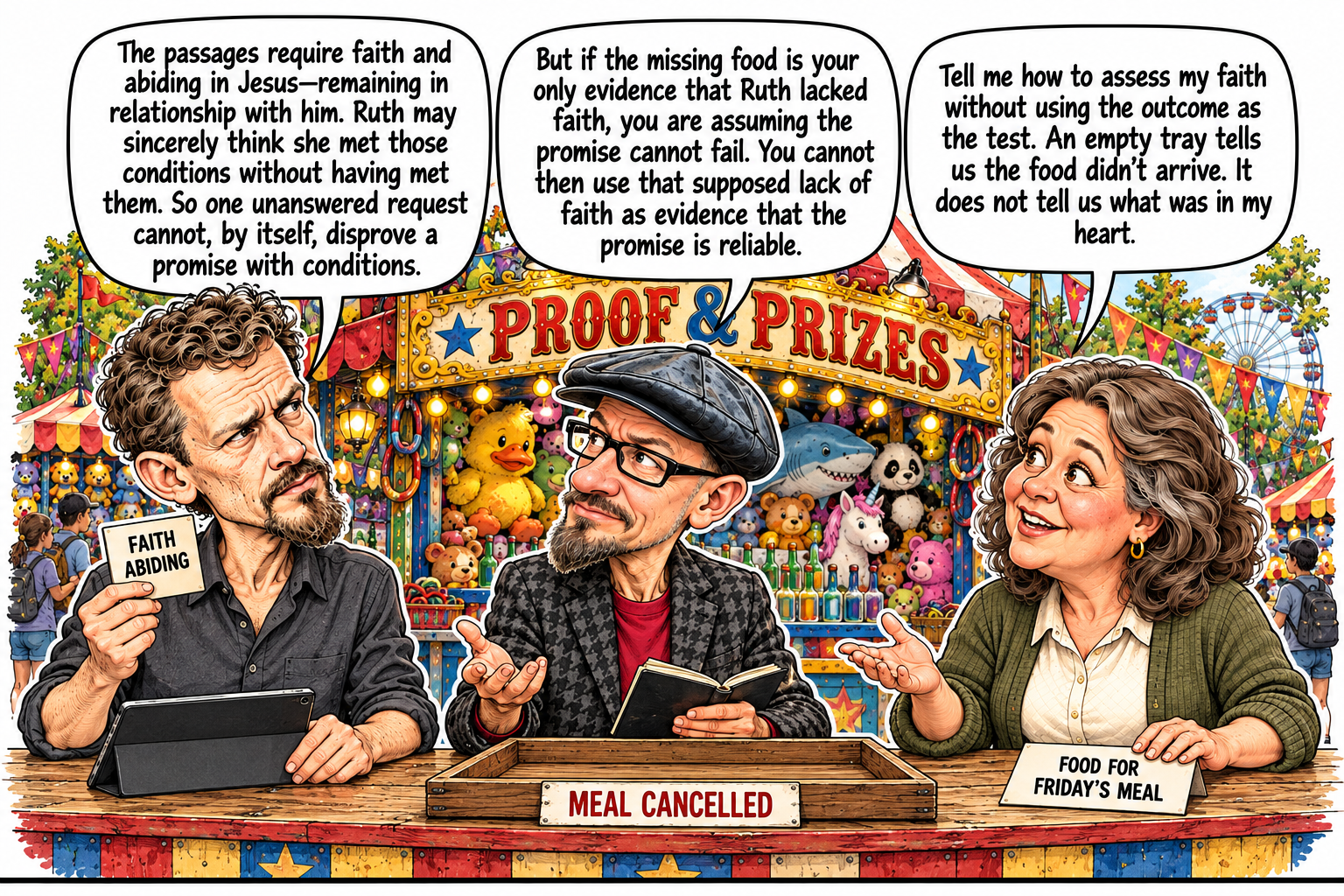
Faith conditions create a genuine complication. To refute a conditional promise with a failed case, one must establish that the case met the conditions. A petitioner’s confidence about personal sincerity may not establish every requirement a theology recognizes. That limitation should be admitted rather than hidden.
The circular move occurs elsewhere. Assume that every qualifying prayer succeeds. Infer from this failure that the petitioner did not qualify. Then use that diagnosis to defend the assumption that every qualifying prayer succeeds. The inference to nonqualification can be valid if the premise is independently supported; it cannot furnish the support that its own premise requires.
The personal cost can be substantial. An unmet need is already a disappointment. Being told that the disappointment reveals an invisible personal deficiency adds an accusation without supplying evidence. Self-examination becomes an endless search for the fault that the protected guarantee supposedly requires.
This does not justify calling every theological disagreement gaslighting or every minister dishonest. Such charges require attention to actual conduct, authority, dependence and harm. The narrower objection is sufficient: do not deny ordinary evidence its standing and shift failure onto an uncheckable defect in the person who relied on the assurance. Greg’s acknowledgment that he cannot inspect Ruth’s heart models a necessary limit on that inference.
Let evidence count in both directions
A single disappointment does not disprove God or every answer to prayer. A single favorable result does not automatically establish supernatural intervention either. Outcomes can have ordinary causes, and claims differ in scope. A universal guarantee, a conditional assurance, a claim about increased chances and a claim about rare exceptions need different kinds of assessment.
An outcome supports a claim when there are reasons to expect it more under that claim than under relevant alternatives. Precise numerical probabilities are not required in every case, but some reason for the comparison is. An automatic verdict of answered supplies no such reason. It can be attached to the record whether or not prayer made the advertised difference.
This does not imply that all underlying outcomes are equally likely, or that raw frequencies could never supply evidence. A clear pattern supported independently of flexible labels could matter. So could other arguments offered for religious trust. Those must do their own evidential work. They cannot be replaced by favorable anecdotes credited without comparison while every adverse case is dismissed without cost.
A free God could decline a test or act for hidden reasons. That protects a possibility. If the defense makes the supposed intervention indistinguishable from nonintervention across every possible record, however, it also removes the basis for presenting favorable outcomes as a public demonstration. The evidential door cannot be open only when the news is good.
Keep the value; correct the guarantee
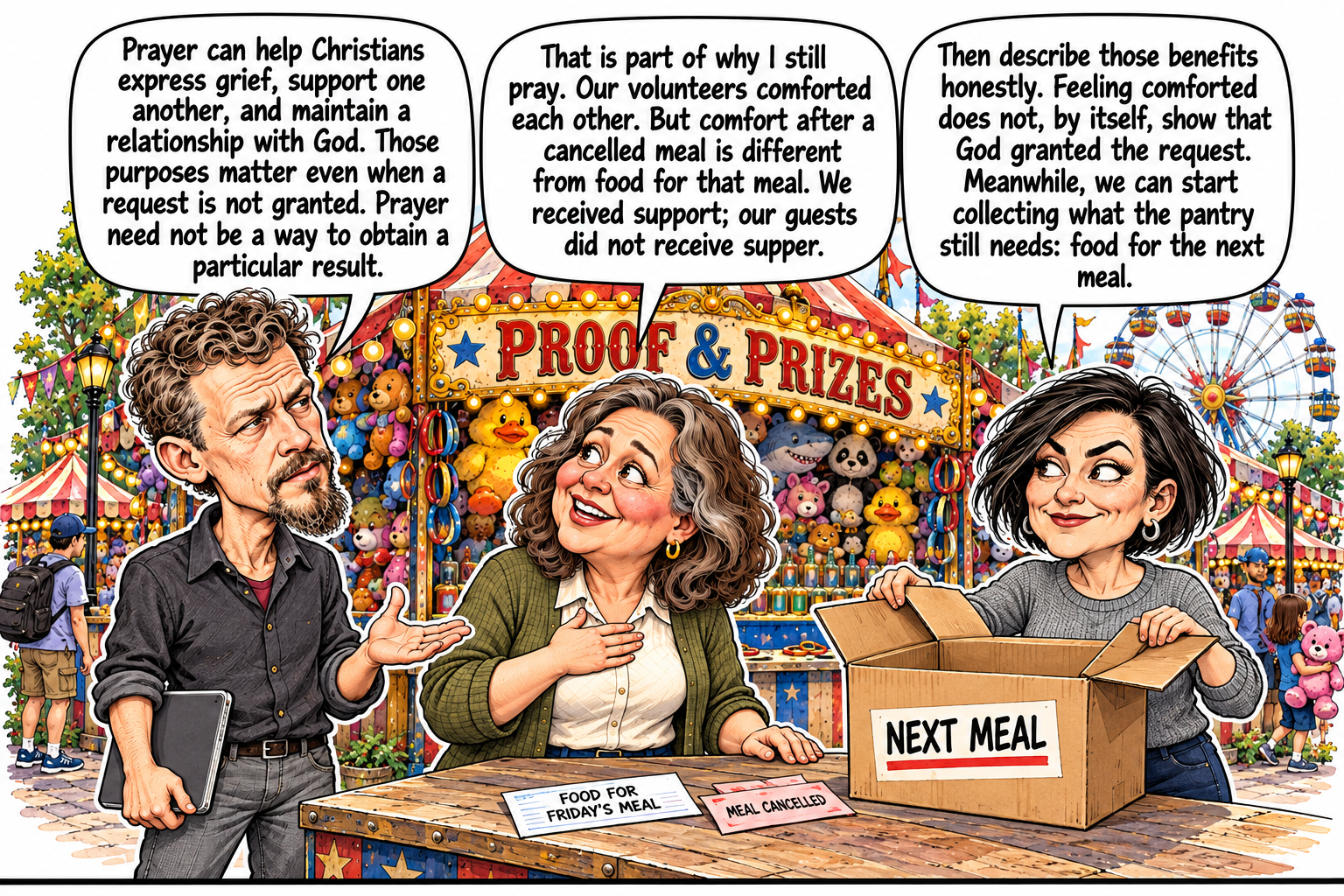
Prayer may be a language of relationship, lament, hope or solidarity. Ruth can continue praying while acknowledging that the meal was cancelled. There is no contradiction in valuing a practice and rejecting an exaggerated claim made on its behalf. A skeptic need not sneer at comfort to ask whether the asserted supernatural explanation has been established.
The same discipline applies to practical action. People providing food neither proves nor disproves that God acts through people. It does show that food was provided. Human cooperation can be pursued and assessed while disagreements about its ultimate explanation remain. The collection box does not require a shared theology before it can receive a contribution.
The conclusion is firm but limited. An unrestricted rule that turns every outcome into vindication supplies no support by itself for dependable intervention. Hidden answers remain possible, and other kinds of value remain available. Neither possibility authorizes the confidence of a guarantee. State the conditions clearly, admit the failures honestly, and stop asking a comforting explanation to impersonate the thing that was promised.