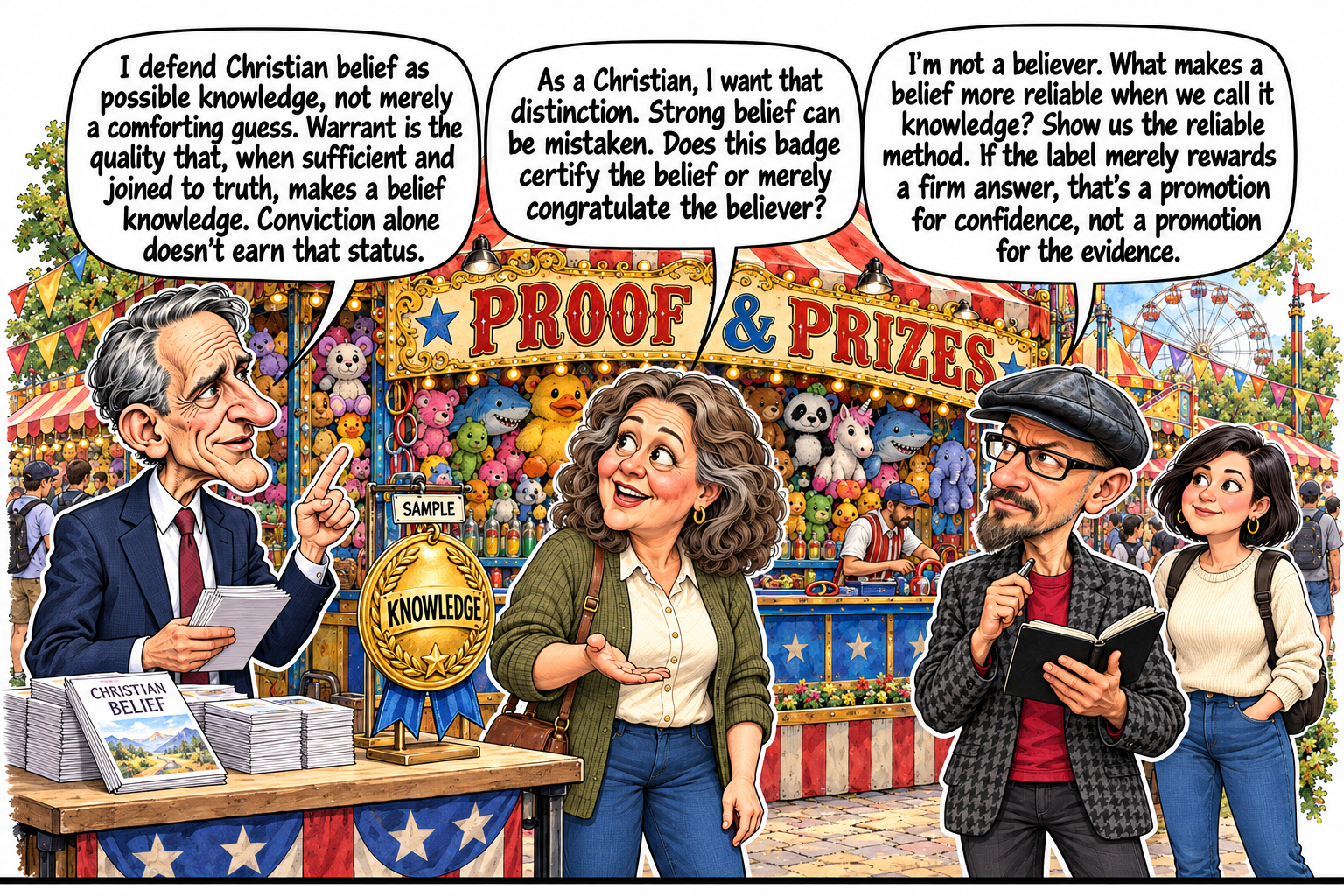


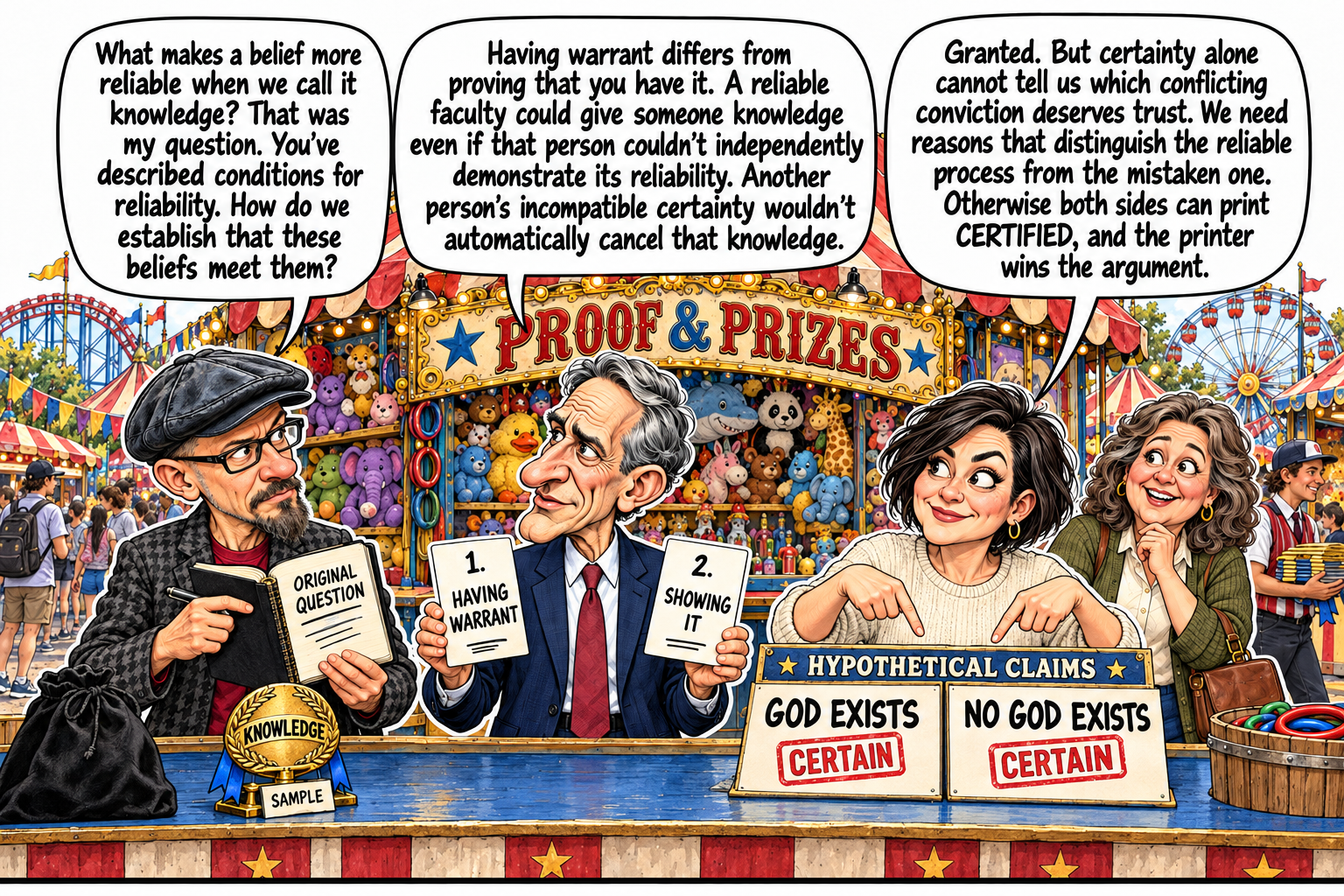


Calling a belief “knowledge” can sound like an upgrade. The skeptical question is what, exactly, has improved: the evidence, the method that produced the belief, or only the title attached to it? If a label rewards greater confidence without greater support, the promotion can make our assessment less accurate. A gold badge is an attractive accessory. It is a poor substitute for showing how the belief tracks truth.
The real target is an unearned upgrade
We should distinguish several things: whether a proposition is true, how confident a person is, what reasons support that confidence, and whether the process producing the belief is reliable. A lucky correct guess can be true without being a good method. A strong feeling can be sincere without being well supported. A reliable process may produce beliefs without its user being able to explain all its workings.
The proper-function account defended in the comic takes those distinctions seriously. Warrant is intended as a quality which, in sufficient degree and together with true belief, yields knowledge. The account requires properly functioning faculties, suitable conditions and a process successfully directed toward truth. It is not simply the instruction to feel certain. Warrant can have degrees, and confidence plus a lucky true answer does not exhaust its requirements.
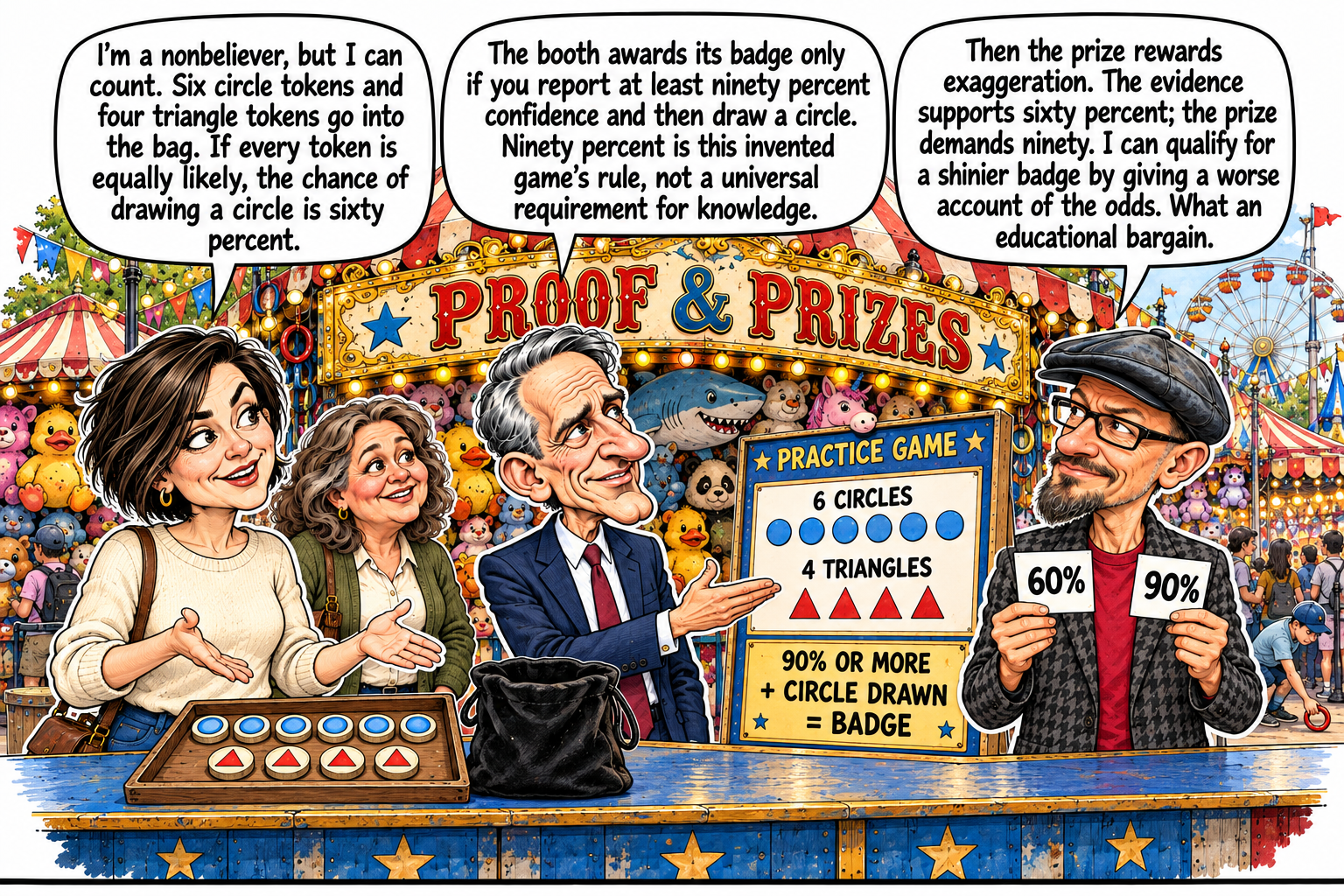
The skeptical criticism must therefore be conditional. If a system rewards crossing a confidence threshold despite unchanged evidential support, it can conflict with accuracy. To establish that a particular theory of knowledge has this defect, one must show that the theory actually imposes that incentive. A toy booth can expose the problem clearly; it cannot make a sophisticated opponent responsible for a rule invented for the demonstration.
What the numbers establish
The practice game contains six circle tokens and four triangle tokens, with each token equally likely to be drawn. The probability of a circle is therefore 0.6. Reporting sixty percent expresses that probability. Reporting ninety percent exaggerates it. The booth's ninety-percent requirement is an invented prize rule, not an established universal threshold for knowledge.
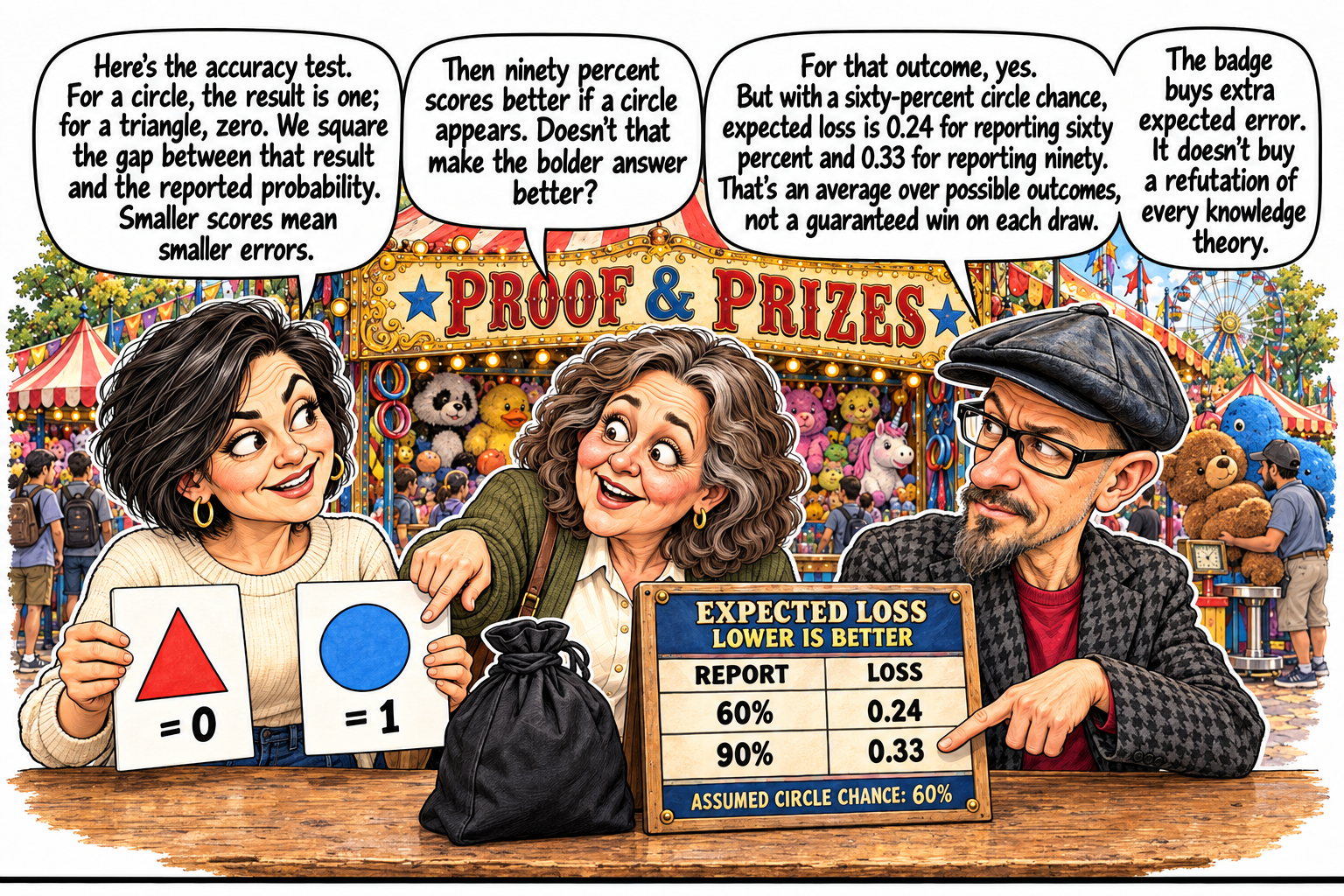
To compare the reports, let a circle count as outcome 1 and a triangle as outcome 0. Subtract the outcome from the reported probability and square the difference. This is a form of the Brier score: smaller values represent smaller errors. A ninety-percent report scores better when a circle actually appears, but much worse when a triangle appears. The important comparison is the average error across the possible outcomes, weighted by their probabilities.
At a sixty-percent circle chance, reporting 0.6 gives expected error 0.6 × 0.4² + 0.4 × 0.6² = 0.24. Reporting 0.9 gives 0.6 × 0.1² + 0.4 × 0.9² = 0.33. The badge rule therefore rewards a report with greater expected error in this example. It does not guarantee a worse score on every individual draw; one lucky circle can flatter the exaggerated forecast.
The general result is equally revealing. If the event probability is p and the reported probability is q, expected squared error is p(1 − p) + (q − p)². The first term is unchanged by the report. The second is smallest when q equals p. Moving the report away from the supported probability increases expected error by the square of the discrepancy. The rule has made exaggeration profitable without making it accurate.
That result applies under the stated probability model and scoring rule. It does not prove that every categorical concept of knowledge demands exaggeration, that every sufficiently confident belief is irrational, or that all reliability conditions reduce to one score. In difficult religious disputes, the evidential probability may itself be uncertain. The lesson is to represent that uncertainty honestly, not to invent decimals and then mistake their precision for justification.
The experience and its cause are different questions
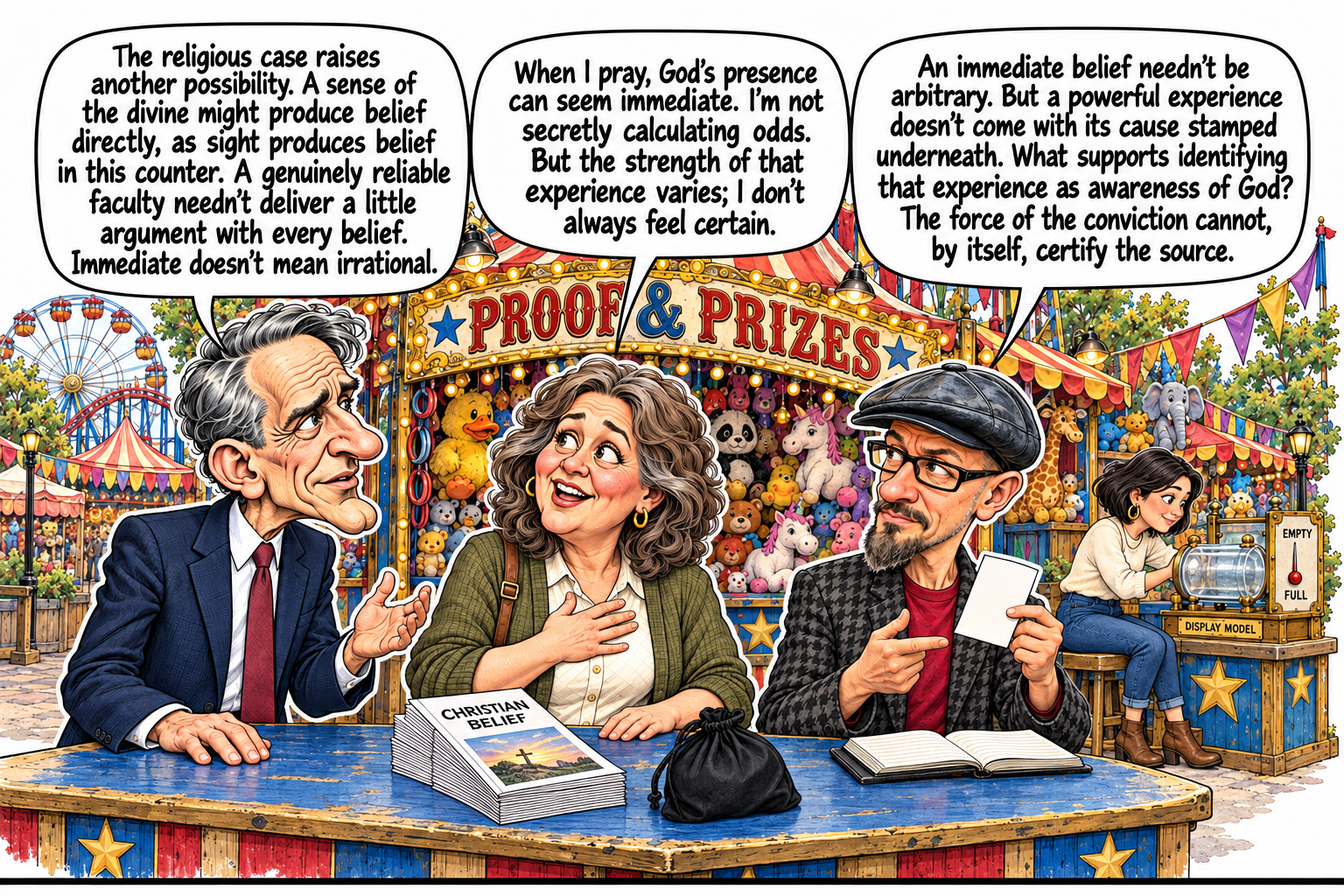
A believer may say that awareness of God is immediate, like perception, rather than the conclusion of an explicit argument. Immediate belief need not be irrational. We do not ordinarily construct a proof before seeing a chair, and a reliable faculty could in principle produce a justified belief before its user understands its mechanism. Skepticism gains nothing by pretending that every reasonable belief must begin with a written syllogism.
The question is whether the proposed religious faculty actually has the relevant connection to truth. A compelling experience supplies information about what the person experiences; it does not automatically identify the experience's cause. Interpreting it as awareness of God adds a claim that must be assessed. Intensity alone cannot settle the matter, especially when similarly intense experiences receive incompatible interpretations.
The stuck fuel gauge illustrates the distinction between a confident output and a reliable process. A gauge that always reads FULL fails because its output does not respond appropriately to the tank. Merely saying that it was designed to give that reading cannot repair the failure. But the analogy does not establish that religious experience is a stuck gauge. A proper-function theory requiring successful truth-directed operation would reject the defective gauge too. The remaining task is to investigate whether the alleged divine sense meets the conditions claimed for it.
Having reliability is different from establishing it
A person could possess knowledge without being able to prove to an audience that the belief-forming process is reliable. This is a serious point. The skeptical demand for reasons must not silently become the stronger claim that no one can know anything without first independently certifying every faculty involved. That demand would threaten ordinary perception and memory along with religious belief.
Yet the distinction does not settle a dispute between rival claims to religious authority. When we are asked to accept a belief or increase our confidence, the claim that its production would be reliable if the proposed religious account were true does not itself establish that the account is true. A possible explanation of how someone could know leaves the public question of what supports accepting that explanation.
Conflicting certainties make that question urgent without proving that every claimant is mistaken. One claimant might possess a reliable process while another does not. What distinguishes them? Relevant evidence could include coherence, consequences, independent arguments and comparison with alternative explanations. Assessing a unique claim does not require literally stepping outside the universe or conducting repeated universe-sized experiments. It does require reasons capable of doing more than reproducing the claimant's assurance.
Keep the eraser beside the conclusion
Evidence can support a belief, undermine it or answer an earlier objection. The strength of confidence should remain responsive to those changes. Successfully answering one objection does not automatically remove every other uncertainty, just as one unresolved difficulty does not necessarily defeat a well-supported overall case. The assessment needs to preserve how much support remains.
A knowledge vocabulary can coexist with these distinctions. Its defenders can reasonably argue that it records truth, reliability and the difference between success and luck. The skeptical preference here is to make those features explicit rather than let the word “knowledge” obscure them. In rigorous inquiry, an account of the claim, the reasons, the method and the remaining uncertainty is more informative than a ceremonial announcement that the badge has been earned.
The case for dispensing with the label in such assessments is therefore methodological, not a theorem proved by the toy game. Retain every defensible truth and reliability condition. Retain the evidence and revise the confidence. What should be discarded is any supposed epistemic promotion for which no improvement in support or truth-tracking can be shown. The clipboard tells us what can be defended. The badge tells us what somebody would like to call it.