APOLOPLEX

Episode 03 / The Evidence Trail

The Question Checkpoint

One question reaches the Evidence Trail. The admission form keeps getting longer.

Must a skeptic defend an entire worldview before questioning a claim? A comic examines the burden of proof, suffering and equal scrutiny in Christian apologetics.

An argument takes a day out

Frank, David, Phil, Morgan and Ruth
Equal scrutiny for claims and objections

Original fictional satire. This is an imagined conversation, not an actual encounter or quotations. The dialogue, visitors and checkpoint are invented.

Use ← and → to move between scenes.

Scene 1: One question at the gate. Frank stands at the Evidence Trail with open hands beside a board reading GOD IS LOVING AND ALL-POWERFUL. Phil responds from the center, and Ruth stands on the right beside a separate WHY THIS SUFFERING? question tray. An ASK A QUESTION gate stands between the booth and the visitors. David and Morgan listen behind Ruth; the hedge maze, observation tower, owl topiary and other park visitors fill the background.
SCENE 01 / 10View / zoom image ↗
Read dialogue

Frank stands at the Evidence Trail with open hands beside a board reading GOD IS LOVING AND ALL-POWERFUL. Phil responds from the center, and Ruth stands on the right beside a separate WHY THIS SUFFERING? question tray. An ASK A QUESTION gate stands between the booth and the visitors. David and Morgan listen behind Ruth; the hedge maze, observation tower, owl topiary and other park visitors fill the background.

Frank: I’m here to defend Christianity: a loving, all-powerful God exists, and we have good reasons to believe. Bring your hardest question. The evidence can take it.

Phil: I’m a nonbeliever. Why would a loving, all-powerful God allow so much apparently needless suffering? I’m challenging how that suffering fits your claim, not claiming one painful event disproves every possible God.

Ruth: I’m a Christian, and I want an answer too. If God cares about people and can protect them, why do people suffer so terribly when we can see no good achieved?

Notes from the queue · 01

One question at the gate

The checkpoint begins with a perfectly reasonable invitation. The distinction to watch is between examining a question and checking whether the questioner has earned permission to ask it.

The suffering objection asks about what we would expect from the God described. It does not claim to have proved every possible God logically impossible, or that suffering has no possible explanation.

One invented encounter, not a claim that Frank always avoids questions. Apparent needless suffering is the representative example; the episode does not settle the whole problem of evil.

A deeper dive

The claim gives the question its force

Phil’s objection begins with the description on Frank’s board: God is loving and all-powerful. Love suggests concern for those who suffer, while power appears to provide the ability to help. The amount and apparent pointlessness of some suffering therefore call for an explanation. The question is directed at that combination of claims; it does not require a prior demonstration that every kind of god is impossible.

The word apparently matters. An observer’s inability to identify a good reason for suffering is not a proof that no such reason exists. But that limitation does not automatically remove the evidential problem. The defender still needs to explain why the observed pattern should be reasonably expected under the proposed account, or why independent support for the account outweighs this difficulty.

Three positions, one shared question

Frank defends Christianity; Phil is a nonbeliever; Ruth remains Christian while asking what her own description of God commits her to. Their disagreement is therefore about the strength and implications of the claim, not simply about membership in opposing camps. A believer can recognize a serious objection without abandoning belief, just as a nonbeliever can recognize a serious reply without converting.

The checkpoint will test whether the original question receives an answer. A fair conversation may examine the questioner’s reasoning, but that examination must connect to an actual premise or inference. It becomes an evasion when the critic must first finish an entire philosophy before the advertised claim can face scrutiny.

Scene 2: First, your moral foundation. Frank clips a MORALITY placard across the ASK A QUESTION gate on the left. Phil stands at center, notebook in one hand, pointing immediately below LOVING on the GOD IS LOVING AND ALL-POWERFUL board without obscuring the wording. Ruth responds at the right with both palms open. Her WHY THIS SUFFERING? card remains fully visible in a separate tray. The Evidence Trail and hedge maze continue behind them.
SCENE 02 / 10View / zoom image ↗
Read dialogue

Frank clips a MORALITY placard across the ASK A QUESTION gate on the left. Phil stands at center, notebook in one hand, pointing immediately below LOVING on the GOD IS LOVING AND ALL-POWERFUL board without obscuring the wording. Ruth responds at the right with both palms open. Her WHY THIS SUFFERING? card remains fully visible in a separate tray. The Evidence Trail and hedge maze continue behind them.

Frank: Before calling suffering wrong, tell me what makes anything objectively wrong without God. If your objection assumes a moral standard, the source of that standard matters. What foundation are you using?

Phil: For this question, I’m using your claim that God loves people. A loving, all-powerful being would seem likely to prevent suffering unless there is a sufficient reason to allow it.

Ruth: So Phil can ask what we should expect from the God we describe. We can discuss moral foundations separately. Changing the subject to Phil’s credentials doesn’t explain why this suffering fits our description of God.

Notes from the queue · 02

First, your moral foundation

The checkpoint has acquired a whole branch of philosophy. Yet Phil’s question can temporarily use the Christian description of God to ask what follows from it.

This is an internal challenge: provisionally accepting stated premises to test their implications. It neither solves moral foundations nor declares them irrelevant to every argument.

The sufficiency of a divine reason remains disputed. The dialogue claims an apparent evidential tension, not a proved contradiction or a settled secular moral theory.

A deeper dive

An objection can use the defender’s own premise

Frank’s question about the basis of moral judgment could matter if Phil’s argument depended on an unsupported theory of objective morality. A critic does not receive immunity merely by asking a question. If a disputed premise is necessary to the objection, the critic owes reasons for that premise.

Phil’s narrower challenge uses the advertised description of God. Given what Frank means by loving, how does the observed suffering fit? This is an internal criticism: it asks whether a position explains the world consistently with its own commitments. Phil can temporarily grant those commitments for the argument without endorsing them as his complete worldview.

A relevant challenge must identify the dependency

An internal criticism can still fail. Phil might misunderstand divine love, overlook a relevant distinction, or demand an outcome that the Christian account never predicts. Frank can answer by identifying that mistake and defending his interpretation. Simply asking for the ultimate foundation of Phil’s morality does not yet identify any such mistake.

Ruth’s participation makes the point especially clear. Her Christian commitment gives her a reason to care about the meaning of the same claim. Asking how suffering fits that claim is not an act that only a nonbeliever must obtain a license to perform. The MORALITY placard satirizes an admission demand; it does not settle the philosophical foundations of morality.

Scene 3: The application gets longer. Frank holds up a long blank ruled questionnaire at the left. Morgan supports its curling lower end at center, with her free palm raised. Phil stands at right with his notebook and points beside the separate WHY THIS SUFFERING? question tray. The ASK A QUESTION gate now carries MORALITY, REASON and RIGHTS placards. Ruth and David sit listening on a wall beside the maze map.
SCENE 03 / 10View / zoom image ↗
Read dialogue

Frank holds up a long blank ruled questionnaire at the left. Morgan supports its curling lower end at center, with her free palm raised. Phil stands at right with his notebook and points beside the separate WHY THIS SUFFERING? question tray. The ASK A QUESTION gate now carries MORALITY, REASON and RIGHTS placards. Ruth and David sit listening on a wall beside the maze map.

Frank: But your reasoning depends on a worldview too. What makes reason trustworthy without God? Before you criticize Christianity, shouldn’t you explain reason, morality and human rights within your own account of reality?

Morgan: I’m not a believer, and I don’t have a finished account of everything. If this objection contains a bad inference, identify it. My unfinished philosophy is not evidence that your explanation of suffering is correct.

Phil: You’ve turned a question about your claim into an entrance exam for the critic. Test the assumptions this objection actually needs. We don’t owe you a complete worldview before you owe us an answer.

Notes from the queue · 03

The application gets longer

A useful follow-up identifies an assumption or a faulty step. An unlimited admission form can postpone the original question indefinitely.

Morgan’s lack of a complete theory is not a proof that any secular account is correct. The narrower point is that the Christian answer has not been established by that lack.

No claim about the biology of thought, the truth of naturalism or the correct foundation of rights is asserted. Reason and rights remain entries on the exaggerated form, not separate debates.

A deeper dive

The burden must follow the argument

Questions about reason, morality and rights are substantial philosophical questions. They can be relevant to evaluating a person’s broader outlook. The mistake is to assume that every objection depends on solving all of them first. An objection may expose a specific tension using premises the defender already accepts.

Morgan accepts responsibility for the inferences she actually makes. If her criticism relies on an account of reason or rights, that reliance can be examined. But an unfinished answer on one subject is not a general disqualification from identifying an error elsewhere. The burden of giving reasons attaches to claims and inferences, not to a complete inventory of everything a person does not know.

An unfinished rival is not a completed defense

The strongest reply is that worldviews form connected systems: weaknesses in one part may affect confidence in another. That is true enough to justify asking about genuine connections. It does not justify treating every gap as equally relevant, or assuming that the defender’s system has no gaps of its own.

The accumulating placards and unending form make the asymmetry visible. While the visitor fills in additional boxes, the original suffering question remains unanswered. Christianity still needs support for its own claims. A critic’s incomplete philosophy cannot do the work of that support, any more than an unanswered objection automatically establishes the critic’s entire worldview.

Scene 4: Crossing out is not filling in. David sits left of Morgan at the counter while Ruth, Frank and Phil listen. Two cream cards read IF A RIVAL FAILS and CHRISTIANITY IS TRUE, separated by a chalk arrow with a wide missing middle section. David points to the first card and opens his other hand; Morgan points to the second. An empty evidence box sits in front, and WHY THIS SUFFERING? remains in a separate tray at lower right. David’s final balloon is lower left.
SCENE 04 / 10View / zoom image ↗
Read dialogue

David sits left of Morgan at the counter while Ruth, Frank and Phil listen. Two cream cards read IF A RIVAL FAILS and CHRISTIANITY IS TRUE, separated by a chalk arrow with a wide missing middle section. David points to the first card and opens his other hand; Morgan points to the second. An empty evidence box sits in front, and WHY THIS SUFFERING? remains in a separate tray at lower right. David’s final balloon is lower left.

David: I’m defending Christianity, and exposing weaknesses in a competing worldview can be part of that defense. If your alternative cannot account for what we observe, that failure should affect the comparison.

Morgan: Yes, if those alternatives really compete over the same evidence. But defeating one proposed explanation doesn’t establish yours unless you show those are the only options. I haven’t offered a complete rival theory.

David: I do offer a positive case for Christianity. But yes, a failed rival doesn’t fill my evidence box. I still have to defend what I put in it.

Notes from the queue · 04

Crossing out is not filling in

The gap in the chalk arrow marks a missing inference. David’s criticism matters when it genuinely weakens a competing explanation, but that does not automatically establish the conclusion on the next card.

The shortcut fails when a rejected alternative is treated as the only alternative without an argument. The scene does not deny that Christianity can be supported by a positive case; it asks for that case to be assessed.

David does make positive arguments for Christianity in his public work. These invented lines must not imply that he only attacks rivals or that one worldview has been refuted here.

A deeper dive

When eliminating an alternative helps

David is right that explanations can be compared. If two accounts make different expectations reasonable, evidence that undermines one can improve the relative standing of the other. Criticism of competing views is therefore not automatically a diversion. The relevant questions are whether the accounts concern the same evidence and whether the comparison has been framed fairly.

The stronger claim—that the failure of one rival establishes Christianity—needs more. It would require showing that the rejected rival and Christianity exhaust the relevant possibilities, or supplying some other positive reason to favor Christianity over the remaining options. Without that step, the conclusion outruns the comparison. The broken chalk arrow marks this missing connection.

What remains in the evidence box

Morgan has not offered a complete alternative explanation of reality. This limits what can fairly be attributed to her, but it does not make her objection disappear. One can show that a proposed explanation has a problem before possessing a successful replacement. That distinction is common to ordinary inquiry: detecting a fault and repairing it are different achievements.

David’s reply preserves his Christian position and his claim to offer positive reasons. He accepts only that a failed rival cannot substitute for those reasons. The scene does not announce that his evidence box is permanently empty, or that no comparison could favor Christianity. It insists that the contents must be presented and defended, rather than inferred from an opponent’s unfinished answer.

Scene 5: A possible answer. Frank presents a POSSIBLE card beside the separate WHY THIS SUFFERING? card at the turquoise ASK A QUESTION checkpoint. Phil holds his open notebook and a pen near his chin; Ruth steadies the question tray. The complete GOD IS LOVING AND ALL-POWERFUL claim and galaxy illustration stand at left above MORALITY, REASON and RIGHTS. David and Morgan listen behind Ruth.
SCENE 05 / 10View / zoom image ↗
Read dialogue

Frank presents a POSSIBLE card beside the separate WHY THIS SUFFERING? card at the turquoise ASK A QUESTION checkpoint. Phil holds his open notebook and a pen near his chin; Ruth steadies the question tray. The complete GOD IS LOVING AND ALL-POWERFUL claim and galaxy illustration stand at left above MORALITY, REASON and RIGHTS. David and Morgan listen behind Ruth.

Frank: God could permit suffering for goods we cannot yet see. Freedom, courage and relationships can involve real risks. If God has sufficient reasons, suffering and divine goodness are not logically incompatible.

Phil: That addresses an impossibility claim. My question concerns evidence: why expect suffering on this scale, including suffering that seems to achieve no good, if a loving, all-powerful God governs the world?

Ruth: A possible reason keeps an answer available. It doesn’t show that the reason explains the suffering we actually see. Possibility has cleared a low bar. It hasn’t earned an evidence stamp.

Notes from the queue · 05

A possible answer

POSSIBLE is a useful label. It becomes misleading only if it is quietly promoted to WELL SUPPORTED.

An adequate possible explanation may answer a claim that God and suffering cannot coexist. The present question asks how well a loving, all-powerful God explains the amount and pattern of suffering; its evidential weight still needs an answer.

The proposed goods are possibilities, not established explanations of particular suffering. No claim that unknown probabilities are equal, that every harm is pointless, or that a single counterexample disproves Christianity.

A deeper dive

Compatibility clears one kind of challenge

Frank offers reasons that could connect suffering with goods such as freedom and courage. If an objection claims that suffering and a loving, powerful God are logically incompatible, a coherent account in which both coexist can challenge that alleged contradiction. This is a genuine argumentative achievement when the objection is one of impossibility.

Phil’s objection is different. He asks about the scale and character of the suffering actually observed. Showing that some suffering could be permitted for a good reason does not yet show that the observed pattern is well explained. A possibility can answer ‘Could these coexist?’ while leaving ‘How well does this account fit what we see?’ substantially open.

A possible reason still needs support

A defender may offer evidence that a proposed good really requires a particular cost, or explain why human limitations make some reasons difficult to identify. Those responses deserve assessment. Their force depends on the details: what they explain, what they leave unexplained, and what independent support they have. Merely adding an unknown sufficient reason to every difficult case cannot by itself establish the reason’s existence.

Ruth’s distinction does not turn missing support into a demonstration of falsehood. The POSSIBLE card remains available, but it has not earned an evidential promotion merely by avoiding contradiction. The objection and the answer must meet at the same level. Otherwise the conversation celebrates the defeat of a stronger claim that Phil never made.

Scene 6: What the description commits us to. Frank holds the left edge of a tall cream claim board reading GOD IS LOVING AND ALL-POWERFUL above a blue-and-gold galaxy. Phil stands to its right and points beside the claim with his index finger; Ruth opens her hand at the far right. WHY THIS SUFFERING? occupies its own foreground tray, separate from the POSSIBLE cards. Morgan and David listen behind Ruth amid the Evidence Trail hedges and lamps.
SCENE 06 / 10View / zoom image ↗
Read dialogue

Frank holds the left edge of a tall cream claim board reading GOD IS LOVING AND ALL-POWERFUL above a blue-and-gold galaxy. Phil stands to its right and points beside the claim with his index finger; Ruth opens her hand at the far right. WHY THIS SUFFERING? occupies its own foreground tray, separate from the POSSIBLE cards. Morgan and David listen behind Ruth amid the Evidence Trail hedges and lamps.

Frank: God’s goodness is his nature, not a rule above him. If we have good reasons to believe in God, we can trust that what he permits is consistent with that goodness.

Phil: Then give those reasons and explain what calling God loving predicts. If every possible pattern of suffering fits equally well, that description doesn’t help us assess this evidence. Defining God as good cannot do that work.

Ruth: I believe God is loving, not merely entitled to the label. That claim says something about his concern for people. If the label excuses every outcome, we haven’t explained anything.

Notes from the queue · 06

What the description commits us to

A description should tell the visitor something about what is being described. If LOVING can fit every conceivable pattern equally well, the sign has stopped helping with this particular evidence.

The scene permits an independent case for God and does not assume that God and humans have identical duties. It challenges using a definition alone to answer the evidential question.

The if-clause matters: the dialogue does not assert that every theological account makes every observation equally expected. Philosophical explanations need not be reducible to one laboratory experiment.

A deeper dive

A definition does not complete an explanation

Frank locates goodness in God’s nature and appeals to other reasons for belief. This need not assume a moral rule standing above God, and it need not say that divine duties are identical to human duties. Those are separate philosophical issues. The immediate question is what the description loving contributes to explaining the observed suffering.

A definition can specify what a claim means, but it cannot alone show that the described being exists or that the world fits the description well. If independent reasons support belief, those reasons can be offered. Calling the being good again does not supply the missing connection between the observed pattern and the proposed explanation.

Meaningful descriptions constrain expectations

Phil’s criticism is conditional. If every possible pattern of suffering fits equally well, loving does no discriminating work for this evidence. This does not claim that all theological accounts have that defect. A substantive account may explain which outcomes are expected, which would be surprising, and why some uncertainty remains.

Ruth’s concern comes from within her Christian commitment: she means more by love than an entitlement to a flattering label. The reply need not promise that a loving God prevents every harm. It does need to give some content to concern for people and explain how the relevant suffering fits. The board is still held in the conversation so that its attractive description also remains answerable to scrutiny.

Scene 7: The questioner gets inspected. Frank holds the WILLINGNESS placard below MORALITY, REASON and RIGHTS on an ornate turquoise ASK A QUESTION gate. Morgan answers from the center, directly beneath her balloon. Phil silently carries the WHY THIS SUFFERING? tray; Ruth speaks at right with a hand on her chest, and David listens behind. The original Christian claim board and galaxy stand at far left.
SCENE 07 / 10View / zoom image ↗
Read dialogue

Frank holds the WILLINGNESS placard below MORALITY, REASON and RIGHTS on an ornate turquoise ASK A QUESTION gate. Morgan answers from the center, directly beneath her balloon. Phil silently carries the WHY THIS SUFFERING? tray; Ruth speaks at right with a hand on her chest, and David listens behind. The original Christian claim board and galaxy stand at far left.

Frank: Let me ask something personal. If you were convinced Christianity was true, would you follow Christ? Sometimes reluctance is about what people want, although I don’t think every unbeliever rejects the evidence for that reason.

Morgan: I would believe a claim the evidence established. Whether I wanted to obey is another question. My willingness to follow Christ doesn’t explain suffering. You’re inspecting the questioner while the claim slips past untouched.

Ruth: And I want Christianity to be true. That desire doesn’t prove my belief false, either. Our feelings deserve attention, but the reasons for and against the claim still need examining.

Notes from the queue · 07

The questioner gets inspected

The checkpoint has begun inspecting a visitor’s plans after belief instead of the reasons for belief. Those are different questions even when both are worth discussing.

Emotion and resistance can influence reasoning. Neither a nonbeliever’s reluctance nor a Christian’s hope determines whether a particular claim or objection is sound. The original reasons still require examination.

Frank’s dialogue explicitly allows exceptions to his motive account. The scene uses no diagnosis of private motives, no claim that all believers or nonbelievers are dishonest, and no quotation assigned from a guest.

A deeper dive

Belief, obedience and explanation are different questions

Frank’s willingness question asks about a personal response to Christianity if it were established as true. That can be meaningful in a conversation about commitment. It is not identical to asking whether Christianity is true, or whether the evidence offered supports it. A person could accept a claim and resist acting on it, or want a claim to be true while finding it insufficiently supported.

Morgan therefore separates her willingness to follow from the suffering objection. An unwilling response would not, by itself, identify a false premise in her argument. To answer the objection, the discussion must return to the claim about God and the suffering it is supposed to explain. Inspecting the questioner is not yet inspecting the question.

Motives deserve symmetrical treatment

Desire can affect how people search for and weigh evidence. That is a reason for care, not a shortcut from a suspected motive to the falsity of a conclusion. The relevant task is to show where the reasoning or evidence has been mishandled. Frank’s explicit exception also matters: the scene does not have him accuse every nonbeliever of rejecting evidence out of desire.

Ruth applies the same caution to her own wish that Christianity be true. Her hope does not prove her belief false, just as Morgan’s possible reluctance would not prove Christianity true. The WILLINGNESS placard becomes another checkpoint requirement only when this personal question is allowed to replace the original evidential one. No facial expression establishes anyone’s hidden motive.

Scene 8: The same question in both directions. Frank, Phil and Morgan gather around a large two-column checklist headed WHAT SUPPORTS IT? and WHAT WEAKENS IT? Phil holds his notebook and points beside the central divider near the second heading; both columns remain blank. The WHY THIS SUFFERING? card sits separately on the left and a POSSIBLE card on the right. Ruth and David listen behind them at the Evidence Trail, surrounded by its maze, observation tower and owl topiary.
SCENE 08 / 10View / zoom image ↗
Read dialogue

Frank, Phil and Morgan gather around a large two-column checklist headed WHAT SUPPORTS IT? and WHAT WEAKENS IT? Phil holds his notebook and points beside the central divider near the second heading; both columns remain blank. The WHY THIS SUFFERING? card sits separately on the left and a POSSIBLE card on the right. Ruth and David listen behind them at the Evidence Trail, surrounded by its maze, observation tower and owl topiary.

Frank: You’re asking what would count against my belief. What would count against your objection? If you dismiss every possible divine reason, you’ve built the same protective fence around your own position.

Phil: Agreed. Evidence that the suffering served a sufficient purpose, with no less harmful way to achieve it, would weaken my objection. So would showing that my expectations misunderstand the claim you’re actually defending.

Morgan: And if I claimed suffering made every God impossible, a coherent counterexample would defeat that claim. But we’ve raised an evidential challenge. An answer must address the strength of that challenge, not a stronger claim we haven’t made.

Notes from the queue · 08

The same question in both directions

The useful question travels in both directions. Phil identifies what could weaken his objection instead of demanding openness only from Frank.

This is a standard for relevant support and criticism, not a demand that every religious or philosophical claim be settled by one simple experiment. A coherent possibility and evidence for its actuality play different roles.

The proposed defeating evidence is a conditional criterion, not a claim that such purposes have been found or that humans can decisively prove their absence. The objection itself remains open to revision.

A deeper dive

The critic must say what could change the assessment

Frank’s demand for openness applies to Phil as well as to the defender. If Phil calls suffering evidence against the Christian account, he should be able to describe what would weaken that judgment. Evidence connecting the suffering to a sufficient good, or strong independent support for the account, could change the balance. A critic cannot demand responsiveness while declaring his own conclusion untouchable.

That openness need not take the form of one decisive experiment. Philosophical assessments may depend on several considerations whose force changes together. The useful requirement is an intelligible connection between reasons and confidence: what would count in favor, what would count against, and why those considerations matter.

Do not quietly change the objection

Morgan preserves the distinction between logical impossibility and an evidential difficulty. If the objection alleged a contradiction, an adequate possible reconciliation would bear directly on it. If the objection instead concerns how well the account explains the world, compatibility alone leaves further work. Neither participant should switch between these standards merely because one is easier to meet.

The shared checklist does not promise a mechanical verdict, identical numerical weights or perfect certainty. Its blank columns require both sides to supply reasons. The question remains in its own tray because a fair procedure has not already answered it. The point is reciprocal exposure to evidence, not the ritual appearance of balance.

Scene 9: An objection can have weight. David sits at left and Phil at right, with Ruth, Frank and Morgan listening between them. A large central clipboard has two blank columns headed WHAT SUPPORTS IT? and WHAT WEAKENS IT?. Phil points toward the second heading with his index finger, keeping its letters clear. WHY THIS SUFFERING? stands in a separate tray at lower right; blank reply paper lies beside David. His final speech balloon is lower left.
SCENE 09 / 10View / zoom image ↗
Read dialogue

David sits at left and Phil at right, with Ruth, Frank and Morgan listening between them. A large central clipboard has two blank columns headed WHAT SUPPORTS IT? and WHAT WEAKENS IT?. Phil points toward the second heading with his index finger, keeping its letters clear. WHY THIS SUFFERING? stands in a separate tray at lower right; blank reply paper lies beside David. His final speech balloon is lower left.

David: A whole case can remain persuasive despite one unresolved objection. I can think suffering counts against Christianity and still judge the positive evidence stronger. That isn’t automatically a double standard.

Phil: Right. The test isn’t whether one objection makes you abandon Christianity. It’s whether relevant contrary evidence is allowed to weaken your case. If every difficulty leaves the case just as strong, what work is scrutiny doing?

David: I’m prepared to defend that balance. But I won’t call every difficulty a victory. An unanswered objection is still an objection; it doesn’t become Christian evidence just because a skeptic asked it.

Notes from the queue · 09

An objection can have weight

A case can lose some support and remain the strongest available case. That is different from an arrangement in which every result is recorded as another success.

The dialogue establishes a fair standard for comparison; it does not claim to have weighed every Christian argument. Neither an unresolved objection nor an unanswered defense automatically settles the whole worldview.

No numerical likelihoods, total probabilities or equal-prior assumptions are introduced. David’s acknowledgment is fictional dialogue, not a reported public concession about suffering.

A deeper dive

One difficulty need not defeat a whole case

David defends a cumulative case: several considerations together may support Christianity even when one objection remains unresolved. That is a legitimate structure of reasoning. A single adverse consideration does not automatically outweigh every favorable one, and rational assessment does not require abandoning a view the moment a difficulty appears.

Phil distinguishes lowering confidence from immediate abandonment. Evidence can count against a view while leaving it, on balance, better supported than its alternatives. What matters is whether the difficulty receives an honest weight and whether the supporting reasons genuinely compensate for it. Invoking a cumulative case is an invitation to examine that balance, not a declaration that objections have no effect.

An unresolved problem is not automatically a victory

A defender may discover that an apparent problem dissolves after clarification. In that case, explaining the mistake can remove the negative consideration. But merely redescribing every difficulty as evidence for the defended position would make the assessment insensitive to what happens. The defense must show why a particular objection fails or how other reasons outweigh it.

David’s final reply retains his positive commitment while refusing automatic promotion of difficulties into victories. The empty reply card leaves room for an answer without pretending one has been supplied. This is a standard both sides can accept: neither the continued existence of an objection nor the continued existence of belief decides the argument by itself.

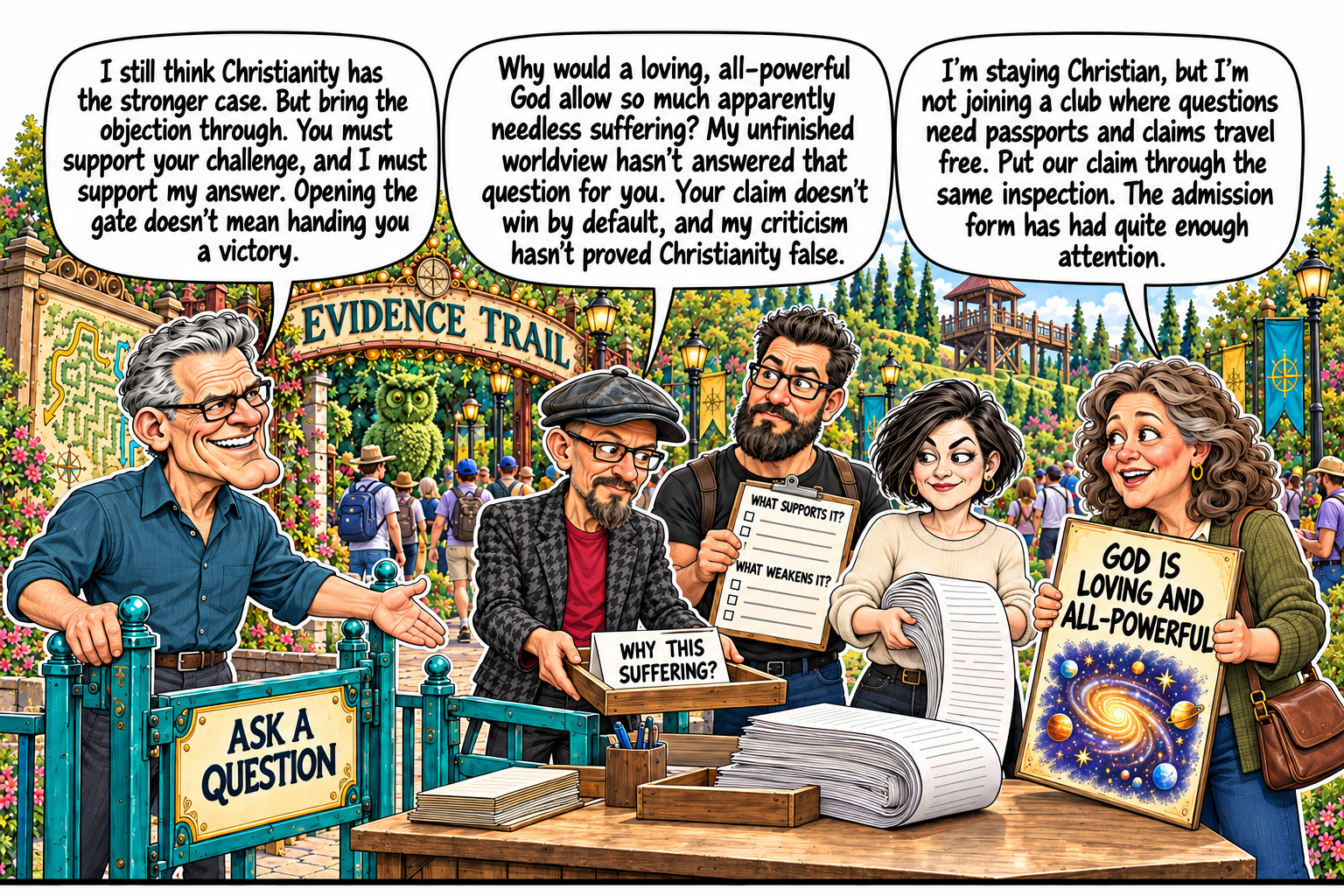
Scene 10: Let the claim through. Frank swings the ASK A QUESTION gate open and gestures Phil through with the WHY THIS SUFFERING? tray. David carries a smaller checklist headed WHAT SUPPORTS IT? and WHAT WEAKENS IT? Morgan gathers the long blank admission form onto the table, while Ruth holds the unchanged GOD IS LOVING AND ALL-POWERFUL board. The gate no longer carries the accumulated requirements; blank-backed placards are stacked on the table.
SCENE 10 / 10View / zoom image ↗
Read dialogue

Frank swings the ASK A QUESTION gate open and gestures Phil through with the WHY THIS SUFFERING? tray. David carries a smaller checklist headed WHAT SUPPORTS IT? and WHAT WEAKENS IT? Morgan gathers the long blank admission form onto the table, while Ruth holds the unchanged GOD IS LOVING AND ALL-POWERFUL board. The gate no longer carries the accumulated requirements; blank-backed placards are stacked on the table.

Frank: I still think Christianity has the stronger case. But bring the objection through. You must support your challenge, and I must support my answer. Opening the gate doesn’t mean handing you a victory.

Phil: Why would a loving, all-powerful God allow so much apparently needless suffering? My unfinished worldview hasn’t answered that question for you. Your claim doesn’t win by default, and my criticism hasn’t proved Christianity false.

Ruth: I’m staying Christian, but I’m not joining a club where questions need passports and claims travel free. Put our claim through the same inspection. The admission form has had quite enough attention.

Notes from the queue · 10

Let the claim through

The checkpoint has processed an impressive amount of paperwork without answering the first question. Its improvement is modest but essential: the claim now has to join the inspection.

A critic owes support for an objection; a defender owes support for a reply. Neither side needs to finish all philosophy before a specific argument can be examined, and neither inherits victory from the other’s unfinished work.

The ending resolves access to scrutiny, not the problem of suffering or the truth of Christianity. The unchanged original question is repeated verbatim; the central procedural criticism remains the focus.

A deeper dive

Opening the gate leaves the substantive work to do

The ending changes the procedure rather than settling the suffering question. Frank still believes Christianity is true. Ruth still shares that Christian commitment. Phil and Morgan have not supplied a complete alternative account of reality, and the removal of the checkpoint does not grant them a victory over every Christian argument.

What changes is the condition for hearing an objection. A visitor need not first deliver a complete theory of morality, reason, rights and motivation before asking whether the advertised claim explains the world. Relevant dependencies can still be challenged. They must be identified in the actual argument, rather than imposed as a universal entrance examination.

The same risk for claims on both sides

Reciprocal scrutiny means that positive claims need support, objections need defensible premises, and both can be weakened by contrary considerations. It does not mean that every position is equally plausible or deserves equal confidence. Differences in confidence should follow differences in reasons, not different admission rules for believers and nonbelievers.

The original question is repeated because it has survived the detours. The polemic targets an arrangement in which questions need passports while claims travel freely. An open gate removes that protection; it does not manufacture an answer. The conversation can now proceed to the difficult work of explaining suffering and assessing the reasons offered on either side.

After the ride · The skeptical case & private feedbackPut the claim through the checkpointOpen the article and feedback formClose the article and feedback form 6 min read

A claim does not become well supported because its critic lacks a complete philosophy. Yet a familiar defensive maneuver turns a specific objection into an examination of the person raising it. Before the question can be heard, the skeptic is asked to account for morality, reason, rights and reality itself. The original claim waits comfortably beside the gate, apparently exempt from the admission requirements.

An objection needs premises, not a passport

An objection is an argument. Its force depends on whether its premises are defensible and its conclusion follows, not on whether its author has solved every neighboring problem. A critic who identifies a contradiction in an explanation need not already possess a complete replacement explanation. Discovering a fault in a map does not require drawing the whole continent.

This does not grant objections immunity. A critic making a positive assertion must support it. If an objection relies on a disputed moral premise, a particular account of reason or an empirical assumption, those dependencies can legitimately be challenged. The relevant question is which assumptions the objection actually needs. An unanswered problem elsewhere in the critic's worldview matters only if an argument connects it to the present inference.

That distinction separates scrutiny from obstruction. “Your conclusion depends on this unsupported premise” addresses an argument. “You have not explained all of morality, so I need not answer you” replaces a relevant test with an indefinitely expanding entrance exam. The burden of proof cannot be made to disappear by giving the visitor more forms.

Start with the claim about a loving God

The comic uses apparently needless suffering to test this asymmetry. Christianity is presented as affirming a loving, all-powerful God. The questioner asks why the scale and character of suffering fit that description, especially where no sufficient good is apparent. The challenge can begin from the defender's account of divine love and power; the critic need not first establish an entire non-theistic moral system.

An internal criticism examines a position using commitments that position itself accepts. If “loving” includes substantial concern for people, and power includes the ability to prevent terrible harm, then suffering calls for an explanation of how those commitments fit what happens. The criticism still relies on an interpretation of love, power and sufficient reason. A defender can challenge that interpretation. But the defender must identify the relevant error rather than announce that a nonbeliever is unlicensed to notice suffering.

Calling suffering objectively wrong and asking what a supposedly loving being would be expected to permit are related but distinguishable questions. A debate about the ultimate foundation of moral facts may be worthwhile. It does not automatically answer the latter question. Even a successful argument that objective morality depends on God would leave a further task: explaining why these events fit the particular kind of God being defended.

Possibility clears a lower bar than explanation

A defender may propose freedom, courage, relationships or goods beyond our present understanding. These are substantive possibilities, and they can matter. A coherent possible reason can defeat the simple claim that suffering and divine goodness are logically incompatible. The skeptic should not pretend that establishing a painful event settles every possible conception of God.

An evidential objection asks a different question: how expected is this pattern of suffering under the proposed account? Showing that God could have a sufficient reason leaves open whether that proposal makes the observed suffering more understandable or probable. The possibility of an explanation is not yet evidence that the explanation applies. A POSSIBLE stamp is useful paperwork; it is not an answer to every question on the form.

Human limitations also matter. Failure to see a good does not prove there is none. But an appeal to unknown reasons must be handled consistently. If every troubling observation is neutralized by an unspecified purpose while every pleasing observation counts as confirmation, the account has been protected from evidential loss without a demonstrated entitlement to that protection. The defender needs to explain what the hypothesis leads us to expect and why, including how acknowledged limits affect both favorable and unfavorable judgments.

Definitions cannot do all the moral work

Saying that goodness is God's nature offers a view about the basis of goodness. It does not by itself explain why a particular harmful event is consistent with the ordinary concern for persons invoked when God is described as loving. The grounding of a quality and the evidence that conduct expresses that quality are different issues.

A theological account may provide reasons for the apparent tension. Those reasons should be considered. What fails is the shortcut in which the actor's title settles the evaluation before the action is examined. If “loving” can accommodate every imaginable treatment of people equally well, the description has lost the contrast that originally made it reassuring. The label has been polished while the explanatory work remains undone.

This is a conditional criticism of a method, not a claim that every theological account is empty. Nor must every philosophical claim be reducible to one laboratory test. The reasonable demand is that the account have consequences relevant to the issue and permit evidence to bear on its credibility. A theory should tell us more than how to praise it after any outcome.

A failed rival does not fill an empty evidence box

Comparisons between worldviews can be relevant. If two proposals make competing predictions, evidence against one may improve the relative position of the other. If an exhaustive set of alternatives has been established and all but one are eliminated, elimination can be decisive. Skeptics should not prohibit these ordinary forms of reasoning.

But the critic at the gate has not necessarily offered a complete rival worldview. The observation that a particular explanation fails does not entail that the critic's unfinished alternative must explain everything. Nor has the choice between Christianity and that one alternative automatically been shown exhaustive. Other possibilities, mixtures and unknowns cannot be erased by arranging two boxes on a table.

The Christian claim therefore needs its own relevant support. A weakness in a rival can affect a comparison, but it cannot justify conclusions beyond what that comparison establishes. The same rule applies in reverse: criticizing an apologetic argument does not automatically prove atheism. Neither side may turn an opponent's unanswered question into an unlimited credit balance.

Inspect the reasons before diagnosing the questioner

People can resist conclusions for emotional reasons. They can also embrace conclusions for emotional reasons. Bias may affect which evidence receives attention, and specific evidence of bias can warrant closer scrutiny of a method or testimony. None of this licenses dismissing an argument merely because its author might dislike the conclusion.

A person may want Christianity to be false and identify a valid objection. Another may want it to be true and offer good evidence. The psychological history of a belief does not settle its truth. Where motive is relevant, explain how it affects the reliability of the particular claim. Otherwise, the conversation has substituted a biography for a reply.

The skeptical position must accept the same exposure to correction. Evidence of a sufficient purpose, a justified challenge to the critic's expectations or a stronger total case could weaken the objection. Admitting that possibility is intellectual discipline, not a concession that the evidence has already appeared. A cumulative case can survive an objection while still being weakened by it. “I remain persuaded” and “this objection counts for nothing” are not equivalent.

The proper ending leaves the original question open to examination. Christianity has not won because a skeptic lacks a finished worldview, and skepticism has not won because one problem remains difficult. What has been rejected is the unequal procedure: rigorous entry requirements for the critic, automatic admission for the favored claim. Put both through the checkpoint. A conclusion worth defending should survive scrutiny of its reasons, not merely the exhaustion of its questioners.

A private note

What did you think?

Have a question, correction or suggestion? Send it privately to Phil. Your message will not appear on this site.

The question has finally reached the claim.

Keep the questions coming.

Open original size ↗

Choose Zoom in for full-size lettering.

Read dialogue

A deeper dive