


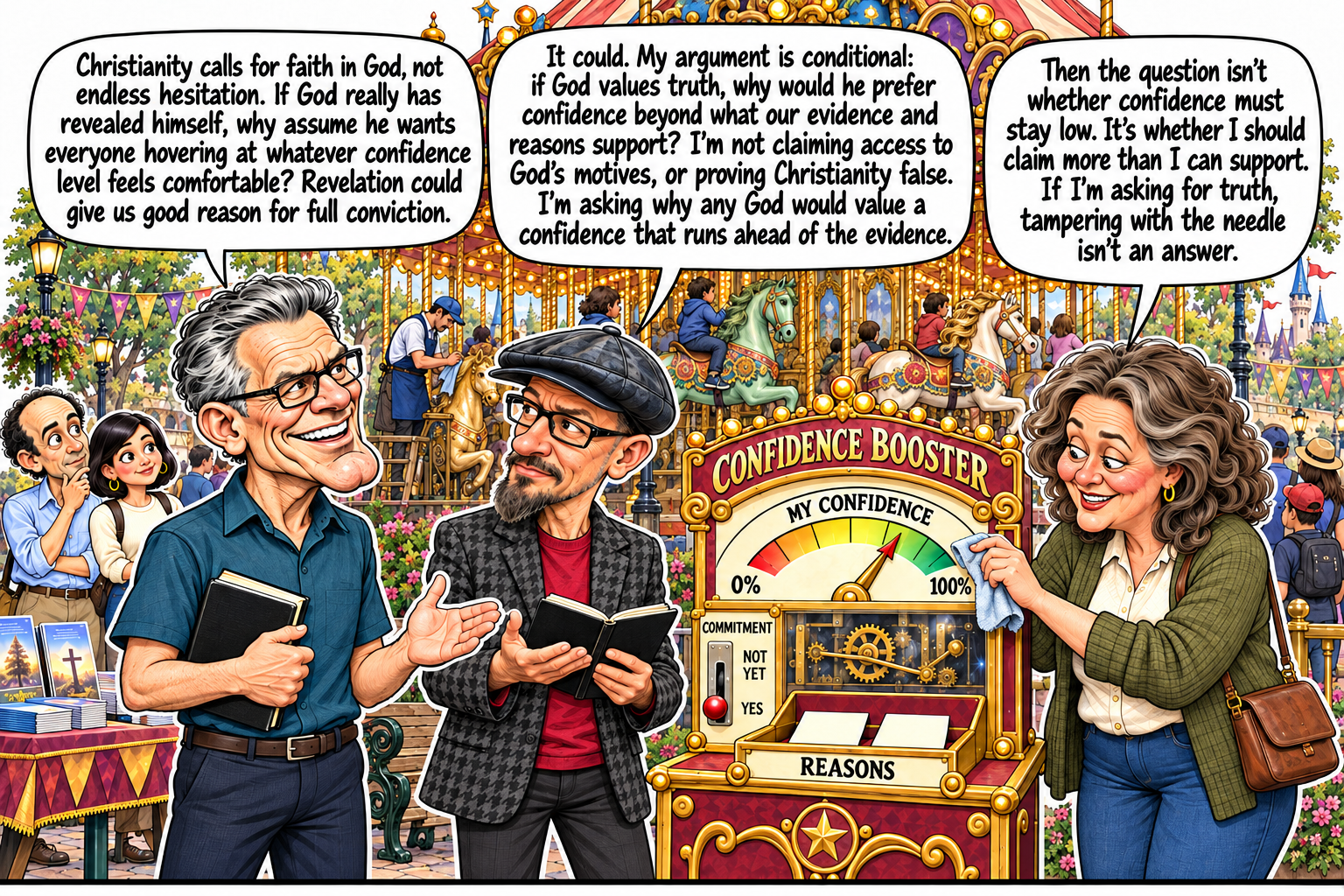

A belief does not become better supported because someone holds it more intensely. Confidence can outrun the reasons for it, and calling the excess “faith” does not close the distance. The skeptical challenge is precise: when we ask what is true, the strength of our belief should answer to the strength of the relevant reasons. Commitment can be wholehearted while our assessment remains uncertain.
The booth has two controls for a reason
We routinely act without certainty. We choose a treatment, trust a friend or accept a job while acknowledging possibilities that could make the decision turn out badly. The decision may be definite even though the belief supporting it is qualified. Costs, benefits and available alternatives help determine what to do; they do not, merely by mattering to us, change what is likely to be true.
Religious commitment can be understood in the same way. A person might decide to practice Christianity while remaining uncertain about some of its claims. Whether that particular commitment is wise requires further discussion, but the distinction is coherent. “I will live this way despite uncertainty” is different from “my decision has removed the uncertainty.” The commitment lever and the confidence dial are not interchangeable parts.
If faith means reliance, allegiance or hope under uncertainty, the central objection is not to that meaning. The objection arises when faith is asked to increase confidence beyond what the reasons support. A stronger decision is then being mistaken for a stronger case. The machine has become persuasive by connecting a handle to the display instead of to the evidence.
A reasonable trust is not an unlimited guarantee
A child may have excellent reasons to trust caring parents. Parents possess knowledge the child cannot independently reconstruct, and testimony is an indispensable source of evidence. Adults depend on testimony too. Demanding a personal investigation of every claim would make ordinary learning impossible. Skepticism should not turn childhood dependence into an intellectual offense.
Yet a source's reliability has limits and domains. Being dependable about safety, meals and school does not automatically establish expertise about every religious proposition. Parents may transmit an inherited conviction with complete sincerity while lacking grounds strong enough to warrant the certainty they communicate. The child's confidence is psychologically understandable without thereby measuring the strength of the historical or theological case.
Changing the family's religion exposes this limitation. Similar trust can produce confidence in incompatible propositions. That fact alone does not prove all the propositions false, or make testimony useless: fallible methods can still convey truth. It does show that the intensity of inherited conviction cannot decide between the competing claims. We need additional reasons that distinguish the reliable testimony from the mistaken testimony. A loving delivery does not authenticate everything in the package.
The degree of belief should remain answerable to reasons
When an adult revisits an inherited belief, the rational question is how much support remains after relevant evidence and objections are considered. If the case strengthens, confidence should rise. If the case weakens, confidence should fall. A policy that permits only increases is a loyalty mechanism masquerading as inquiry.
The numerical dials in the comic illustrate that principle; they do not measure Christianity. We have not calculated a universal probability for the resurrection, and people need not attach exact percentages to every judgment. “Plausible but unresolved,” “strongly supported,” and “very doubtful” can express meaningful differences. When the evidence warrants a range, a precise-looking number may conceal rather than improve the assessment.
Nor is a person's current feeling automatically the correct standard. Someone can underestimate good evidence, overlook a serious objection or misjudge an informant's reliability. The task is to improve the assessment of the reasons, not merely to ratify whichever confidence level feels comfortable. The principle constrains both religious certainty and skeptical certainty. Disbelief gets no complimentary turn of the crank.
What independent work is faith doing?
Consider a person whose careful assessment leaves substantial uncertainty. If further testimony, an argument or an experience supplies new support, increased confidence may be justified. The new support must still be evaluated, but something has entered the case. If nothing new enters and confidence rises solely because the person is encouraged to have more faith, the uncertainty has been bypassed rather than answered.
Calling faith an independent route to truth raises a further question: how does that route distinguish truth from error? Different religious commitments can generate intense conviction in incompatible answers. That does not show that every spiritual experience is worthless. It means conviction alone lacks the needed power to discriminate. An alleged revelation might be evidence, but its identification as revelation is itself a claim requiring assessment.
A method need not be infallible to be useful. It does need some defensible connection to truth and some means of identifying or correcting mistakes. Where faith tracks good reasons, those reasons justify the belief. Where it exceeds them, the excess remains unsupported. Where conflicting claims are certified merely by faith, repeating the certificate does not identify the true claimant. An independent method cannot be established simply by renaming confidence.
Tomorrow's evidence cannot justify yesterday's excess
A believer may report transformation or a powerful experience after committing. Such an experience can be real, significant and worth investigating. Its evidential force depends on what it supports compared with alternative explanations. The strength of an experience and the truth of its religious interpretation are different questions.
If new evidence does strengthen the case, it can justify greater confidence from that point onward. It does not retroactively supply reasons unavailable before the experience. The earlier decision to investigate or participate might have been sensible as an action under uncertainty. That does not mean an earlier claim to certainty was evidentially warranted. A later successful journey does not change how much information was available when the ticket was bought.
The same standards should apply when another religion reports confirmation after commitment. Symmetry means comparable scrutiny, not a declaration that all traditions have equal evidence or equally likely conclusions. A Christian may argue that Christianity has a stronger case. The skeptical request is to show the relevant difference rather than treat one's own assurance as evidence while dismissing everyone else's as psychology.
A truth-valuing God would still need a reason to prefer overconfidence
The theological challenge is conditional. If God exists and values truth, what reason is there to think he wants confidence beyond the support available to a person? A believer might answer that trust, obedience or relationship matters too. Those aims could bear on action and commitment. They do not by themselves increase the probability of the proposition being believed.
This argument does not establish God's private intentions or prove Christianity false. It asks the defender of evidential overconfidence to explain its supposed virtue. If God supplies additional reasons, confidence can properly rise. If the reasons remain unchanged, treating greater certainty as spiritually superior makes truth-sensitive revision harder without making the belief more accurate.
The skeptical conclusion is therefore demanding but ordinary: examine the reasons, distinguish them from the force of conviction, and revise in either direction. Faith may name a commitment. It cannot earn additional evidential authority by insisting on a louder answer. The degree of belief belongs with the degree of support. The rest is decoration on the dial.