APOLOPLEX

Episode 08 / The Evidence Trail

The Map That Can't Be Wrong

A closed gate starts a conversation about what would make a belief change.

When should evidence change a Christian claim? A comic examines confirmation, historical testimony and private experience, with objections and skeptical analysis.

An argument takes a day out

John, Michael, Phil, Alex and Ruth
Evidence, correction and protected commitments

An imagined conversation. All dialogue, anecdotes, actions and park incidents are fictional.

Use ← and → to move between scenes.

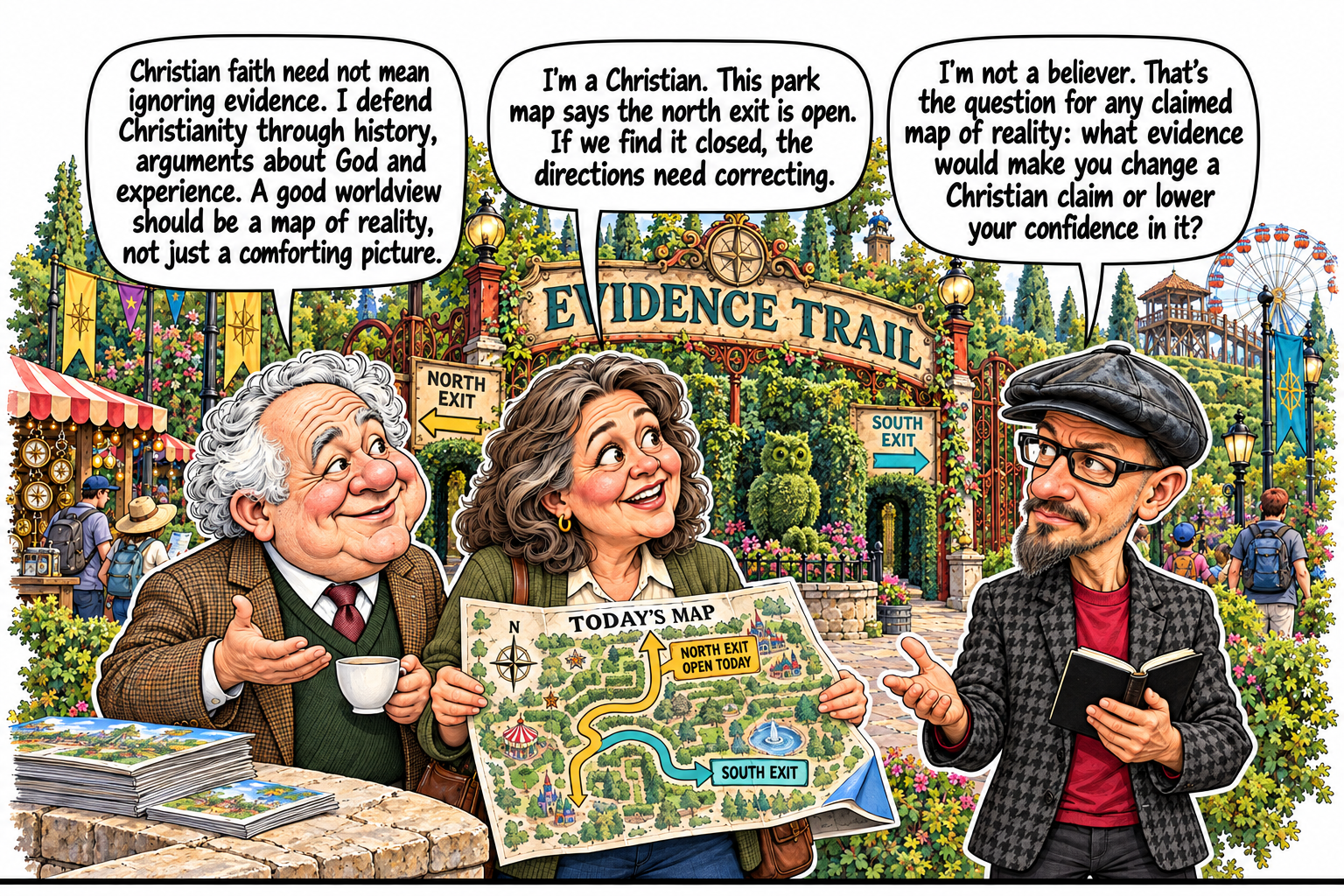
Scene 1: A map of the evidence. John gestures with an open hand while holding a teacup beside Ruth, who presents a folded park map. Its yellow north route is labelled NORTH EXIT OPEN TODAY; the teal route is labelled SOUTH EXIT. Phil holds his notebook and raises an open hand. Behind them, the Evidence Trail arch and separate north and south direction signs stand amid hedges, flowers, a compass stall and passing visitors.
SCENE 01 / 12View / zoom image ↗
Read dialogue

John gestures with an open hand while holding a teacup beside Ruth, who presents a folded park map. Its yellow north route is labelled NORTH EXIT OPEN TODAY; the teal route is labelled SOUTH EXIT. Phil holds his notebook and raises an open hand. Behind them, the Evidence Trail arch and separate north and south direction signs stand amid hedges, flowers, a compass stall and passing visitors.

John: Christian faith need not mean ignoring evidence. I defend Christianity through history, arguments about God and experience. A good worldview should be a map of reality, not just a comforting picture.

Ruth: I'm a Christian. This park map says the north exit is open. If we find it closed, the directions need correcting.

Phil: I'm not a believer. That's the question for any claimed map of reality: what evidence would make you change a Christian claim or lower your confidence in it?

Notes from the queue · 01

A map of the evidence

Calling a belief a map invites a question about how it responds when the territory disagrees.

The park comparison concerns correction. It does not turn a geographical mistake into a verdict about God.

A deeper dive

What the comparison commits us to

John offers Christianity as an account of reality supported by reasons. That is a legitimate ambition. Once a claim is defended by evidence, however, it is fair to ask which evidence matters and what could weaken the case. A description that fits every imaginable result can remain logically possible while failing to distinguish the world we find from worlds we do not.

The park map makes one modest commitment: the north exit is open today. Finding the correct gate chained shut would conflict with that instruction. The example isolates the connection between a claim and a potential correction. It does not suggest that all Christian claims have the simplicity of a gate status or can be settled by a walk.

Reasons need consequences

An evidence-led account need not begin without assumptions, rely only on direct observation, or promise certainty. It should make clear how observations and arguments affect confidence. Historical evidence, philosophical reasoning and experience may have different roles. A statement of willingness to reconsider becomes informative when it identifies a possible loss and the belief or degree of confidence that would change.

The skeptical question is therefore specific, not a demand that John abandon Christianity before the conversation begins. The discussion asks whether evidence can do corrective work. The same demand will apply to the visitors who criticize his case.

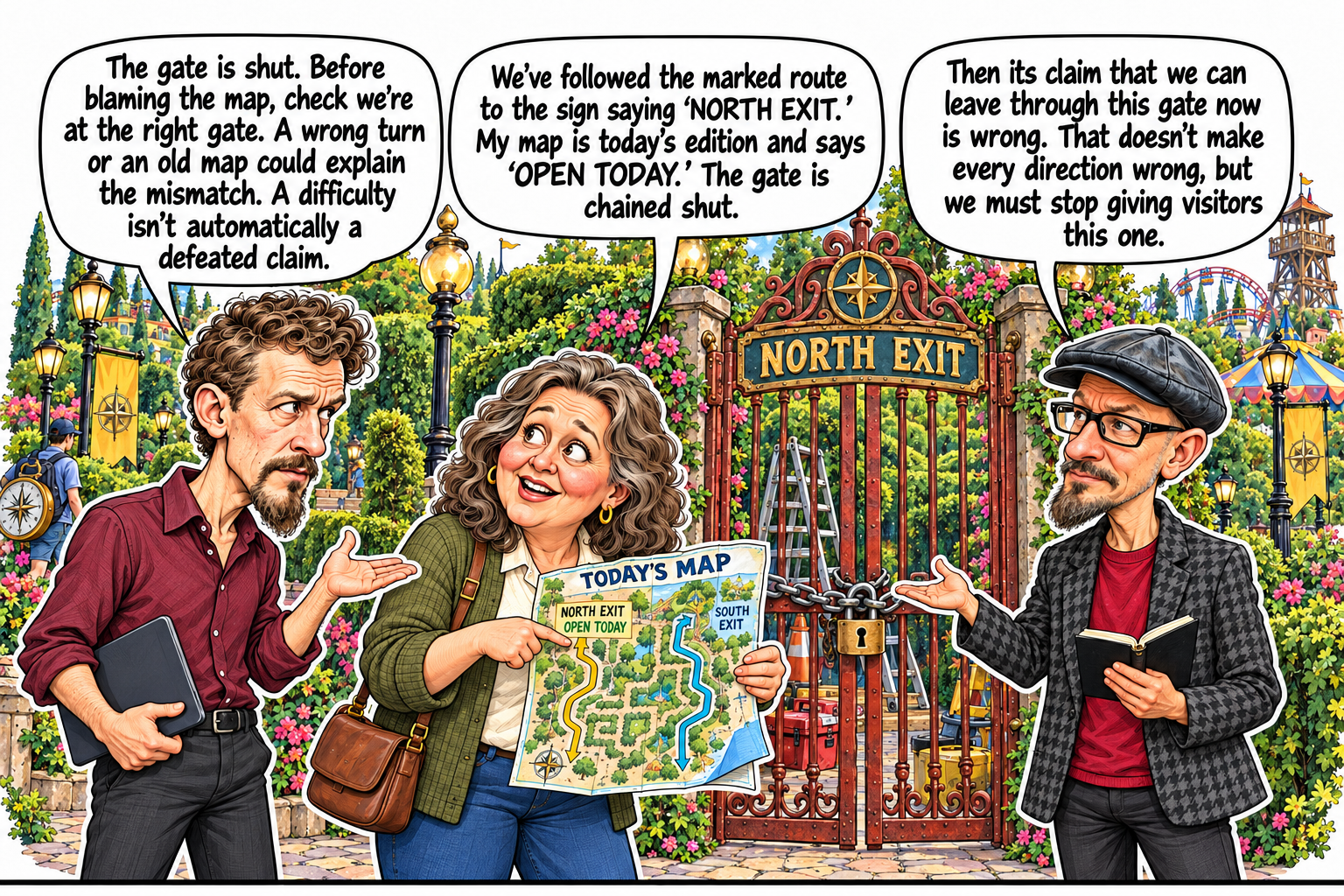
Scene 2: Are we at the right gate?. Michael, Ruth and Phil stand before a closed red gate labeled NORTH EXIT. A single chain and padlock secure it, with a ladder and toolbox beyond the bars. Ruth points just beneath NORTH EXIT / OPEN TODAY on her loose map, whose yellow and teal routes and blue folded corner remain visible. Michael holds his tablet and an open palm; Phil gestures toward the chain while holding his notebook.
SCENE 02 / 12View / zoom image ↗
Read dialogue

Michael, Ruth and Phil stand before a closed red gate labeled NORTH EXIT. A single chain and padlock secure it, with a ladder and toolbox beyond the bars. Ruth points just beneath NORTH EXIT / OPEN TODAY on her loose map, whose yellow and teal routes and blue folded corner remain visible. Michael holds his tablet and an open palm; Phil gestures toward the chain while holding his notebook.

Michael: The gate is shut. Before blaming the map, check we're at the right gate. A wrong turn or an old map could explain the mismatch. A difficulty isn't automatically a defeated claim.

Ruth: We've followed the marked route to the sign saying 'NORTH EXIT.' My map is today's edition and says 'OPEN TODAY.' The gate is chained shut.

Phil: Then its claim that we can leave through this gate now is wrong. That doesn't make every direction wrong, but we must stop giving visitors this one.

Notes from the queue · 02

Are we at the right gate?

Check that the observation actually conflicts with the claim. Here the gate name, route and current instruction agree; the chain contradicts the access claim.

A mistake in one instruction warrants correcting that instruction. Further conclusions need further evidence.

A deeper dive

First establish the mismatch

Michael raises legitimate alternatives. The visitors could have taken a wrong turn, reached a different gate or read an obsolete edition. Any of those errors would weaken the inference from a blocked gate to an inaccurate current instruction. Investigating them is responsible inquiry, not necessarily an attempt to evade evidence.

Ruth answers those alternatives in the dialogue: the marked route leads to the named north exit, the guide is the current edition, and it says the exit is open today. The chain supplies direct contrary evidence about access now. The map can be well made in other respects while that instruction is wrong.

Keep the correction proportional

A broad theory contains many claims and supporting assumptions. An unexpected observation does not identify the faulty component by itself. A measuring instrument might fail; a background condition might have changed. The task is to locate the error using further evidence, not to declare every difficulty decisive or every repair suspicious.

The visitors need not resolve all cartographic reliability before changing the immediate advice. Recommending this gate as an available exit is now unjustified. That practical consequence is part of acknowledging the error. No theological conclusion follows from the chain alone.

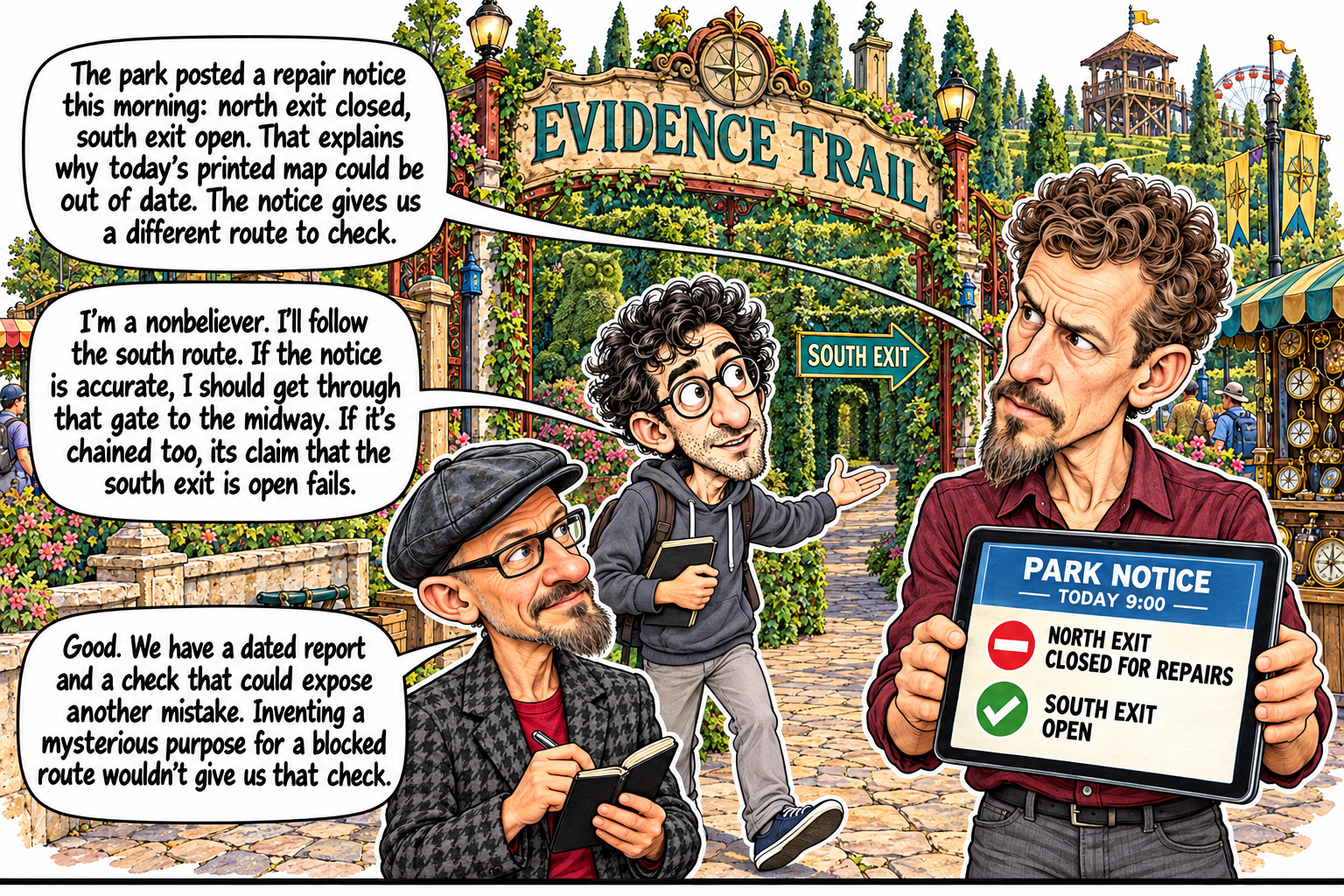
Scene 3: A reason we can check. Three speech balloons descend at left toward Michael, Alex and Phil. Michael holds a tablet displaying a park notice dated TODAY9:00: NORTH EXIT CLOSED FOR REPAIRS and SOUTH EXIT OPEN. Alex gestures toward the teal south-exit arrow with one foot raised to begin walking. Phil holds a pen and notebook. The Evidence Trail arch, hedges, tower and compass stall fill the background.
SCENE 03 / 12View / zoom image ↗
Read dialogue

Three speech balloons descend at left toward Michael, Alex and Phil. Michael holds a tablet displaying a park notice dated TODAY9:00: NORTH EXIT CLOSED FOR REPAIRS and SOUTH EXIT OPEN. Alex gestures toward the teal south-exit arrow with one foot raised to begin walking. Phil holds a pen and notebook. The Evidence Trail arch, hedges, tower and compass stall fill the background.

Michael: The park posted a repair notice this morning: north exit closed, south exit open. That explains why today's printed map could be out of date. The notice gives us a different route to check.

Alex: I'm a nonbeliever. I'll follow the south route. If the notice is accurate, I should get through that gate to the midway. If it's chained too, its claim that the south exit is open fails.

Phil: Good. We have a dated report and a check that could expose another mistake. Inventing a mysterious purpose for a blocked route wouldn't give us that check.

Notes from the queue · 03

A reason we can check

The repair notice is a report worth checking, not an infallible replacement for the map. Alex states the possible failure before he walks the route.

A supported correction names both a reason to reconsider and a different expectation that can itself be wrong.

A deeper dive

A repair with evidence behind it

The earlier park notice is evidence for an operational change: a closure for repairs and an available south exit. It is not merely a story invented from the inconvenience. Its source, time and content can be inspected by the group. Those features give the explanation some support apart from the desire to preserve the map.

The notice could still be mistaken or superseded. Alex therefore names a further check: follow the south route and see whether he can pass through the gate to the midway. A second locked gate would conflict with the notice’s claim of current access. The earlier timestamp is not itself a guarantee, and a later change in conditions would need its own evidence.

More than room for an excuse

A proposed hidden purpose for the blockage could be logically possible. Without a reason to expect this particular result, it supplies no comparable route check. The difference is not between an explanation with extra detail and one without it. It is between detail supported by accessible information and detail added only to accommodate what has already happened.

This is an illustration of a good correction, not a rule that every legitimate explanation must produce an immediate experiment. In history, an independently dated record or evidence of textual dependence might perform the same corrective role. The relevant requirement is an accountable connection between reasons, expectations and revision.

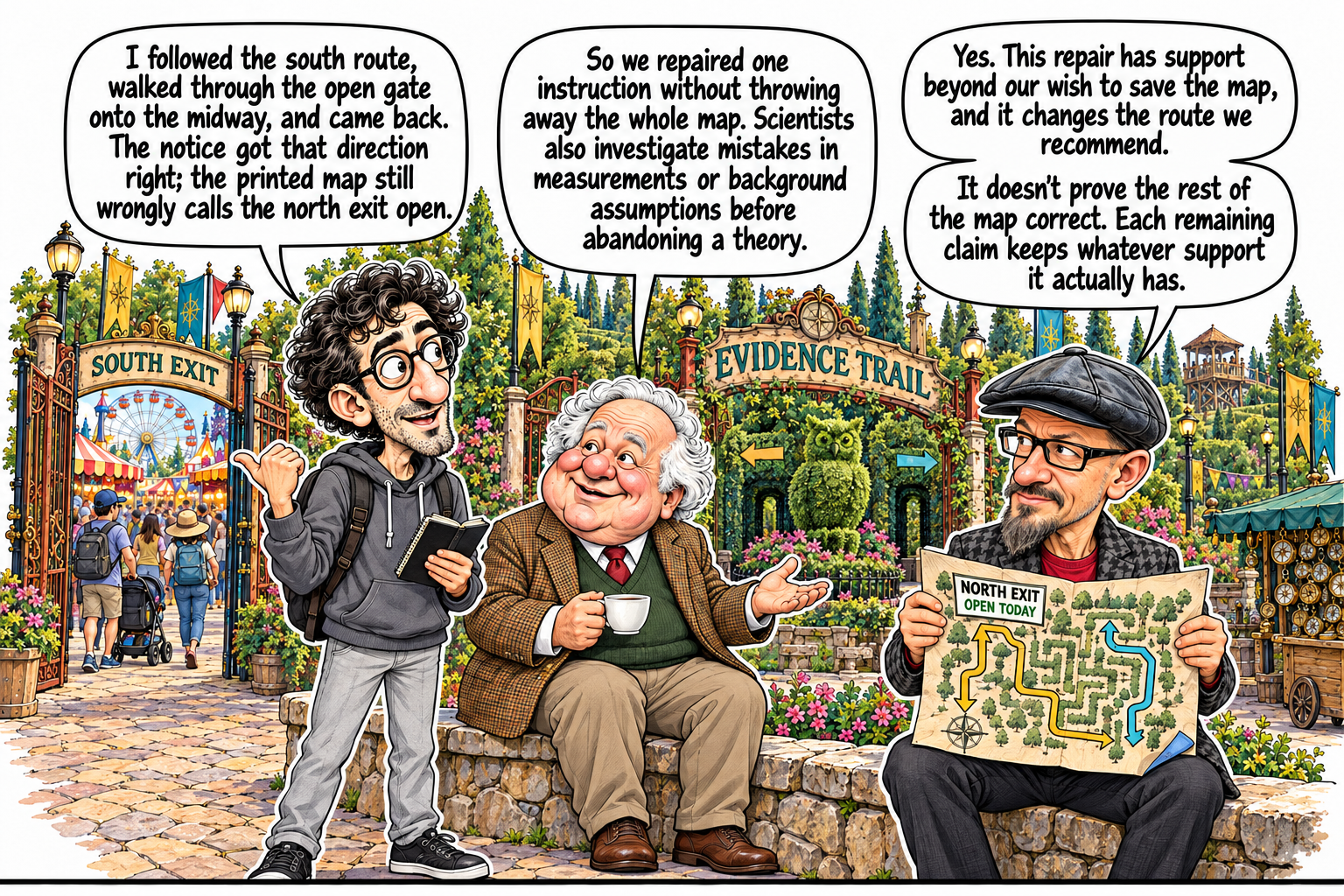
Scene 4: The route changes. Alex stands at left and points his thumb back toward the open SOUTH EXIT, where visitors walk onto the midway. John sits on the wall with a white teacup and open palm. Phil sits at right holding the loose map, whose yellow north route is still marked OPEN TODAY; its teal route and blue corner fold remain visible. The Evidence Trail arch, owl topiary and compass stall surround the conversation.
SCENE 04 / 12View / zoom image ↗
Read dialogue

Alex stands at left and points his thumb back toward the open SOUTH EXIT, where visitors walk onto the midway. John sits on the wall with a white teacup and open palm. Phil sits at right holding the loose map, whose yellow north route is still marked OPEN TODAY; its teal route and blue corner fold remain visible. The Evidence Trail arch, owl topiary and compass stall surround the conversation.

Alex: I followed the south route, walked through the open gate onto the midway, and came back. The notice got that direction right; the printed map still wrongly calls the north exit open.

John: So we repaired one instruction without throwing away the whole map. Scientists also investigate mistakes in measurements or background assumptions before abandoning a theory.

Phil: Yes. This repair has support beyond our wish to save the map, and it changes the route we recommend. It doesn't prove the rest of the map correct. Each remaining claim keeps whatever support it actually has.

Notes from the queue · 04

The route changes

The checked south route changes the group’s advice. It does not retroactively make the printed north instruction right.

Correcting one part can preserve a larger framework when the remaining parts still have support.

A deeper dive

What the successful walk establishes

Alex reports reaching the midway through the south gate and returning. That is support for the notice’s access claim at the time of his walk. It also makes the revised advice useful: visitors should take the checked route. The correction therefore changes behavior as well as wording.

The walk does not independently establish every detail of the maintenance explanation, certify all park notices, or guarantee that the south gate will stay open indefinitely. Access and the reason for closure are distinguishable claims. The present check bears most directly on the former; the dated notice and visible repair equipment offer separate, defeasible support for the latter.

Keeping a framework can be reasonable

John’s analogy to scientific repair is fair. A well-supported framework need not be discarded whenever a peripheral expectation fails. Checking observations and revising a subsidiary assumption can improve it. Responsible persistence differs from immunity because the revision is constrained by evidence and leaves room for further failure.

The original map did not accurately describe the north exit merely because a replacement instruction worked. Admitting exactly what changed prevents a common confusion: preserving part of an account is presented as vindicating the whole original account. The group can keep useful directions while withdrawing the false one.

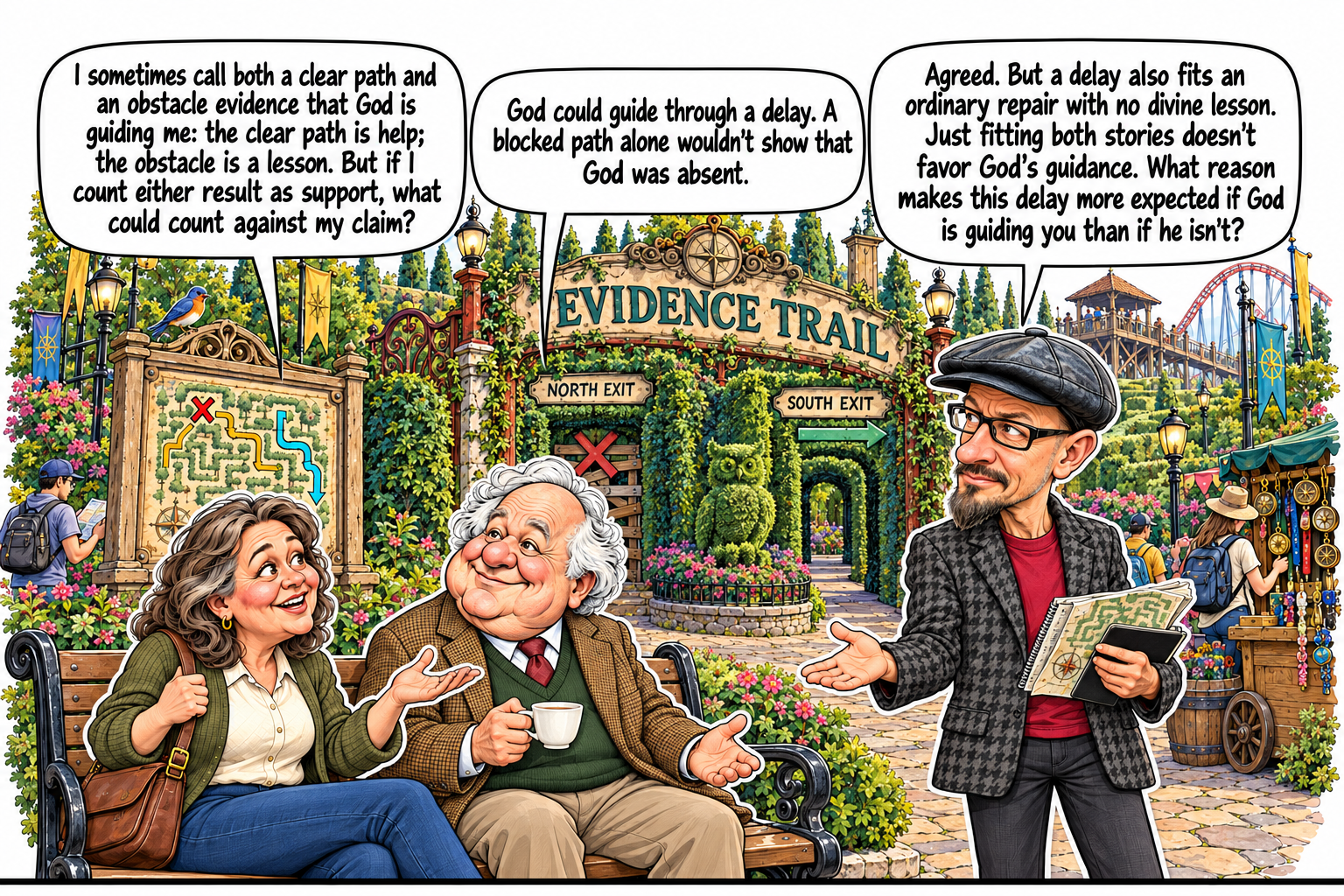
Scene 5: When both outcomes count as success. Ruth and John sit on a park bench while Phil stands at right. Ruth holds her bag strap and raises an open palm; John holds a white teacup and opens his other hand. Phil holds a map and notebook while responding with an open palm. A blocked north route, open south hedge passage, owl topiary, map board and compass cart fill the background.
SCENE 05 / 12View / zoom image ↗
Read dialogue

Ruth and John sit on a park bench while Phil stands at right. Ruth holds her bag strap and raises an open palm; John holds a white teacup and opens his other hand. Phil holds a map and notebook while responding with an open palm. A blocked north route, open south hedge passage, owl topiary, map board and compass cart fill the background.

Ruth: I sometimes call both a clear path and an obstacle evidence that God is guiding me: the clear path is help; the obstacle is a lesson. But if I count either result as support, what could count against my claim?

John: God could guide through a delay. A blocked path alone wouldn't show that God was absent.

Phil: Agreed. But a delay also fits an ordinary repair with no divine lesson. Just fitting both stories doesn't favor God's guidance. What reason makes this delay more expected if God is guiding you than if he isn't?

Notes from the queue · 05

When both outcomes count as success

A possible lesson may keep divine guidance compatible with the delay. Compatibility alone does not show that divine guidance explains it better.

The question concerns Ruth’s practice of counting every outcome as support, not whether God could ever guide someone.

A deeper dive

A method with no losing result

Ruth identifies a particular rule: a clear path confirms guidance, and an obstacle also confirms guidance because it can be called a lesson. John correctly replies that a delay cannot, by itself, exclude every possible divine purpose. A person could intend a lesson that others do not understand. Possibility deserves that limited concession.

The concession does not establish the alleged intention. Ordinary maintenance can produce a delay without a divine lesson. If an event is offered as evidence favoring one explanation, the advocate needs a reason to expect that event more under that explanation than under the relevant alternative. Merely making the event compatible with a flexible story does not supply that reason.

No invented probabilities

The scene assigns no numerical chances and does not assume the rival explanations are equally probable. Their mere compatibility leaves the comparative evidential claim unestablished. Other evidence could favor one explanation, but it must be supplied and assessed rather than smuggled in through the word “guidance.”

Nor does every favorable observation need an equal and opposite unfavorable observation of identical weight. Evidence varies in quality. The concern is a rule that grants credit for success while ensuring that no relevant failure can reduce confidence. The remedy is to specify what the claim leads us to expect, why, and what would count as a genuine loss.

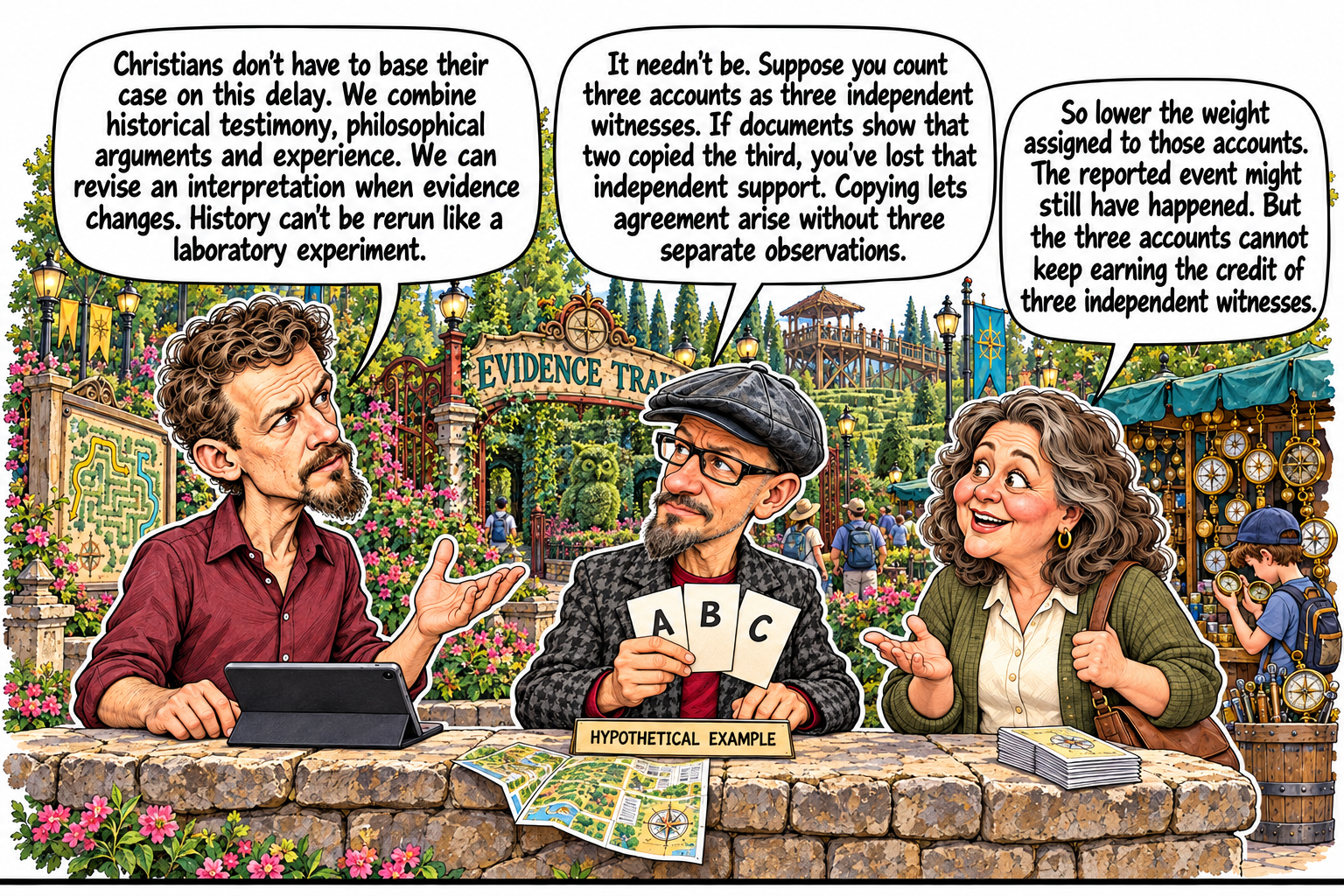
Scene 6: What the records could change. Michael gestures beside his tablet on a low stone wall. Phil holds three plain fanned cards marked A, B and C above a label reading HYPOTHETICAL EXAMPLE. Ruth responds with an open palm and her other hand on her bag strap. A folded park map lies on the wall. Behind them are the Evidence Trail arch, hedges, an owl topiary, a tower and a compass stall with visitors.
SCENE 06 / 12View / zoom image ↗
Read dialogue

Michael gestures beside his tablet on a low stone wall. Phil holds three plain fanned cards marked A, B and C above a label reading HYPOTHETICAL EXAMPLE. Ruth responds with an open palm and her other hand on her bag strap. A folded park map lies on the wall. Behind them are the Evidence Trail arch, hedges, an owl topiary, a tower and a compass stall with visitors.

Michael: Christians don't have to base their case on this delay. We combine historical testimony, philosophical arguments and experience. We can revise an interpretation when evidence changes. History can't be rerun like a laboratory experiment.

Phil: It needn't be. Suppose you count three accounts as three independent witnesses. If documents show that two copied the third, you've lost that independent support. Copying lets agreement arise without three separate observations.

Ruth: So lower the weight assigned to those accounts. The reported event might still have happened. But the three accounts cannot keep earning the credit of three independent witnesses.

Notes from the queue · 06

What the records could change

History can be assessed through traces and records even when its events cannot be repeated.

Three accounts copied from one source do not supply the corroboration of three independent observations. That loss does not by itself prove the reported event false.

A deeper dive

A cumulative case is allowed

Michael offers the strongest relevant response: Christian belief need not rest on the inconvenience at this gate. Its defenders may combine historical testimony, philosophical reasoning and experience. A fair critic should examine those reasons and their relationships. There is no general requirement that historical events be reproduced in a laboratory before they can be believed.

A cumulative case nevertheless has to account for dependence. Three accounts can agree because three people independently observed an event, or because two writers copied a single account. Those different origins affect how much additional confirmation the agreement provides. Counting documents is not the same as counting independent observations.

A specific historical correction

Phil explicitly supposes a case; he does not claim to have established that any particular Christian documents have this relationship. In the hypothetical, records demonstrate the copying. That discovery removes the extra support previously attributed to independence, while leaving the original account to be assessed on its own merits.

Ruth’s conclusion follows without a dramatic verdict on the event. The event may still have occurred. What must change is the evidential weight and the public description of the argument. Two copies cannot continue to be advertised as two independent confirmations once their dependence has been established. Genuine remaining reasons are not erased, but the lost reason cannot keep being counted.

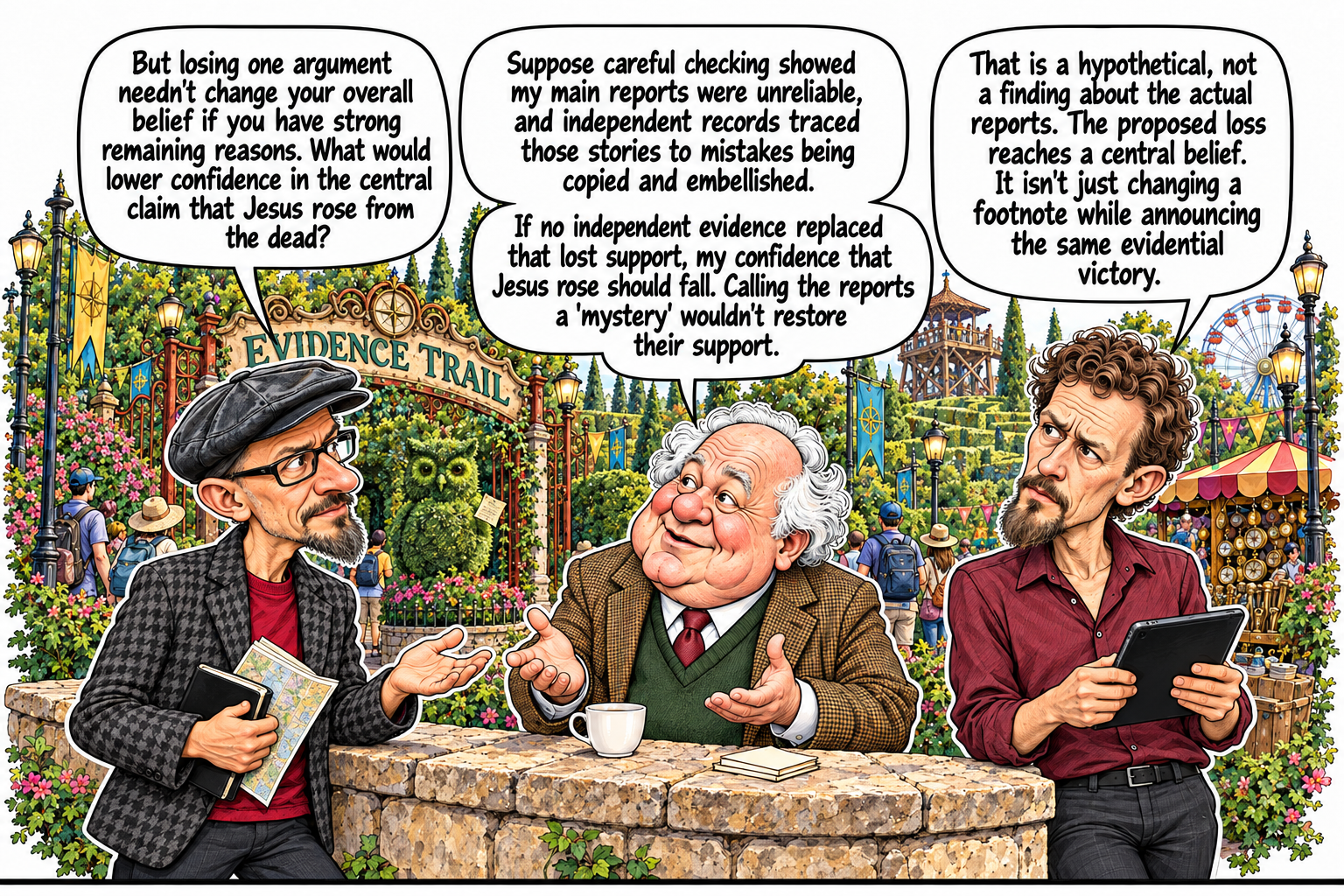
Scene 7: A loss that reaches the conclusion. Phil at left asks John in the center a question across the stone wall. John holds both palms open, with his white teacup and three plain face-down cards on the wall. Michael at right holds his tablet and listens with a tilted head. The owl topiary, Evidence Trail arch, visitors and compass stall surround them.
SCENE 07 / 12View / zoom image ↗
Read dialogue

Phil at left asks John in the center a question across the stone wall. John holds both palms open, with his white teacup and three plain face-down cards on the wall. Michael at right holds his tablet and listens with a tilted head. The owl topiary, Evidence Trail arch, visitors and compass stall surround them.

Phil: But losing one argument needn't change your overall belief if you have strong remaining reasons. What would lower confidence in the central claim that Jesus rose from the dead?

John: Suppose careful checking showed my main reports were unreliable, and independent records traced those stories to mistakes being copied and embellished. If no independent evidence replaced that lost support, my confidence that Jesus rose should fall. Calling the reports 'a mystery' wouldn't restore their support.

Michael: That is a hypothetical, not a finding about the actual reports. The proposed loss reaches a central belief. It isn't just changing a footnote while announcing the same evidential victory.

Notes from the queue · 07

A loss that reaches the conclusion

A willingness to revise matters when it names a loss and the central confidence that would fall.

The imagined historical conditions in this scene are not findings about actual resurrection accounts.

A deeper dive

From a local loss to central confidence

A person may have several substantial reasons for a belief. Losing one weak reason need not change an overall judgment very much, especially if independent evidence remains strong. Phil grants that point before asking about the central Christian claim that Jesus rose from the dead. The question is whether sufficiently important evidence can ever lower confidence in that conclusion.

John supplies a concrete conditional answer. Suppose important reports he relies on prove unreliable, and independent records trace the stories to copied and embellished mistakes. With no replacement for that support, confidence in the resurrection should fall. Those conditions are stronger and more specific than merely encountering a difficulty. Their significance follows from the role the reports were playing in his own case.

Neither a verdict nor an empty promise

Michael explicitly marks the example as hypothetical. The scene performs no actual source analysis and reaches no historical verdict about the resurrection. The value of the example is to make a proposed correction understandable before the imagined findings arrive, including what would change and why.

A generic declaration that one is open-minded would not do the same work. Nor would changing a peripheral footnote while retaining all the former evidential credit. The result required here is a real reduction in confidence in a central claim, proportionate to the loss. That need not mean certainty that the claim is false, abandonment of every religious practice, or a predetermined numerical reduction.

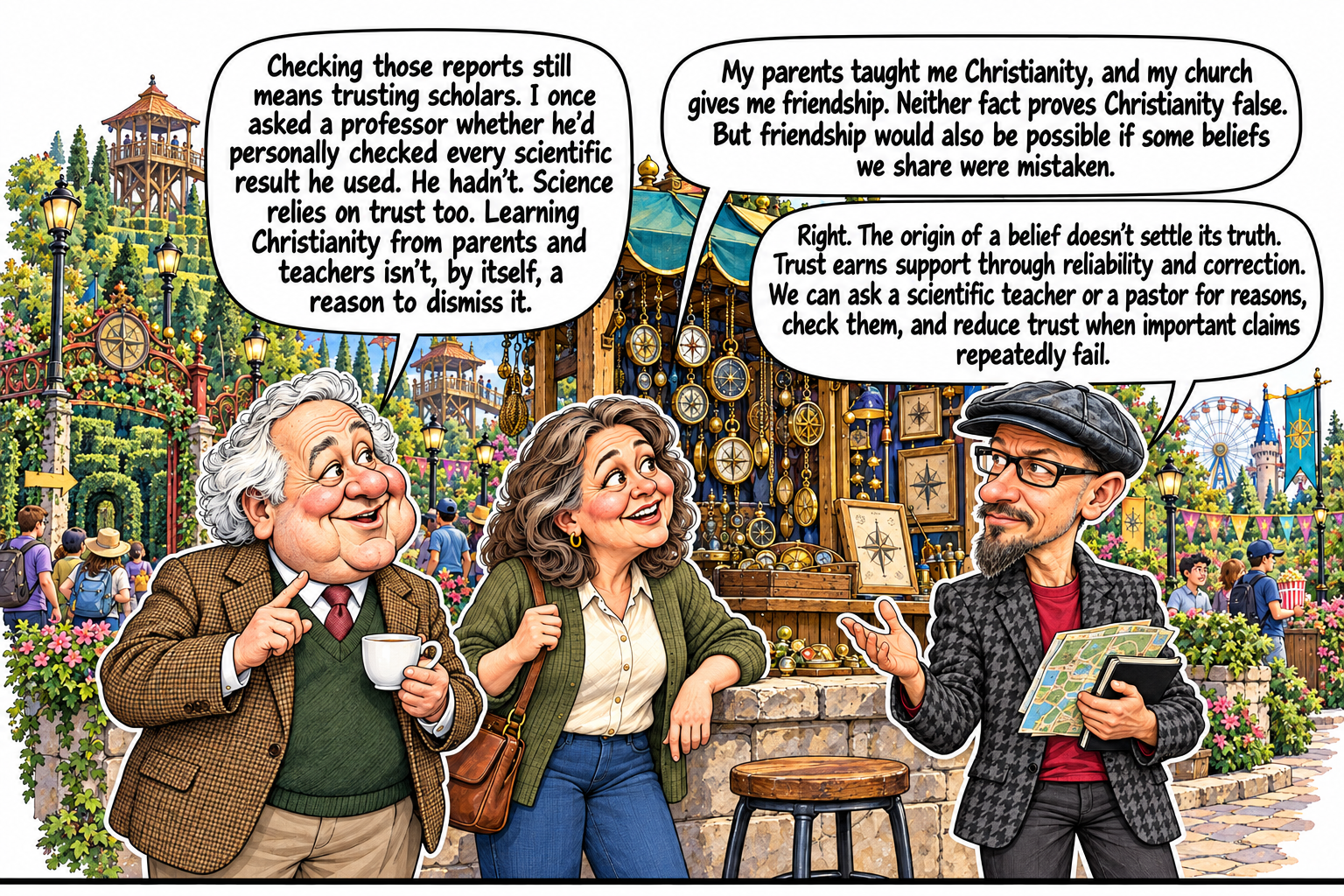
Scene 8: Trust that can be corrected. At a crowded compass stall, John at left holds a white teacup and raises one forefinger. Ruth leans on the wall in the center, holding her bag strap and smiling toward Phil. Phil at right opens one hand while holding a folded map and notebook. An empty stool stands in front; visitors, hedge paths, a tower and rides fill the background.
SCENE 08 / 12View / zoom image ↗
Read dialogue

At a crowded compass stall, John at left holds a white teacup and raises one forefinger. Ruth leans on the wall in the center, holding her bag strap and smiling toward Phil. Phil at right opens one hand while holding a folded map and notebook. An empty stool stands in front; visitors, hedge paths, a tower and rides fill the background.

John: Checking those reports still means trusting scholars. I once asked a professor whether he'd personally checked every scientific result he used. He hadn't. Science relies on trust too. Learning Christianity from parents and teachers isn't, by itself, a reason to dismiss it.

Ruth: My parents taught me Christianity, and my church gives me friendship. Neither fact proves Christianity false. But friendship would also be possible if some beliefs we share were mistaken.

Phil: Right. The origin of a belief doesn't settle its truth. Trust earns support through reliability and correction. We can ask a scientific teacher or a pastor for reasons, check them, and reduce trust when important claims repeatedly fail.

Notes from the queue · 08

Trust that can be corrected

Learning from others is unavoidable. The question is whether that reliance has checks and can be corrected.

A community’s friendship may be real and valuable even when it does not establish the truth of every shared belief.

A deeper dive

Trust does not end the inquiry

John’s professor anecdote is invented for this conversation, not a quotation or historical report. Its reasonable point is that scientific learning depends extensively on teachers, experts and institutions. Nobody personally repeats every experiment that informs ordinary life. A demand that religious people rely on no testimony would apply an impossible standard selectively.

The reply concerns the quality and revisability of trust. We can ask what supports an expert’s claims, whether others can inspect the methods, whether independent checks agree, and what happens when important errors appear. Public access does not mean every reader must become an expert. It means the grounds and rules are open in principle to competent challenge rather than protected by membership alone.

Origins and benefits are different questions

The fact that Ruth learned Christianity from her parents does not show it is false. Inferring falsity just from a belief’s origin is a mistake; upbringing also supplies many true ordinary beliefs. Conversely, inheritance does not establish truth. The present reasons and correction practices still need examination.

Friendship supplies another real good with a limited implication. A supportive community can contain mistaken beliefs, so its support does not by itself distinguish true doctrine from false doctrine. This is not a demand to abandon friendships or deny comfort. It keeps the practical value of belonging separate from the evidential status of the claims held within that community.

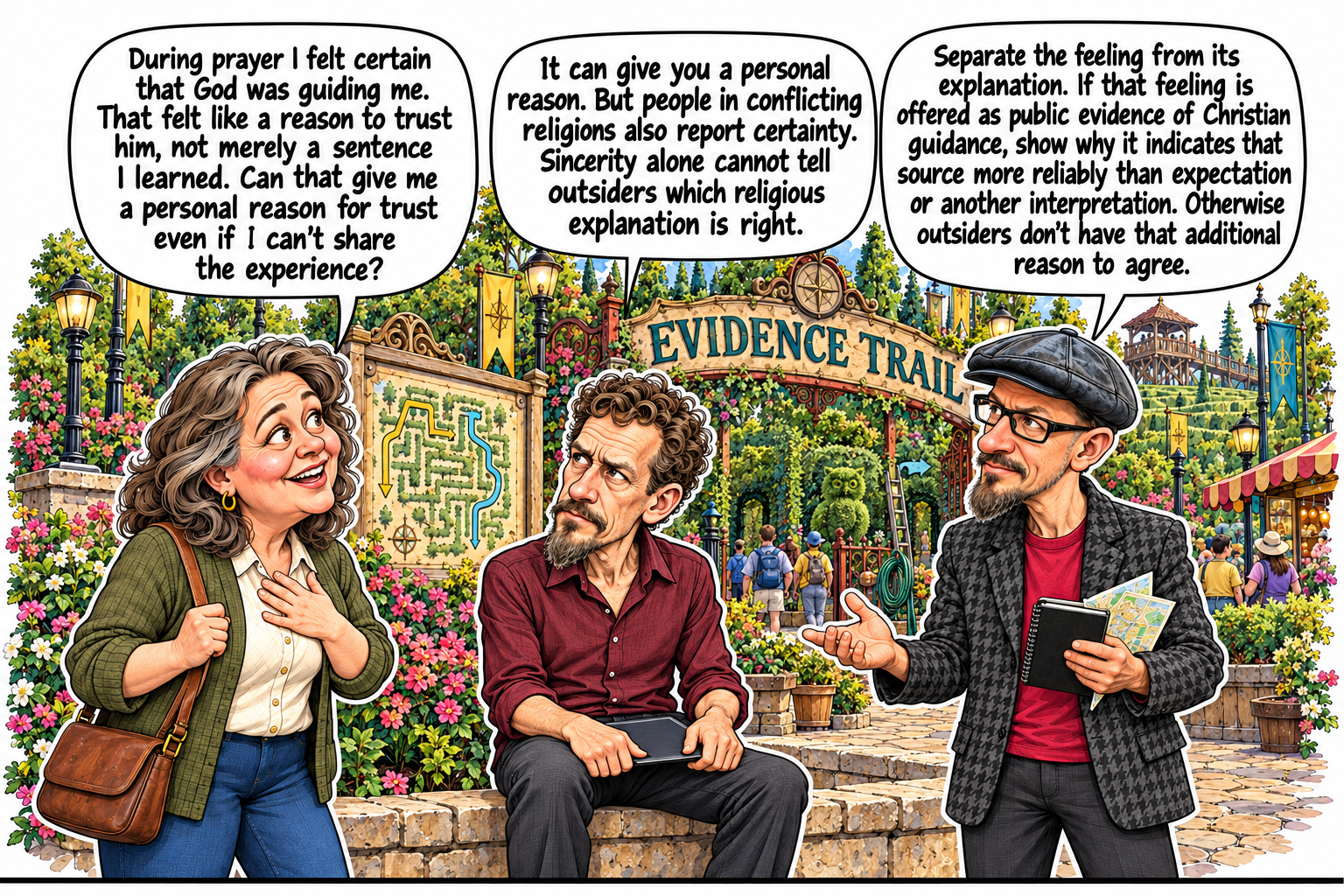
Scene 9: The feeling and the public claim. Ruth stands at left with one hand on her chest and the other on her bag strap. Michael sits on the wall in the center, facing her with both hands at the edges of a face-down tablet on his lap. Phil stands at right with an open palm, folded map and notebook. Flowers, the maze map, owl topiary and passing visitors keep the setting ordinary.
SCENE 09 / 12View / zoom image ↗
Read dialogue

Ruth stands at left with one hand on her chest and the other on her bag strap. Michael sits on the wall in the center, facing her with both hands at the edges of a face-down tablet on his lap. Phil stands at right with an open palm, folded map and notebook. Flowers, the maze map, owl topiary and passing visitors keep the setting ordinary.

Ruth: During prayer I felt certain that God was guiding me. That felt like a reason to trust him, not merely a sentence I learned. Can that give me a personal reason for trust even if I can't share the experience?

Michael: It can give you a personal reason. But people in conflicting religions also report certainty. Sincerity alone cannot tell outsiders which religious explanation is right.

Phil: Separate the feeling from its explanation. If that feeling is offered as public evidence of Christian guidance, show why it indicates that source more reliably than expectation or another interpretation. Otherwise outsiders don't have that additional reason to agree.

Notes from the queue · 09

The feeling and the public claim

Ruth’s experience can be personally significant without automatically deciding its cause for everyone else.

Public persuasion requires reasons that discriminate between explanations, not only a report of strong certainty.

A deeper dive

The experience and its interpretation

Ruth reports a feeling of certainty during prayer and treats it as a personal reason for trust. Nothing in the scene denies that she felt it. The further claim is that the feeling reliably indicates guidance from the Christian God. That claim includes an interpretation of the experience’s source, not merely a description of what she felt.

Michael’s acknowledgment leaves room for personal reasons that are not inferred from a formal argument. The criticism is narrower: a subject’s certainty does not automatically transfer to people who do not share the experience. When incompatible religious interpretations are also held sincerely, sincerity alone cannot select the true interpretation.

What an additional reason would do

A defender might provide evidence about the reliability of the claimed source, independently corroborated content, or a reason that rival explanations fit less well. Those possibilities deserve examination. The scene does not claim that all experiences are identical, equally credible, or equally probable; equal standards do not require equal verdicts.

Without the additional connection, the particular public argument remains incomplete. That does not demonstrate that the Christian explanation is false or that Ruth has no personal justification. It prevents an inflation of the conclusion: a powerful seeming is presented as if it were already a shared confirmation of its doctrinal interpretation. The demand for an accountable bridge also applies to secular interpretations of private experience.

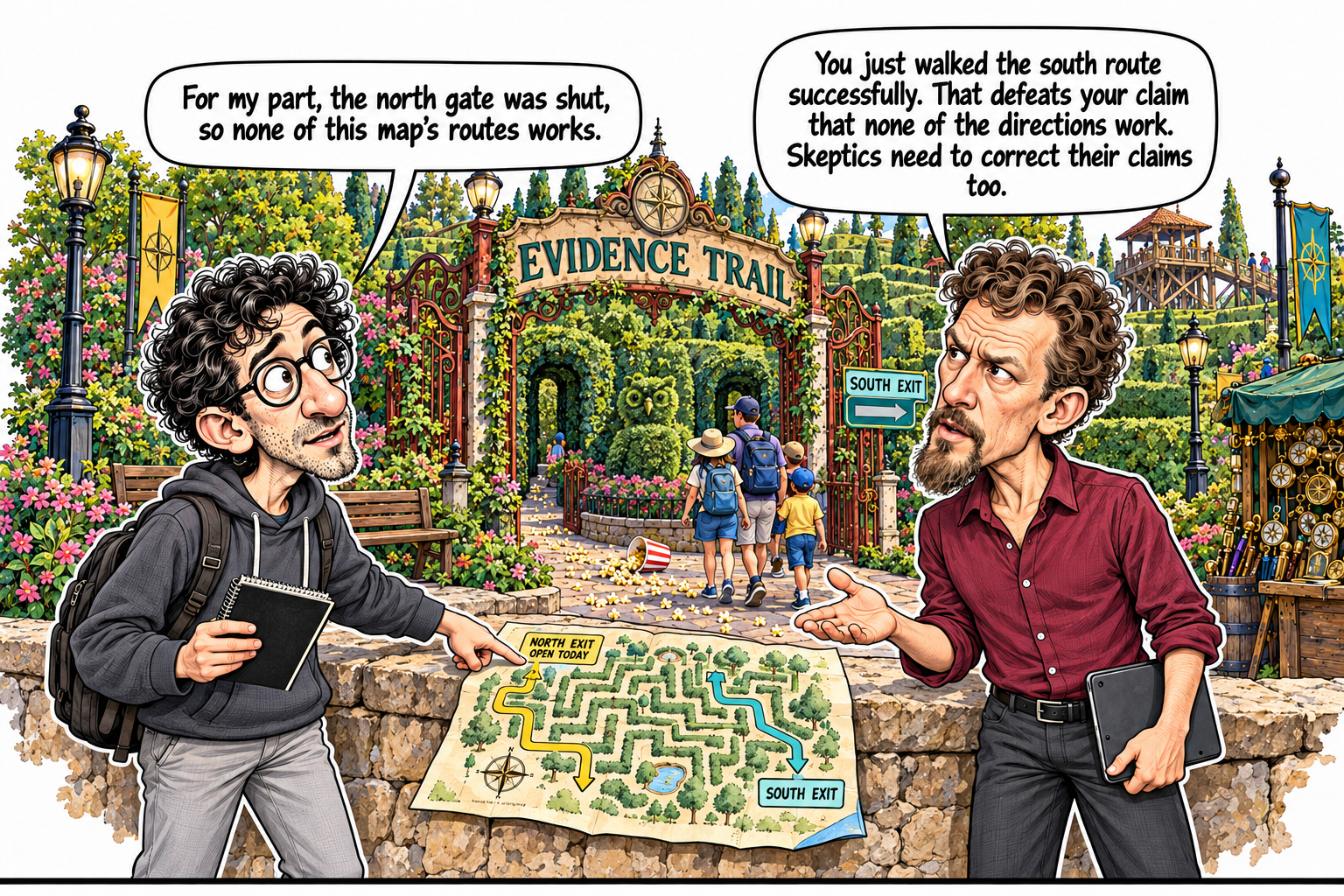
Scene 10: One route worked. Alex at left points beside NORTH EXIT / OPEN TODAY on the loose paper map resting on a low wall. Michael at right holds his tablet and opens one hand toward the conversation. The map has yellow and teal routes, a SOUTH EXIT label and a blue folded corner. Behind them, visitors walk through the park near a SOUTH EXIT direction sign, owl topiary and compass stall.
SCENE 10 / 12View / zoom image ↗
Read dialogue

Alex at left points beside NORTH EXIT / OPEN TODAY on the loose paper map resting on a low wall. Michael at right holds his tablet and opens one hand toward the conversation. The map has yellow and teal routes, a SOUTH EXIT label and a blue folded corner. Behind them, visitors walk through the park near a SOUTH EXIT direction sign, owl topiary and compass stall.

Alex: For my part, the north gate was shut, so none of this map's routes works.

Michael: You just walked the south route successfully. That defeats your claim that none of the directions work. Skeptics need to correct their claims too.

Notes from the queue · 10

One route worked

Alex’s own successful walk contradicts his claim that none of the routes works. He retracts that claim.

A deeper dive

The rule reaches the critic

Alex makes a blanket claim about the map after encountering one closed exit. Michael answers with evidence Alex himself supplied: the south route worked. This is not a vague plea for balance. A particular observed success directly contradicts the claim that no route works. Alex narrows his conclusion to the instruction actually shown wrong.

The correction leaves open how reliable the map is overall. One useful route does not certify every route, just as one wrong route does not establish universal failure. The same proportionality should govern a critic’s assessment of Christian arguments. Finding a bad defense does not prove that all defenses are bad or that the defended proposition is false.

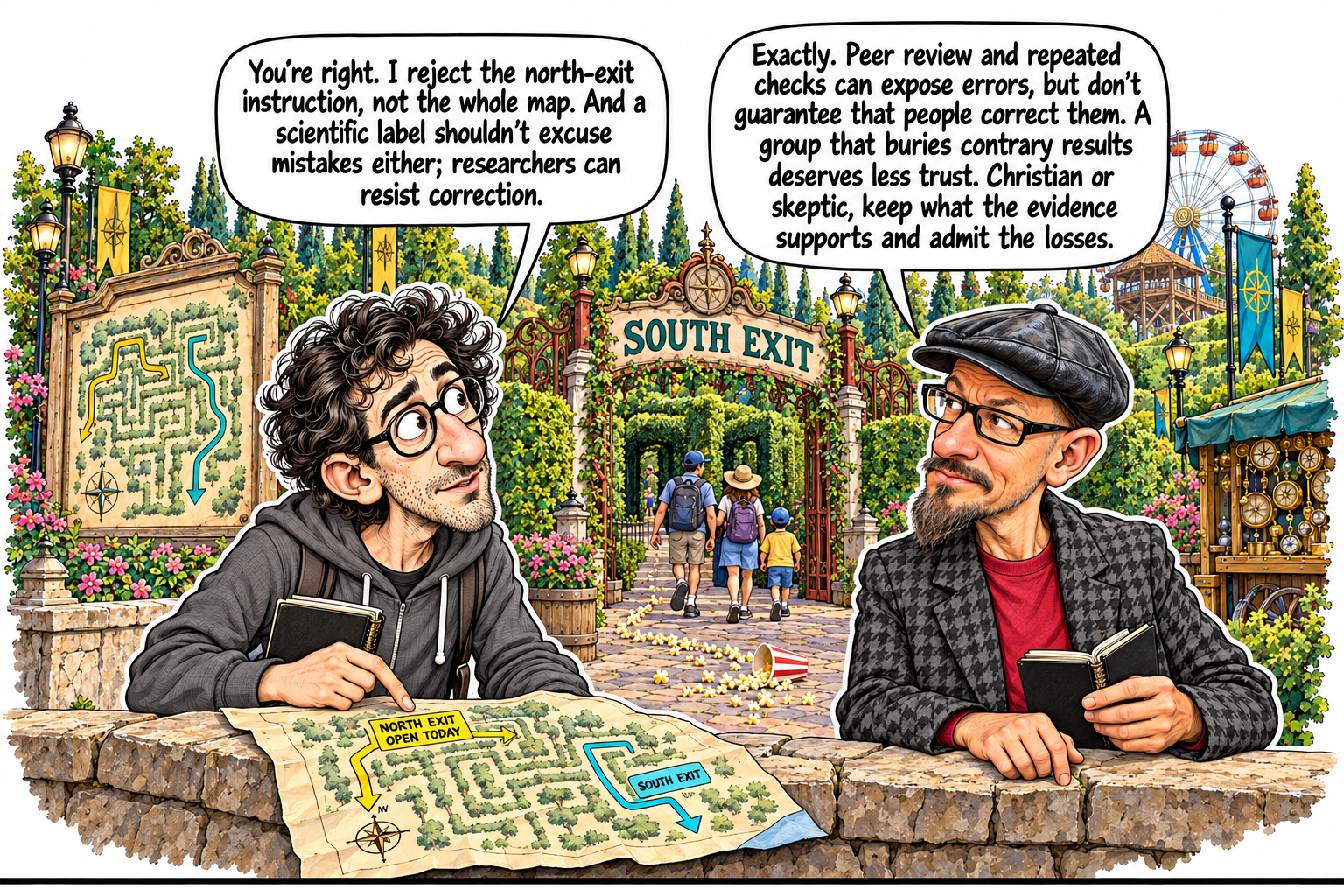
Scene 11: The skeptic corrects his map. Alex and Phil lean over a loose park map on a stone wall. Alex points beside NORTH EXIT / OPEN TODAY on the yellow route; the teal route is marked SOUTH EXIT, and the paper has a blue lower-right fold. Phil holds an open black notebook. Behind them, a family walks through an open SOUTH EXIT arch; a compass cart and spilled popcorn fill the park scene. Two separate balloons point to Alex at left and Phil at right.
SCENE 11 / 12View / zoom image ↗
Read dialogue

Alex and Phil lean over a loose park map on a stone wall. Alex points beside NORTH EXIT / OPEN TODAY on the yellow route; the teal route is marked SOUTH EXIT, and the paper has a blue lower-right fold. Phil holds an open black notebook. Behind them, a family walks through an open SOUTH EXIT arch; a compass cart and spilled popcorn fill the park scene. Two separate balloons point to Alex at left and Phil at right.

Alex: You're right. I reject the north-exit instruction, not the whole map. And a scientific label shouldn't excuse mistakes either; researchers can resist correction.

Phil: Exactly. Peer review and repeated checks can expose errors, but don't guarantee that people correct them. A group that buries contrary results deserves less trust. Christian or skeptic, keep what the evidence supports and admit the losses.

Notes from the queue · 11

The skeptic corrects his map

Scientific institutions can also fail to correct themselves. Their authority depends on what they do with evidence, not only on their name.

A deeper dive

Institutions can resist their own standards

Review by other researchers and repeated checks can reveal errors, but they do not guarantee that a community acknowledges them. Incentives, selective reporting and resistance can preserve mistakes. A skeptical argument that treats anything labeled scientific as automatically reliable would repeat the very immunity it criticizes.

The positive standard is therefore conditional for everyone: expose claims to competent criticism, retain relevant contrary findings, and make correction consequential. Trust should fall when a group buries evidence or changes its standards to protect a preferred conclusion. No psychological diagnosis of the group’s members is needed to criticize that observable practice.

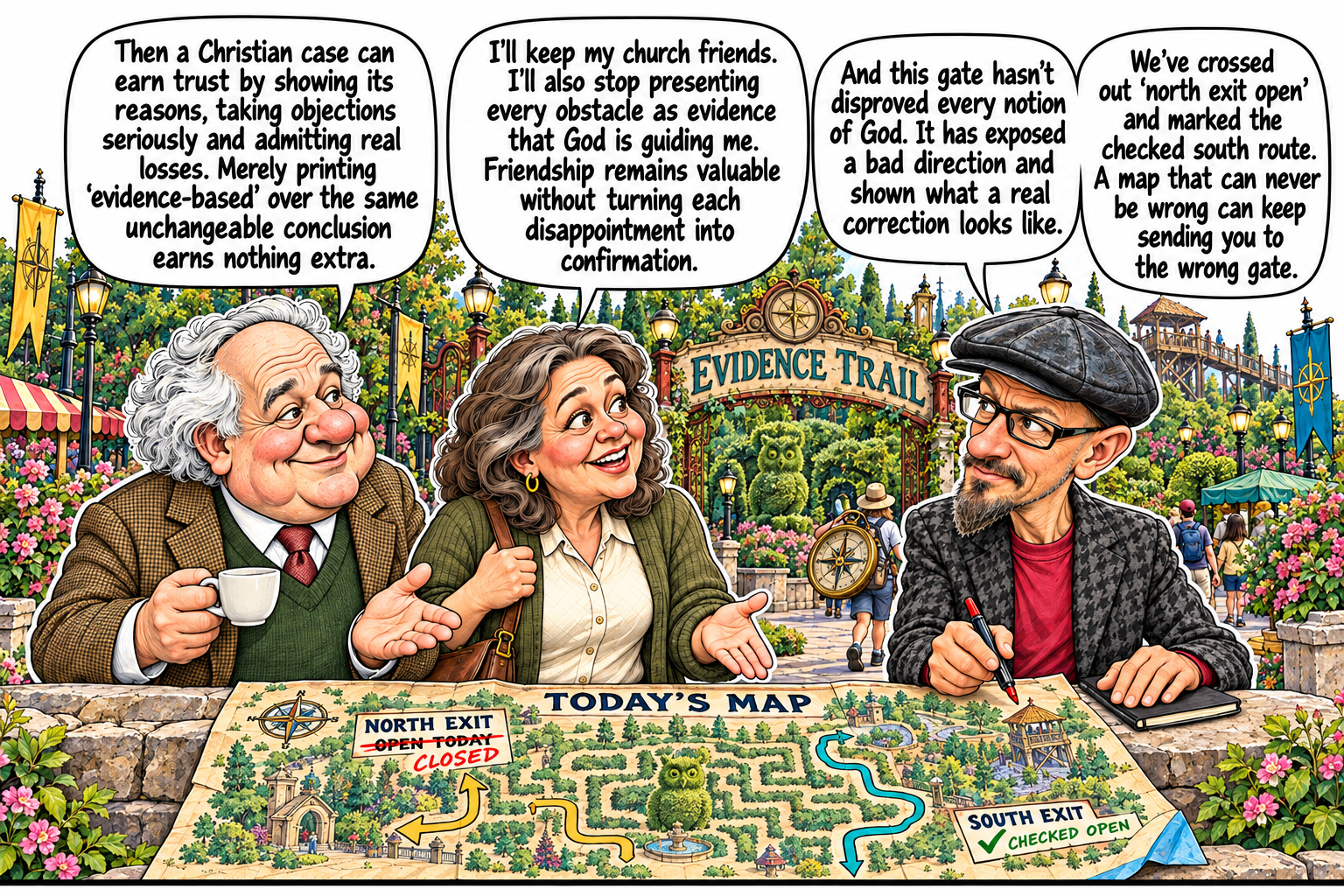
Scene 12: A correction you can use. John, Ruth and Phil stand behind a stone wall over a large park map. Its north-open claim is crossed out and marked CLOSED, while the south exit is marked CHECKED OPEN. John holds his teacup and an open palm, Ruth gestures beside her bag, and Phil holds a marker above the map with his other hand on a notebook. A visitor carrying an oversized compass walks into the park behind them.
SCENE 12 / 12View / zoom image ↗
Read dialogue

John, Ruth and Phil stand behind a stone wall over a large park map. Its north-open claim is crossed out and marked CLOSED, while the south exit is marked CHECKED OPEN. John holds his teacup and an open palm, Ruth gestures beside her bag, and Phil holds a marker above the map with his other hand on a notebook. A visitor carrying an oversized compass walks into the park behind them.

John: Then a Christian case can earn trust by showing its reasons, taking objections seriously and admitting real losses. Merely printing 'evidence-based' over the same unchangeable conclusion earns nothing extra.

Ruth: I'll keep my church friends. I'll also stop presenting every obstacle as evidence that God is guiding me. Friendship remains valuable without turning each disappointment into confirmation.

Phil: And this gate hasn't disproved every notion of God. It has exposed a bad direction and shown what a real correction looks like. We've crossed out 'north exit open' and marked the checked south route. A map that can never be wrong can keep sending you to the wrong gate.

Notes from the queue · 12

A correction you can use

The revised map preserves a record of what was wrong and gives different advice. That is the practical meaning of correction.

The conclusion concerns how claims earn support. A closed gate has settled no question about God’s existence.

A deeper dive

Correction earns something a label cannot

The ending leaves the original mistake legible. The north-open instruction is crossed out, the closure is acknowledged, and the checked south route is marked. This is useful because it alters what a traveler is advised to do. Simply renaming the blockage a successful lesson would not correct the access claim.

John extends the same principle to Christian advocacy. A case can gain credibility by supplying inspectable reasons and accepting the consequences when those reasons weaken. Scientific vocabulary may accurately describe such work, but the vocabulary cannot perform the work. A framework protected from all evidential loss has not earned the authority of a framework that permits correction.

What remains open

The story has neither proved nor disproved God, assessed the actual resurrection records, or measured anyone’s religious experience. It has identified a failure in one evidential practice: counting every outcome as confirmation while providing no way to lose that credit. Ruth can stop using that argument while retaining her friendships and other beliefs for whatever reasons remain.

The corrected map is fallible too. “Checked open” reports a check at a time, not an eternal guarantee. That limitation is a virtue of the claim’s honesty, not a defect to hide. The skeptical conclusion asks for confidence proportionate to actual support and for corrections that change what is claimed. A belief’s ability to survive every objection is not, by itself, evidence that it accurately describes reality.

After the ride · The skeptical case & private feedbackWhen nothing can count against a belief, what counts for it?Open the article and feedback formClose the article and feedback form 6 min read

A belief can survive because it keeps passing demanding checks. It can also survive because its defenders have arranged for every possible result to count as a success. Those are very different achievements. The language of evidence, models and careful inquiry cannot erase the difference. A map that sends a visitor to a locked gate has not been vindicated when the inconvenience is renamed a lesson in patience.

The skeptical challenge is not that Christians must abandon their beliefs at the first difficulty. It is that a claim advertised as evidence-led must let evidence do more than decorate an existing commitment. What could lower confidence? Who can examine the reasons? Would the same standard apply if the result favored a rival? And what would actually change after a substantial failure? These questions concern the reliability of a practice, not the sincerity or intelligence of the people using it.

A correction must change something

Start with a claim specific enough to assess. The north exit is open today. If we are at the named gate during the relevant period and a chain prevents passage, the access claim is wrong. Perhaps the map was printed before a repair closure. That explanation can be reasonable if an earlier notice or other evidence supports it. The useful response is to acknowledge the false instruction and check an alternative route.

Notice what the repair does not do. It does not make the original instruction correct, certify the rest of the map, or prove that every park notice is trustworthy. It locates a mistake and changes the advice. Large bodies of belief can be repaired in the same responsible way. The relevant question is whether the repair has support and consequences, not whether its defender has added words.

Possibility is not a successful explanation

A person who believes God guides daily events may regard an open path as help and a closed path as instruction. Either interpretation could be possible. But if both results are automatically counted as evidence of guidance, the advocate owes an account of what the alleged guidance makes more expected. An ordinary repair can also cause a delay. Merely fitting a story after the event does not show why that story deserves the evidential credit.

This distinction does not require invented probabilities. It requires an actual comparison: what is the proposed cause, what else could account for the observation, and why does the observation favor the proposal? If that comparison has not been established, we should not pretend it has. Nor should we pretend the proposals have therefore been shown equally probable. Missing support is a reason to withhold the claimed confirmation, not a proof of falsity.

An unknown purpose may block an allegation that a belief is logically impossible. It does not, just by being imaginable, demonstrate that the purpose exists or that it explains this event. The gap between those conclusions is precisely where an unfalsifiable rescue can acquire an undeserved reputation for explanatory success.

The strongest Christian answer deserves a real hearing

Christian defenders can rightly object that their case is cumulative. Historical testimony, philosophical arguments and experience may each contribute. A local error need not destroy that whole case. Historical events cannot be rerun, and rational inquiry includes more than experiments. Surviving records, testimony, source relationships and competing explanations can change our judgments about the past. Logical and mathematical claims have still different warrants.

These differences do not remove the need to account for losses. Suppose three accounts are offered as independent corroboration, and subsequent evidence establishes that two copied the third. Agreement then requires fewer independent observations than the original argument claimed. The event may still have happened, but the extra corroboration is gone. Keeping the same evidential total while merely relabeling the dependence would evade the correction.

A serious cumulative case also says how substantial losses can reach central confidence. If important reports become unreliable, independent evidence favors an ordinary origin for the stories, and no replacement support emerges, the confidence those reports supported should fall. That hypothetical does not establish anything about the actual resurrection accounts. It shows the difference between naming an intelligible loss condition and offering ceremonial assurances of openness. Strong remaining reasons can be retained; vanished reasons cannot keep drawing interest.

Trust is unavoidable; immunity is optional

Scientists learn from teachers and rely on work they have not personally repeated. Christians learn from families, pastors and other believers. A belief is not false merely because it was inherited, and secular learning is not magically free of authority. The issue is whether the authority has a track record, exposes its grounds to competent criticism, and responds appropriately to significant errors.

The same distinction applies to private experience. A feeling of divine guidance may be personally powerful and may supply a reason from the experiencer’s perspective. It does not automatically establish its specifically Christian explanation for outsiders. Sincere, reflective people also report experiences they interpret through incompatible traditions. A public case needs reasons for treating one interpretation as more reliable, with standards that can be applied to rivals too.

This is not a declaration that every religious experience is identical or that no private belief can be rational. It is a refusal to convert personal access into shared confirmation without the connecting argument. If further support exists, examine it. If it does not, acknowledge the limit instead of presenting certainty itself as a method of verification.

No scientific exemption, no skeptical exemption

Science as practiced can be biased, defensive and slow to correct error. Peer review and replication are fallible arrangements, not guarantees of eventual truth. Their value lies in making some errors discoverable and allowing criticism to change results, explanations and confidence. Where a community buries contrary findings, its authority deserves scrutiny regardless of the label on the laboratory door.

Skeptics must accept the same exposure. One bad instruction does not establish that every route on a map fails. One weak Christian argument does not establish that every Christian claim is false. The critic must identify the claim being challenged, use evidence relevant to it, and acknowledge when a Christian response supplies a supported correction. Symmetry concerns standards; it does not require equal confidence in accounts supported by unequal evidence.

Keep the friendship; correct the claim

Communities can offer friendship, meaning and help. Those benefits need not be denied to question a doctrine. But a community can support its members while some shared beliefs are mistaken. Its social success therefore cannot, by itself, establish its supernatural claims. Belonging answers a human need; evidence answers a different question about what is true.

The practical skeptical demand is modest in form and demanding in consequence. Name the claim. Show the reasons. State what could weaken them. Apply the same rules when the evidence points the other way. Admit what has changed. No automatic test resolves every dispute, and judgment remains necessary. But a practice that refuses all meaningful loss cannot earn extra authority by calling itself evidence-based.

The point is not to choose a belief that can never be wrong. It is to arrange our inquiry so that being wrong can become visible and consequential. A corrected map may lose its immaculate appearance. It gains something more useful: a better chance of getting the next traveler where the directions say they will go.

A private note

What did you think?

Have a question, correction or suggestion? Send it privately to Phil. Your message will not appear on this site.

After the ride · The skeptical case & private feedback

Keep the questions coming.

Open original size ↗

Choose Zoom in for full-size lettering.

Read dialogue

A deeper dive